Blog

Chestnut and Walnut Feng Shui Meaning: The Wood of Patience, Wisdom, and Held Opportunity
Two nuts have quietly occupied a place in Chinese folk symbolism for centuries, and neither is usually listed among the famous feng shui items. This guide examines what each one carries, how the two relate to the older tradition of peach wood, and how they are used today in bead bracelets and desk collections.
Walnut and the Idea of Hardening
The walnut in China is the tree nut of the hu tao, and the word carries a long shadow of meaning. A second reading, widely held in the west as well, connects the walnut to the brain and to wisdom, which is not surprising given that the shell resembles the folds of a brain.
Both readings agree on one point that matters for feng shui: the walnut hardens before it opens. The nut spends its formative period sealed inside a hard shell, and the kernel develops in darkness. That is a usable symbol for a person building slowly and quietly, without display, and it is why a walnut is recommended for a study or a home office.
- Carried as a small object to settle a restless or irritable temperament.
- Placed in a study to support concentration and steady thinking.
- Given to a student or beginner, since it stands for learning that takes time.
- Used in the household as a gentle remedy, since walnut hulls and leaves have a place in traditional herbal practice.
Chestnut and the Value of Holding On
The chestnut carries a different emphasis. Its name is read as containing the sound of profit or advantage, and in feng shui practice the chestnut is associated with grasping opportunity before it passes, with holding a position, and with the kind of steady value that does not shout about itself. Where the walnut softens the temper, the chestnut sharpens the grasp.
Chestnuts also carry a strong association with nourishment through the winter. Roasted chestnuts still smell of cold weather and of markets in the late months of the year, which is why the chestnut ends up in seasonal arrangements rather than in a fixed corner of the home.
The Peach Wood Legacy
Any discussion of nut woods in feng shui has to begin with peach wood, because peach wood is the reference point for wood-based protection in the Chinese tradition. The peach is the tree of immortality in Chinese mythology, and peach wood was carved into ritual blades, weapons, seals, and household charms for centuries. It was also the material of the peach wood comb that formed part of a bride’s dowry, itself considered protective.
Later this authority passed largely to jujube wood and to the wood of the paulownia, and a peach wood comb remains a common protective object in popular Taoist practice. Walnut and chestnut are not treated as equivalent to peach wood and should never be described as equivalent. They belong to the same broad family: dense, warm-toned woods with a long history of domestic use, which carry the general character of the wood element without its specific ritual authority.
The Five Elements: Wood and the Autumn Season
Wood belongs to the wood phase, which in the classical system is associated with growth, upward movement, expansion, benevolence, and the beginning of a cycle. Wood is also the element most strongly identified with the color green and with the direction east.
Autumn is the season that closes the wood phase. In the classical wheel of the five phases, autumn belongs to metal, and metal is understood to cut wood, which is why leaves fall and the harvest comes in. Chestnuts and walnuts arrive at the exact moment the wood element is gathered in. This is not a contradiction but a description of the seasonal order: these are the fruits of the wood phase at the moment the wood phase is harvested.
That gives both nuts an elegant feng shui character. They belong to the growing season but mature at the time of contraction, which makes them a symbol of something cultivated inward and brought to completion without display. Practitioners who work with the seasonal wheel treat them as appropriate for the period between harvest and first frost, and as a counterbalance to a room that is too metal-heavy or too dry.
Walnut Bead Bracelets and the Practice of Handling
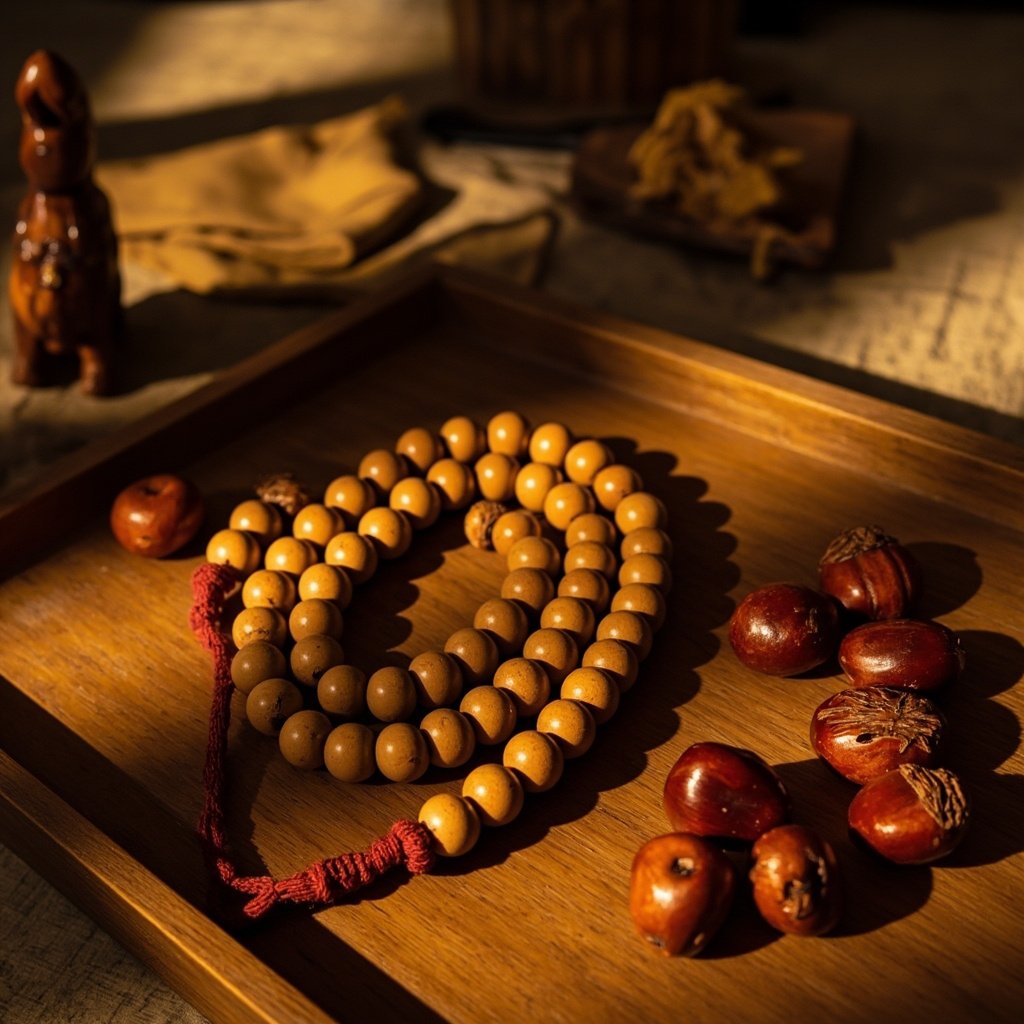
The most familiar modern form of these objects is the bead bracelet. A strand of walnut beads is worn on the wrist and turned over by the fingers, and this repeated handling is the point. The object is not inert while it sits on a shelf; it is worked by the hand, warmed by the skin, and read over and over by a person who is thinking.
The traditional belief is that a bead bracelet acts as a slow register, absorbing restlessness from the person wearing it and returning a settled quality to the fingertips. Walnut is usually preferred for this work over chestnut, because the walnut is the calmer of the two. The beads darken with handling over months, which is read as a visible record of a habit that has been kept.
Shared Meanings: Shell, Kernel, and Containment
Both nuts share a structure that is meaningful in itself. The kernel is valuable and the shell is hard, and the shell exists to protect the kernel through the vulnerable season before releasing it. This is a precise picture of the wood element’s own logic, where the outward form protects the inner growth, and it is why both nuts are treated as favourable rather than aggressive. Nothing about them is loud.
- Wood phase, belonging to growth, expansion, and the benevolent direction.
- Autumn timing, arriving as the wood phase reaches its harvest.
- Dual use, valued as food and as a traditional herbal remedy.
- Concealment, holding the useful part inside, never displaying the whole.
- Durability, keeping well for months, which suits objects meant for steady daily use.
How to Use These Objects in the Home
For a desk, a single walnut or a small dish of polished chestnut seeds reads as an object of quiet concentration, placed on the writing side rather than the visitor side. For a study shelf, a strand of walnut beads beside a stack of books is enough, and a bowl of chestnuts in a dining room carries the seasonal message of abundance without loud decoration.
There are two positions to avoid. Do not put them in a bathroom or a damp pantry, since both nuts spoil in moisture and a spoiled object is an unlucky one. And do not scatter them across a shelf among unrelated objects. The whole point of these symbols is that they gather and hold, and a walnut that shares space with a dozen random items has lost the concentrated quality that made it worth keeping.
A Closing Reflection
What makes the chestnut and the walnut worth studying is that they ask for very little. In the vocabulary of feng shui, that is the wood element at its most useful: the part of the cycle that grows, and the seed that survives the shell to be planted again.