Blog

Peony Feng Shui Meaning: The King of Flowers in Chinese Tradition
Few plants carry as much cultural weight as the peony. Grown in China for well over a thousand years and now cultivated from the Netherlands to New Zealand, this flower is still spoken of as the king of flowers and given the title of national beauty with heavenly fragrance. What interests a feng shui practitioner is not the botanical fact but the meaning the culture attached to it: honor, prosperity, refined taste, and a household able to hold good fortune. This guide looks at peony feng shui meaning in practice, from a garden border to a potted plant on an apartment balcony.
The Peony as King of Flowers
Chinese readers meet the peony early. One primer calls it the king of flowers, another calls it the national beauty with heavenly fragrance. These are not decorative phrases but rankings, and rankings carry obligations: the peony is expected to look prosperous without looking vulgar, and generous without looking showy.
The reference point is Luoyang in Henan province, which became the imperial flower garden and remains the center of peony cultivation. A family that wanted to signal it had reached the top of its own world planted peonies, painted them on porcelain, or embroidered them on wedding hangings.
Peony in Literature and the Art of the Home
The peony holds a distinguished place in Chinese literature. The Tang poet Li Zhengfeng gave it the line that has outlived every other praise: only the peony is truly national beauty. Because poets chose it, painters chose it, and the peony became a standard motif in silk scrolls, carved screens, and ceramic decoration from the Song period onward.
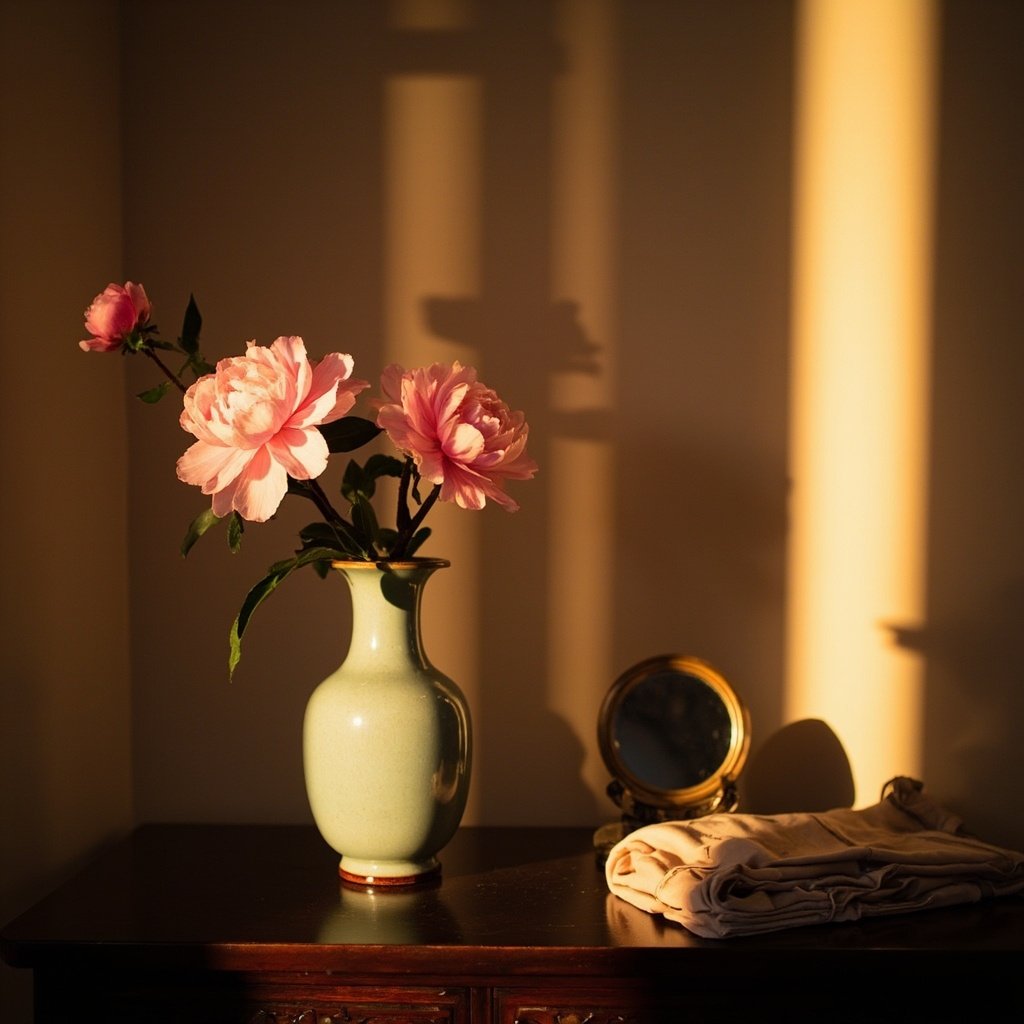
A flower carrying the image of national wealth and court elegance is a different presence in a room from a flower carrying only a pleasant color. It lends authority and refinement to a space, which is why a single branch of peony in a vase has long marked cultivated taste.
The Custom of Bringing the Peony Inside
There is a well-known folk custom of bringing a peony into the home at the turn of the year, or when a family moves house. The reasoning is traditional and direct: a flower the whole realm honors as a sign of prosperity, carried in through the door, brings that fortune in with it. Where the plant stood mattered too, and a peony set near the entrance was said to stop misfortune from following the family indoors.
Some families made the custom deliberate by choosing a date, setting a peony in the hall on a day selected for its favorable influence. That was a way of declaring intent, and in many regions the custom survives with the peony replaced by other auspicious flowers.
Peony Colors and What Each One Signals
Color is where feng shui becomes specific, because color maps to the five elements, and the elements map to different kinds of energy.
- Red and crimson. Red belongs to fire. A red peony strengthens visibility, reputation, and social standing, which suits a person in business, sales, or public work. In a home that already runs hot, red peonies belong sparingly.
- Pink. Pink is fire softened by water, and it is the color most closely tied to relationship and romance. Pink peonies suit a couple’s bedroom or a marriage anniversary arrangement.
- White. White belongs to metal. It purifies, sharpens, and clears, and suits a home that feels cluttered or overstimulated. White is also the classic color of mourning, so context matters.
Where to Plant: Garden Position, Balcony, and Direction
Direction matters because of where the light comes from, and because classical feng shui reads the east as the position of growth and of beginnings. A peony planted in the east of a garden follows the logic of the system: the sun rises there, wood energy feeds it, and the plant does what the sun does anyway.
The west is a reasonable second choice, associated with metal and with harvest, and it suits a house needing steadiness rather than new beginnings. The far north is the weakest position, where cold water energy dominates and the plant will struggle for reasons that are botanical before they are metaphysical.
The Peony as Medicine: One Flower, Two Uses
The bark of the tree peony root has been used in Chinese medicine for well over a thousand years and is still prescribed today for circulation, menstrual complaints, and inflammation. The saying “one flower, two uses” exists because the same plant that decorates a courtyard can be lifted in autumn, dried, and carried in a medicine chest. The famous ornamental forms and the medicinal forms are the same root.
This removes the usual separation between a decorative plant and a working one. A peony in the garden is also a symbol; it is a living storehouse that also happens to be beautiful. That double nature is part of why the flower has held its position for so long.
Potted Peonies and the Flowering Season
Because a tree peony blooms for only a short window, usually in late spring, the flowering season itself becomes part of the reading. Wood energy rises strongly in spring, and a peony in full bloom is a concentrated expression of it: upward movement, expansion, and the kind of visibility that leads people to notice you. A peony blooming in the south of a home, in the position of fire and fame, supports recognition and career.
- Use a heavy pot, because the root ball of a mature tree peony is substantial and a top-heavy plant in a light container is unstable.
- Stand it in the southeast if the family needs growth, or in the east if a new venture needs launching.
- Keep it away from a dead wall and off the exact center of the doorway path, where it blocks movement.
- Place it where a person entering the home meets it first, but not opposite a mirror, where the doubled image drains attention from the plant.
Used with judgment, the peony is a rare plant that is simultaneously beautiful, medicinal, and structurally meaningful. It carries status, but it carries it as an invitation to live well rather than as a threat. That is why the old advice was never to have peonies. It was to have them in the right place, in the right season, and with the right intention behind the choice.