Blog

Magpie Feng Shui Meaning: The Good Luck Bird of Chinese Culture
The magpie occupies an unusual position in world symbolism. In much of Europe and North America the bird carries mixed associations, while in Chinese tradition it is one of the most reliable emblems of good news, celebration, and marital happiness. Its feng shui meaning is therefore unusually well established. A magpie in Chinese art is not a decorative bird: it carries the message of joy arriving, the meaning of welcome, and the promise of a union. This guide covers the folk belief that made the bird auspicious, the classic image of the magpie on plum blossom, the element associations that change with colour, the magpie bridge story, where to place magpie imagery, and why the Western reading runs the opposite way.
The Folk Belief: A Magpie Means News
The core of the tradition is the call. Chinese country people, and urban families before radio and telephones, read the magpie’s voice as a message. When magpies called near the house, someone was expected to arrive. A call in the morning pointed to a welcome visitor, a call in the evening to a distant or slow one. The bird was a herald rather than an omen of misfortune, and the belief was practical before it was poetic. People listened for it. A magpie on the ridgepole of a house, on a gate, or on a windowsill signalled that news travelled toward that home. Two magpies facing each other signalled happiness, three marked the arrival of a new bride.
Magpie and Plum Blossom: The Image of Good News
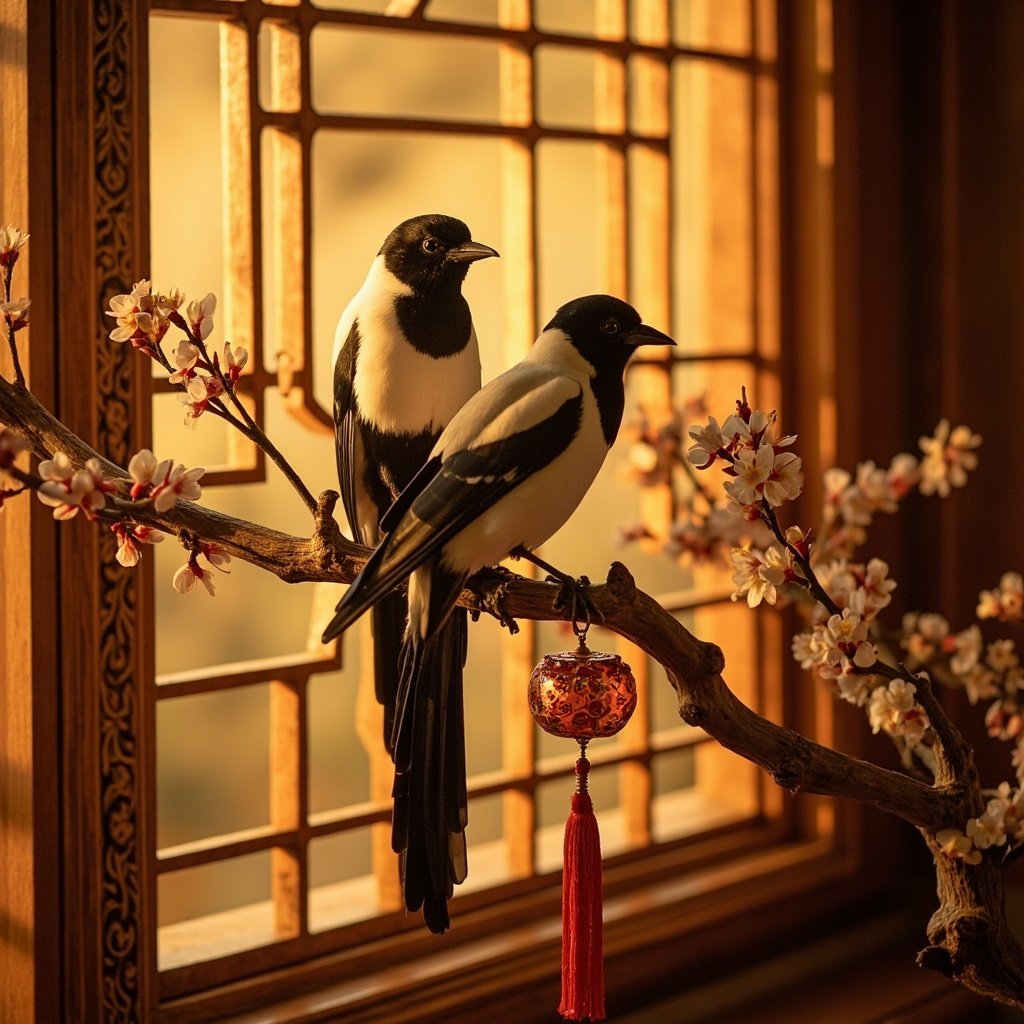
The most reproduced magpie image in Chinese decorative art is the magpie perched on a blossoming plum branch. Plum blossom is one of the three friends of winter and is associated with the five blessings, so the combination carries several layers at once. The magpie delivers good news, the plum branch delivers the five blessings, and the pairing stands for joy arriving in the household.
- Happy arrival. The bird perched above a doorway or window announces news coming in.
- Joy upon the brow. The classic motif pairs the magpie with plum, expressing delight reaching the household.
- Marital felicity. In wedding settings the pairing becomes a wish for a harmonious union.
- Winter endurance. Blossom on a bare branch shows that something survives difficulty and still opens.
The Magpie Bridge and Marriage
The magpie bridge story is why the bird sits so firmly in the vocabulary of marriage. Once a year on the seventh night of the seventh lunar month, two young people who are separated are allowed to meet once. They cross a river of stars on a bridge formed by magpies, which gather in great numbers and place their bodies together to make the span. On the night the bridge is incomplete, the meeting fails and the two are parted again. The story serves as a calendar of the sky, a celebration of loyalty, and a wish for a marriage that holds, which is why a pair of magpies is far more auspicious than a single bird.
Colour and Element Associations
Because the magpie in Chinese art is usually painted in black, white, and red, the element reading depends on the colour used. The body of the bird is generally treated as metal, since black and white are metallic tones and the iridescent sheen reads as metal quality. Red on the bird or in the plum blossom belongs to fire, the element of visibility, celebration, and the south. Green foliage brings in wood, the element of growth and new beginnings, while open sky or a stream brings in water through movement.
Where to Place Magpie Imagery
Placement decides whether the message lands. The first and most common position is the windowsill, especially a window facing east, because the bird is associated with arrivals and the east is the direction of beginnings. The second is the entrance hall, where a magpie facing inward greets anyone crossing the threshold. The third is a courtyard or garden wall, where the traditional position was above the gate so the bird watched the path from the street. The fourth is the facing-door position, where a pair of magpies is placed on opposite sides of a doorway, so each bird faces the other and news is exchanged rather than sent into a wall. A single magpie turned toward a wall sends its message nowhere.
Traditional Objects and How They Are Made
The magpie appears across Chinese decorative arts, and the material changes the reading.
- Stone carving. Marble and soapstone magpies on a scholar’s rock, or a carved pair for a mantelpiece. Stone gives the bird weight and permanence.
- Paper cut and paper painting. The most common form, pasted on windows at festivals and on wedding doors. Paper magpies are temporary and made for a specific occasion.
- Porcelain and ceramics. Pairs of magpies in famille rose enamels, often on a plum branch. This form carries the fire element most strongly through colour.
- Silk embroidery and ink painting. The refined form, hung as a scroll, where the magpie is treated with the brushwork of the scholar tradition.
The Same Bird, Two Cultures
The magpie is a genuinely cross-cultural bird with opposite meanings, and understanding this prevents a common mistake in Western homes. In Britain and much of Europe the magpie is associated with the death of a relative, and a rhyme still runs that one magpie means sorrow and two mean joy. The bird was also tied to thievery and to the Devil. In Chinese tradition the same animal, with the same black and white colouring and the same habit of gathering in pairs, is the messenger of joy. The difference lies in the storyteller, not in the bird: Europe read the magpie as a herald of the underworld, China read it as a herald of the household. A house decorated with the Chinese sense of the symbol may still be read by a Western guest as ominous, so many families keep the message in the plum blossom, the red seal, and the paired birds rather than in the bird alone.
Used well, the magpie is a simple and effective piece of feng shui. It is a message, and the method is to decide what the message should be. A pair of magpies facing each other across a doorway says that good news travels in both directions. A magpie on a windowsill says that this home is open to welcome. The bird does one thing, and it has always done it well: it announces that good news has arrived.