Blog

Bonsai Feng Shui Meaning: Miniature Landscapes for Growth and Calm
A bonsai is a tree compressed into a fraction of its natural size, and its feng shui meaning is built on that compression. Chinese gardeners developed the art from landscape painting and from growing trees in shallow trays for imperial display. The tree is not a decoration of nature but a working model of it. A well-kept bonsai concentrates the upward, spreading energy of wood into a small volume that can be read from across a room. This guide covers the cosmology behind the form, the element it carries, the three-power composition, placements that work, the light it needs, and the places to avoid.
The Idea of Shrinking the Cosmos Into a Small Space
The classical phrase for the bonsai idea translates as shrinking the dragon into an inch. A dragon in Chinese cosmology is a river, a rain cloud, and a force of moving water, so the phrase means compressing immense power into a vessel small enough to hold on a desk. The miniature tree does the same to time and space. A hundred-year-old pine is represented by a tree that may be thirty centimetres tall, and the age is expressed through trunk movement, branch structure, and the patina of the bark rather than through scale. The viewer supplies the missing decades, which is why a bonsai carries a strong sense of accumulated potential.
Bonsai and the Wood Element: Growth Under Control
Wood is the element of spring, the east, new beginnings, and everything that rises. A living tree is the most direct expression of that element available in a home, and a bonsai keeps that expression while staying proportionate to an interior. Because the tree is deliberately shaped rather than allowed to sprawl, it carries the disciplined side of wood: growth that has been directed rather than growth that has run wild. This is why a bonsai supports study, planning, and long projects. It suits the east and southeast sectors and any desk where focused work happens. The tree must be alive and well, with new growth and firm leaves, because a declining plant reverses the reading and speaks of stagnation instead of expansion.
The Three Powers: Tree, Stone, Water, Pot and Stand
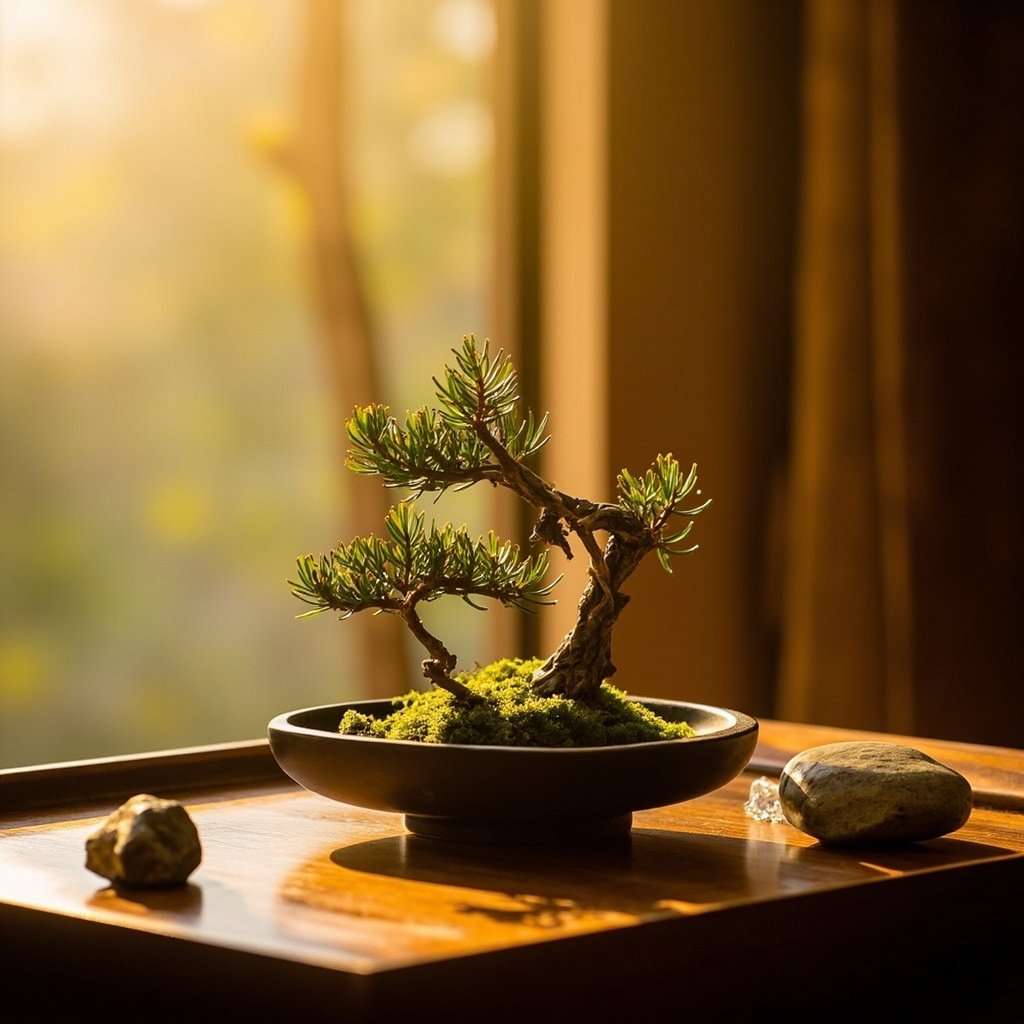
A classical bonsai composition is not a single tree. It is a complete arrangement built on the three powers of Chinese cosmology: heaven, earth, and humanity.
- Tree. The trunk should show movement rather than a straight vertical line, since a curved trunk carries chi more actively.
- Stone. Placed at one side, usually the left in formal display, to suggest a cliff face or an anchor.
- Water or sand. A shallow tray or level sand implies a stream or a dry riverbed.
- Pot and stand. A shallow pot shows that the tree has been lifted from the ground, while the stand gives it the height of an altar.
Where a Bonsai Belongs: Wealth, Study and Hall
The first placement is the wealth position of the home, which is normally the corner you sit in when you turn towards the entrance. A strong, healthy bonsai here raises the quality of that sector and gives the eye a living focal point. The second is the study, where the wood element supports concentrated mental work and the daily care of the tree becomes part of the working rhythm rather than a chore. The third is the entrance hall, where a bonsai greets visitors before they cross the threshold. A fourth placement suits office work: on a low table near a window in a meeting room, a bonsai keeps the wood element present where people sit for long hours. In all of these positions, keep the tree slightly off the centre of the surface, since a symmetrically centred composition reads as static.
Light, Orientation and Seasonal Care
Light is the factor most often mishandled. A bonsai needs bright light, but it does not need to be baked. Outdoors, morning sun and filtered afternoon light are ideal. Indoors, a position near an east-facing window is usually best, with the tree rotated a quarter turn every week so that all sides receive light evenly and the growth stays balanced. A tree kept in one orientation grows lopsided, and a lopsided tree weakens the upright line that carries the composition. Watch the leaves as an indicator rather than following a fixed calendar. New growth and firm leaves mean the position is working. Yellowing leaves or dry tips mean the tree is asking for more light, more water, or less of both.
Places to Keep a Bonsai Away From
Some environments work directly against a bonsai, and placing one there quietly drains the arrangement.
- Bathrooms. Steam, chemical scent, and constantly damp air put the tree under stress and burden the space with water element.
- Kitchens. Heat, grease, and cooking fumes damage the leaves and dull the surface of the pot.
- Radiators and heating vents. Dry forced heat strips moisture from the root ball faster than it can be replaced.
- Low, damp corners. A hollow in the floor collects water and creates a stagnant point that works against the flowing symbolism of the tree.
Water, the Scholar Tradition and Daily Practice
Watering is the daily conversation between the grower and the tree, and it is where much of the tradition lives. A bonsai is not left to the rain. It is checked, watered when the soil begins to dry, and drained. Some water goes to the soil and some is used to mist the foliage, so the cycle of watering and evaporation stands for the cycle of the seasons. In classical practice the water used for a valued tree could carry significance, since water is the element that feeds wood and carries nourishment from root to leaf.
This is also the thread that connects the bonsai to the scholar tradition. For centuries the miniature tree sat on the desk of the scholar and the calligrapher, where it was tended as a discipline and displayed as a landscape painting in three dimensions. A small tree on a desk does the same job today. It gives the person working there a living reminder that patience, regular attention, and small daily acts are what hold a thing together. Placed with care and tended without fuss, a bonsai brings the wood element into a room in its most useful form: growth you can see, patience you can watch, and a quiet focal point that draws chi inward toward the life of the house.