
Blog

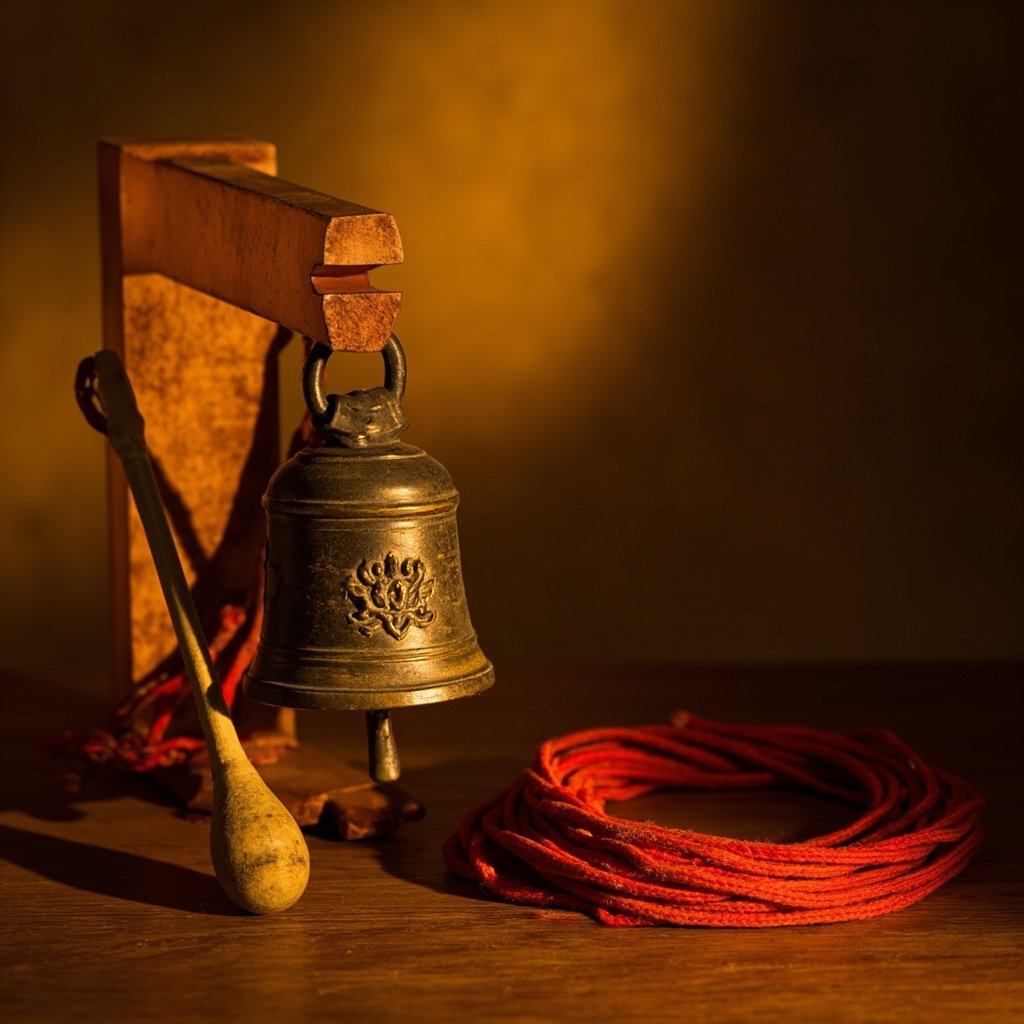
Bell Feng Shui Meaning: Sound, Time, and the Warding of Negative Energy
Almost every culture that built a sacred landscape put a bell in it. The reasons are practical rather than poetic, and that is what makes the subject interesting for feng shui. A bell announces, warns, and marks time. Its sound travels farther than any other object of its size. Bell feng shui meaning rests on those functions, and on the older belief that a voice strong enough to cross a valley can disperse what gathers in the dark.
The Bell as Voice: Announcement and Warning
The first job of a bell is to make an event audible at distance. In the Chinese tradition the pairing is the famous one, the morning bell and the evening drum, a phrase that entered the language to describe a disciplined life. The bell calls the community to begin; the drum sends it to rest. Between them they govern the shape of a day.
A bell is also an alarm. Watchtowers in the old capital rang fire bells, and a great bronze bell could cross a walled city in a single stroke. Its authority comes from being heard first and heard everywhere, and what it announces matters.
Temple Bells and the Dispersal of Unclean Air
The temple bell is the form most people picture, and its use carries an explicit claim about sound. In Buddhist practice the bell is sounded to announce the movement of the liturgy and to spread blessing through the space. The sound is understood to move outward in waves, and a wave that moves outward pushes away what was gathering close.
This is why the great bronze bell at a monastery is hung in a tall, open tower. Height maximizes the radius of the sound. The belief is not that the bell produces good energy in the abstract, but that it produces a moving front, a wave of clean air pushed outward from the center.
Sound and Chi: Why Resonance Is a Feng Shui Principle
Feng shui has always paid close attention to sound, because sound is one of the few forms of energy a person cannot choose not to receive. Light can be blocked by a curtain, a smell can be masked, but sound travels around corners. This is the basis of the classical warning against placing a home next to a bell tower, a railway cutting, or a ventilation shaft.
The positive principle works in the opposite direction. A clear, well-placed sound activates the resonance of a room, and a bell hung near an entrance gives the space an alertness, because the sound marks the entry of air and of people. Where sound is muffled and dead, the reading is that the space is closed and its energy is not moving.
- Movement. A clear tone says air is moving through the space, a condition for it to be considered alive.
- Warning. A tone marking an arrival, an hour, or a closing gate keeps the household attentive to its rhythms.
- Silence. The absence of sound is read as stagnation, which is why a sealed room is treated as a defect.
Material and Element: Metal, Bronze, and Wood
Every bell is assigned to an element by what it is made from, and this is the practical core of bell feng shui meaning. Metal bells, and especially bronze, are metal in the five element scheme. Metal is associated with the west, with autumn, with clarity, and with cutting away what does not belong. A metal bell therefore behaves as a refining instrument: it sharpens the energy of a room rather than adding to it.
Wooden and bamboo bells are read as wood, gentler, tied to growth and to slow opening things. A clay bell is earth, and it grounds. The strongest bell for most homes is a metal one, because most homes need refinement rather than more weight, and the metal voice carries the authority a warding function requires.
Where to Hang a Bell or a Ring in the Home
Hanging a bell is a small act with clear rules, and the rules all concern the point of the bell and the direction of its sound.
- Hang it where the sound spreads inward. Near an entrance or a passage is ideal, because that is where the movement of the house begins.
- Never hang a bell directly over a bed. A repeating sound above a sleeping person prevents rest, and the bed is the one place in a home where ambient noise is read as an injury.
- Keep it clear of the door itself. A bell mounted immediately above an entrance is read as announcing the household to the street, and as scattering, not gathering.
- Do not block light with it. A heavy metal bell in a window cuts the daylight from the room, and light carries the energy.
- Hang it high and to the side. Above head height and offset from the main line of movement, so no one walks under the mouth of it.
The Bell as Time: Rhythm, Measurement, and Order
A bell divides time into intervals, and this is its deeper cultural function. In the temple the bell marks the beginning and the end of practice. In the civic sphere, cast bronze bells announced the hours, and the phrase for the imperial timekeeping apparatus, the clepsydra and the bell together, shows how tightly the two were bound.
Feng shui inherits this meaning. Rhythm in a home is read as order, and order is one of three things a house must have alongside light and air. Marking the hours with sound says that the day has a shape, and that the household keeps it. A clock that chimes and a bell that rings carry this function today, which is why they sit in halls, not bedrooms.
Temple Bell and Church Bell: Two Different Civilizations
The Chinese temple bell and the European church bell are instructive to compare, because two cultures developed the same instrument for different reasons. The Eastern bell is a struck bronze vessel with a wide mouth and a deep, long-decaying tone, hung in a tower to be heard across a landscape. Its function is horizontal: it reaches out over the community and the countryside.
The Western bell hangs in a belfry above a tower that people enter, and its voice is vertical, calling a congregation in through a door and marking the liturgical year. The Chinese bell was also, early on, a musical instrument, where its tone was judged for purity rather than volume.