Blog


Tian Xing Feng Shui 24 Mountains: The Complete Directional Guide
Serious practitioners eventually confront the same limitation. The eight bagua sectors most Western readers know are too coarse to describe how energy moves through a building. A single “northeast” sector spans forty-five degrees, and the quality of qi shifts from one edge to the other. The classical Tian Xing school solved this by dividing the compass into twenty-four finer segments. These are the Twenty-Four Mountains, and they remain the foundation of professional direction analysis in the Chinese metaphysical tradition.
This guide explains what they are, how they are structured, and how to apply them to real spaces.
What Are the 24 Mountains in Tian Xing Feng Shui?
The 24 Mountains, known in classical texts as the twenty-four shan, are directional markers arranged around the luo pan, the traditional feng shui compass. Each mountain occupies exactly fifteen degrees. Twelve are anchored to the zodiac branches, eight to the heavenly stems, and four to the primary trigrams of the bagua.
Together they form an evenly spaced grid covering all 360 degrees. Where the eight-sector bagua gives a broad region, the 24 Mountains give a precise address. A practitioner can say that a doorway faces not merely northeast, but the specific fifteen-degree slice within northeast, and each slice carries a different elemental signature.
For a broader introduction to the school behind this system, see our overview of Tian Xing Feng Shui and celestial energy in the home.
How the 24 Mountains Are Structured
The system rests on three interlocking groups of eight. Twelve earthly branches form the spine: the rat, ox, tiger, rabbit, dragon, snake, horse, goat, monkey, rooster, dog, and pig, each tied to a direction and a season, spaced thirty degrees apart. Eight heavenly stems fill the gaps, carrying wood, fire, earth, metal, and water in yang and yin expressions, so each slice acquires its own elemental signature. Four primary trigrams anchor the corners and connect the ring back to the bagua map most students know.
Because a stem sits adjacent to the branch it supports, the pairing determines which element governs each slice. This is why two neighboring mountains can feel completely different, one supportive and one draining, even within the same bagua sector. The groups together produce one integrated instrument.
Why Precision Matters in Direction Analysis
Many home consultations fail because they stop at the eight-sector level. Take a house whose front door sits at the eastern edge of the northeast sector. A practitioner working only with the bagua would prescribe earth-element remedies, since northeast belongs to the earth phase. But at that edge, the governing mountain may carry wood or water energy, and the earth remedy is misplaced.
Three practical benefits follow from working with the 24 Mountains.
- Accurate remedy selection. Element cures are chosen for the actual fifteen-degree slice, so adjustments produce the intended effect.
- Finer timing decisions. Combined with the annual flying stars, the mountains show which narrow zone receives a supportive or challenging influence in a given year.
- Better furniture placement. A desk, stove, bed, or water feature can be nudged a few degrees to move it from a draining mountain into a supportive one.
Reading the 24 Mountains on the Luo Pan
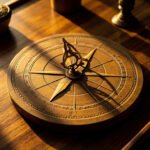
The luo pan is the tool that carries the twenty-four-mountain ring. Its inner rings show the eight trigrams, the middle rings the mountains with the flying star cycles, and the outer rings the twenty-eight lunar mansions. A practitioner aligns the compass, accounts for magnetic declination, and reads the mountain matching the measured bearing. Our guide to reading the feng shui compass and its auspicious directions walks through the rings in order.
Applying the 24 Mountains to Specific Life Goals
Each mountain inherits the character of its element and branch. While a full reading requires your Ba Zi chart, several broad applications are reliable for almost any household.
Wealth and Career
Mountains governed by metal and by branches associated with accumulation tend to support financial matters. Placing a workspace, safe, or wealth-attracting object in a supportive mountain invites steadier progress. For a personal recommendation, a professional office feng shui layout consultation surveys your bearings and prescribes placements.
Health and Rest
The mountain aligned with the household’s dominant element should be kept clean and free of heavy metal or stagnant water. Bedrooms benefit most, since the resting body should not be parked in a draining slice. Where the layout cannot be changed, a year-long feng shui consultation with consecration provides ongoing adjustments as the stars move.
Protection and Grounding
Certain mountains carry a protective quality and respond well to consecrated objects. Placing a natural cinnabar dragon protection pendant in a protective zone is a traditional pairing, as cinnabar holds yang warmth that stabilizes a space. For a grounded alternative, see our guide to obsidian protection and grounding.
Choosing Objects for Each Mountain
Once you have measured your bearings, the object matters less than the element it carries and the intention behind it. A few traditional choices map cleanly onto the system.
- Wealth-attracting crystals. A rutilated quartz wealth bracelet or a citrine prosperity bracelet suits metal and earth mountains oriented toward gain.
- Protective and grounding stones. Black onyx and obsidian anchor a mountain that needs stability rather than stimulation.
- Meditation and clarity objects. A 108-bead bodhi mala supports the inward aspect of a quiet mountain.
- Directional talismans. A three-eyed tianzhu pendant reinforces personal blessing while you work with a home’s layout.
Treat these as starting categories rather than fixed rules. A consecrated piece carries intention that a mass-produced ornament does not, which is why the tradition insists on ritual before placement.
Common Mistakes to Avoid
- Ignoring magnetic declination. A reading several degrees off can place you in the neighboring mountain, changing the elemental diagnosis entirely.
- Measuring from the wrong center. The 24 Mountains are read from the true center of the building or room, not an arbitrary wall position.
- Treating all eight sectors as uniform. This is precisely the error the mountain system was created to solve.
- Buying objects before measuring. A remedy chosen without a bearing is a guess.
Frequently Asked Questions
Do I need a physical luo pan?
A digital compass with declination correction works for basic readings. Full analysis, especially with flying stars, still benefits from the complete instrument.
Is the system compatible with Ba Zi?
Fully. Ba Zi establishes your favorable elements and directions, while the 24 Mountains translate that onto the compass of your home. The two are read together.
Bringing the Mountains Into Your Home
The 24 Mountains transform direction from a vague feeling into a measurable field. By dividing the compass into twenty-four sectors, the Tian Xing tradition gives practitioners a language detailed enough to match a real home, where energy shifts from one edge of a room to the other.
Start with a corrected compass reading from the center of your space. Identify which mountains your door, bed, stove, and desk occupy. Then apply element-appropriate remedies and, where tradition calls for it, consecrated objects that carry genuine intention.
To work with consecrated pieces selected for your directional needs, explore the collection at Yihui Store, where each item is blessed before it reaches you.