Blog

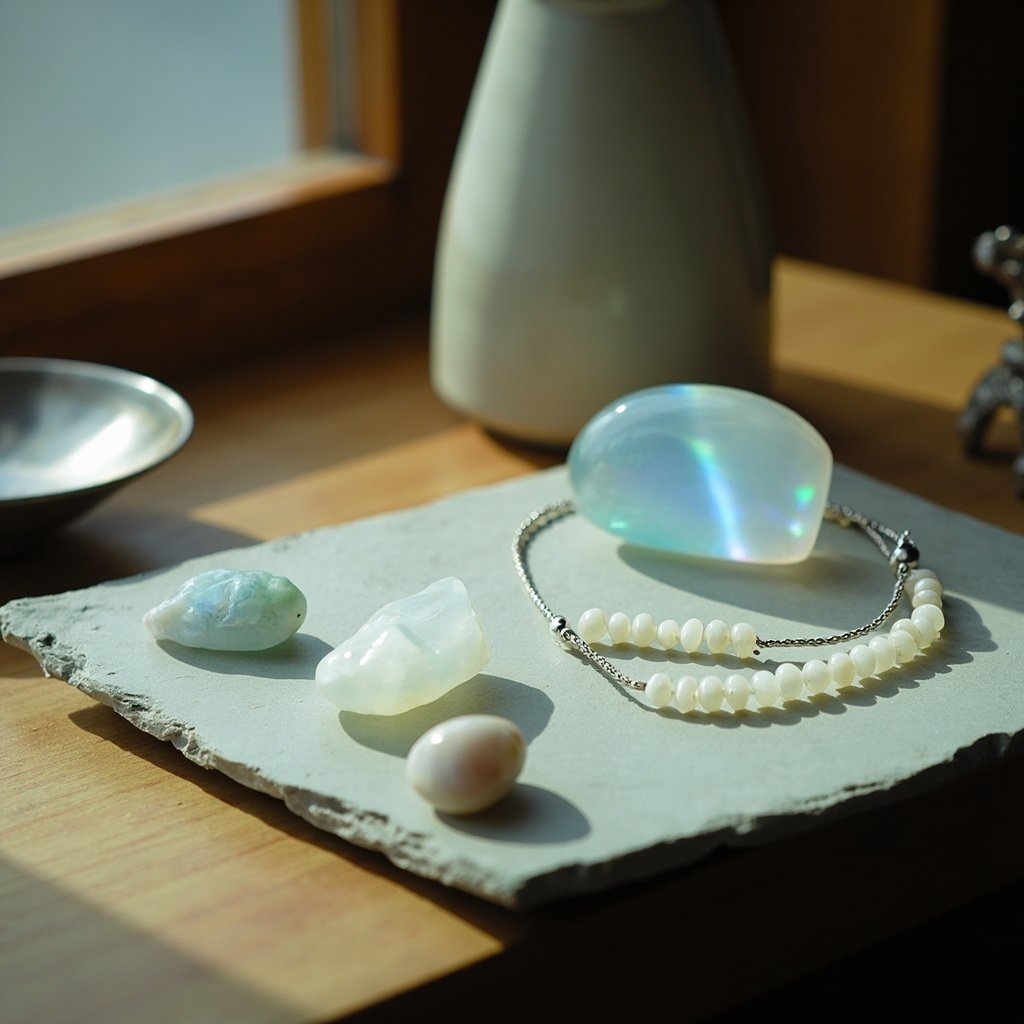
Moonstone Feng Shui Meaning: Intuition, Moon Energy and Gentle Protection
Moonstone has been worn as a stone of the night for centuries, and in Chinese metaphysics it earns its place through a quiet quality rather than a loud one. Where cinnabar strengthens resolve and tiger eye sharpens courage, moonstone softens. It sits on the receptive side of energy, the part of feng shui that governs rest, intuition and emotional balance. This guide explains what moonstone means in feng shui, how its yin nature relates to the water element, where the stone belongs in a home, and how to choose a piece that suits your space instead of following a trend.
What Moonstone Is in Chinese Metaphysical Terms
Moonstone is a feldspar with a layered internal structure that scatters light into a floating sheen, an effect known as adularescence. Classical Chinese practice never named this stone, because it classifies materials by behaviour rather than by geology. A stone that glows softly, stays cool to the touch and shifts colour with the angle of light is read as yin: receptive, cooling, reflective. That classification is what gives moonstone its feng shui role. It is not a lucky charm that delivers outcomes on demand. It is an environmental cue that changes the tone of a room and, over time, the habits of the people inside it.
Why Moonstone Belongs to Yin and the Water Element
Feng shui divides every phenomenon into yin and yang. Yang is bright, active, upward and loud; yin is shaded, still, inward and quiet. A home needs both, and most modern homes are overloaded with yang: screens, overhead lighting, traffic noise, working hours that never fully end. Moonstone is a corrective for that imbalance.
Within the five elements, practitioners read moonstone as water, with a secondary metal affinity in the palest white pieces. Water governs rest, storage of energy and the ability to adapt without breaking; metal supplies clarity and cuts through confusion. Together they describe the stone well: a material that calms a room and helps a household think straight after a long day. Placement follows the same logic, which is why moonstone rarely sits in the busiest part of a house.
The Three Gifts of Moonstone in Feng Shui
- Intuition and honest reflection. A reflective surface invites a person to look inward instead of outward. Placed where you pause each day, the stone works as a reminder to check your own read on a situation before reacting.
- Emotional equilibrium. Water energy is associated with flow rather than suppression. Moonstone is chosen by people who carry tension in the body and want a calmer baseline rather than a burst of motivation.
- Gentle protection. Not every guardian needs fangs. A pixiu or a fu dog confronts; moonstone simply keeps a boundary soft and intact, which suits bedrooms, treatment rooms and spaces where children sleep.
Where Moonstone Belongs in the Home
- The bedside table. The bedroom is the most yin room in a house, so moonstone sits here more naturally than almost anywhere else. A small tumbled stone or a short strand is enough.
- A meditation or reading corner. Any seat used for stillness benefits from a cooling element nearby.
- The relationship sector. In the bagua map the far right corner of a room governs partnership. A peach or cream moonstone here supports patience and softness between two people.
- A child room shelf. Pale moonstone is a common choice for restless sleepers, kept high enough to be safe.
- Bathroom window ledge. Water reinforcing water, useful in a room that already carries strong water energy.
Two places to avoid: the stove area, where fire energy should dominate, and the primary work desk, where decisive yang energy serves you better. A stone that quiets a room works against concentration when you need to push a decision through.
Reading Moonstone Colors
- White and rainbow sheen. The clearest expression of yin. Best for sleep, reflection and rooms that feel overstimulating.
- Peach and apricot. The warm hue introduces a fire note, which suits the relationship corner and any space that feels emotionally cold.
- Grey and black sheen. Quieter and more grounded. A good choice near an entry where outside energy arrives first.
- Blue sheen. A direct water reinforcement, often chosen by people who speak publicly and need steady nerves.
Wearing Moonstone: Four Simple Rules
- Choose the wrist deliberately. The traditional reading is that the left side receives energy and the right side releases it. Wear moonstone on the left when you want calm to come in.
- Cleanse with moonlight, not salt. Moonstone ranks six to six and a half on hardness and dislikes saltwater, harsh sunlight and ultrasonic cleaners. A night on a windowsill during a full moon is the gentlest method.
- Keep the setting simple. Silver, white gold and pale cord let the sheen speak. Heavy dark metal competes with a stone whose whole value is subtlety.
- Rest it occasionally. A stone on a bedside table can stay out permanently, but a worn piece benefits from a day off each month.
Common Misunderstandings
Moonstone is often sold as a stone for women. That framing misses the point. Yin is present in everyone, and a household of any composition benefits from one cooling element in its most restful room. Likewise, moonstone is not a replacement for structural feng shui. It will not correct a bed aligned with a door or a stairway aimed at a sleeping head; it works on atmosphere, and atmosphere is the smallest part of a reading.
The second misunderstanding concerns the moon itself. No ritual is required and no lunar phase unlocks the stone; a full moon is simply a convenient, chemical-free way to clean a soft gem.
Choosing a Piece
Look at the sheen before anything else. A good moonstone shows a floating glow that moves as you turn it, not a flat milky surface, and should be free of internal cracks that dull the effect. Size should match the room: a palm stone for a bedside table, a small cluster for a shelf, a slim bracelet for daily wear.
Final Thoughts
Moonstone occupies a modest place in feng shui, and that is precisely its value. It does not compete with cinnabar for courage, jade for protection or citrine for abundance. It handles the quieter half of a balanced life: sleep, intuition, patience and the ability to reflect before acting. Place one where you rest, keep the setting clean and simple, and let the stone do the only thing it does well, which is to remind a busy household that stillness is also a form of strength.