Blog

Kitchen God Feng Shui Meaning: Zao Jun, the Stove Deity Guide
Every traditional Chinese household once kept two altars: one at the front door for the guardian deities, and one beside the stove for Zao Jun, the Kitchen God. Of the two, the kitchen altar was the more intimate. The guardians watched the threshold against outside harm. Zao Jun watched the inside — the meals cooked, the words spoken over the table, the way a family treated its dependents and guests. In the classical Taoist pantheon he is the household’s recording secretary, and his single annual journey to heaven made him the most negotiated-with deity in Chinese domestic religion.
Who Zao Jun Is
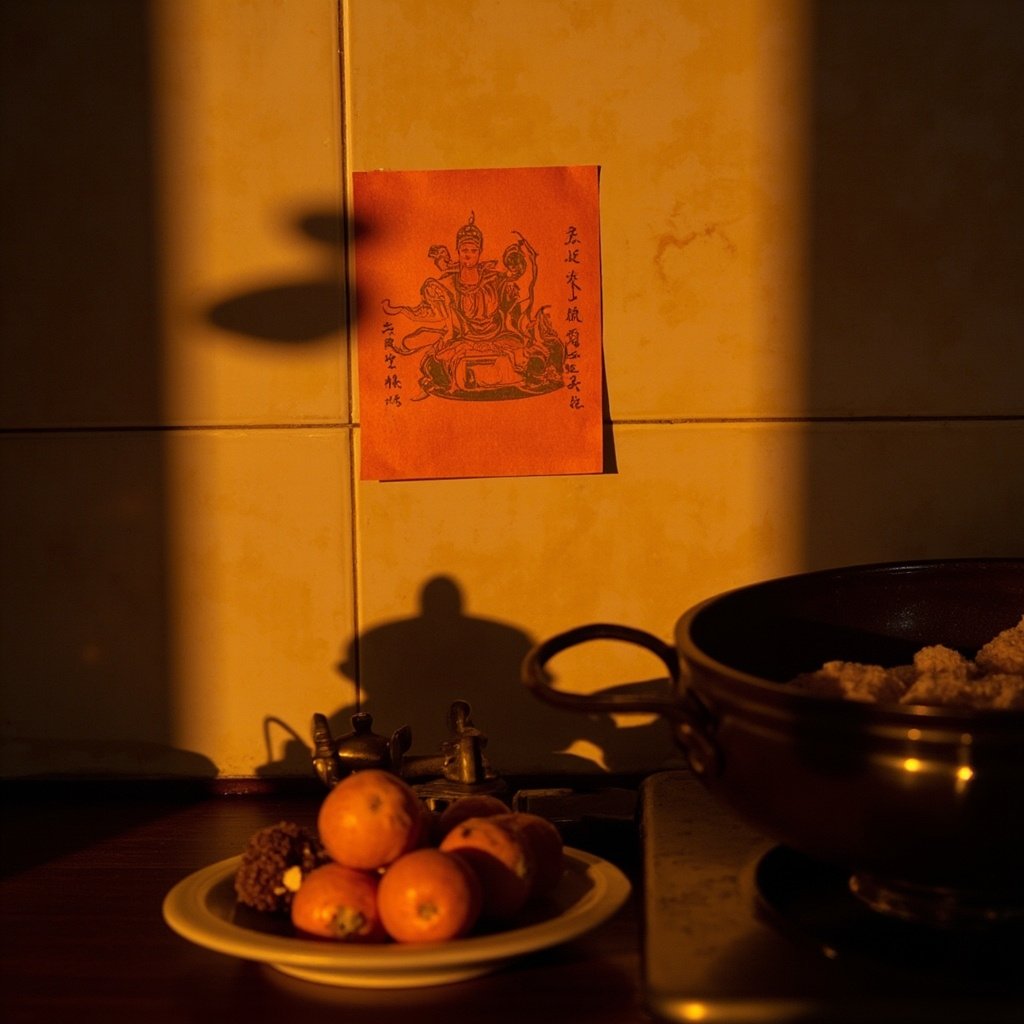
Zao Jun is known in English as the Kitchen God, the Stove God or the Hearth Lord, and in formal Taoist liturgy as the Director of Destinies of the Eastern Kitchen. His shrine was never grand. A printed paper image, a small wooden tablet, a clay figure, or simply a red paper strip pasted above the stove was enough. What mattered was position and attention. He was placed where cooking happened, because food preparation is the household’s most repeated moral act: it is done daily, it feeds dependents, and it reveals whether the cook is generous or grudging.
His origin stories differ by region, and one tells of a man named Zhang who abandoned his wife, lost everything and was taken in as a kitchen servant by the woman he had wronged, hiding in the stove in shame when he recognised her. The versions agree on the essentials: he is a witness rather than a judge, and his record is written by the family’s own behaviour.
The Annual Report at Little New Year
The ritual cycle peaks on the twenty-third or twenty-fourth day of the twelfth lunar month, the festival known as Little New Year. The family prepares the Kitchen God for his ascent to report on the past twelve months. The sequence is consistent across regions:
- Clean the hearth. The stove is scrubbed, the altar dusted and the old paper image removed. Cleaning is understood as a reset of the record, not only of the grease.
- Make the offerings. Sweet sticky candy, malt sugar, rice cakes, fruit, tea and sometimes a cup of wine are set before the image.
- Seal the mouth. A dab of sticky sugar is pressed to the paper lips, so that he can speak only sweetly — or cannot speak at all, depending on the telling.
- Send him up. The paper image and a paper horse are burned with incense and paper spirit money, releasing him toward heaven.
- Welcome him back. On New Year’s Eve or in the days that follow, a fresh image is pasted up and the household begins a new record.
The humour is deliberate. A family that has quarrelled all year offers sugar to the witness who saw it; the tradition does not pretend the record is erased, only that the household must sit with the fact that someone was counting.
What the Kitchen God Actually Represents
Strip away the paper and the candy and the doctrine is simple: the home is observed, and conduct compounds. Zao Jun personifies consequence at domestic scale. He is not a god of wealth or of luck, and nothing in the tradition promises that sweet candy produces a good year. What the ritual asserts is that a household’s daily habits shape the conditions the family lives in — and that is also the honest feng shui reading of a kitchen. A stove that will not light, a sink that drips, a counter crowded with neglected objects, a cook who resents the work: these are not symbolic problems but the actual texture of daily life.
Where the Kitchen Altar Belongs
- Beside the stove, not above it. Traditional placement keeps the image on the wall next to the cooking surface, slightly above standing eye level, never directly over flame or steam.
- Facing into the room. The Kitchen God should look over the household, not out of a window or door. An image facing the exit turns a witness into a departure symbol.
- Clear of the sink. Water and fire stand in opposition in the five element cycle; a shrine wedged between them reads as tension rather than oversight.
- Clean, lit and uncluttered. A small shelf, a cup of tea and one stick of incense make a complete altar. A crowded one is not more devout, only harder to maintain.
Reading the Kitchen Through the Five Elements
The Kitchen God tradition and feng shui analysis meet in the same room. The stove is fire; the sink and refrigerator are water; ceramics, tile and stone are earth; utensils and shelving are metal or wood depending on material. A kitchen reads as balanced when fire and water are separated by a buffer of earth or wood — a counter, a chopping block, a tiled splashback — rather than placed shoulder to shoulder. Where the stove faces the entrance, the cook works with their back to the room and the household’s attention splits; where it sits against a solid wall with a clear sightline to the doorway, the room supports calm, unhurried work.
Practising the Tradition Today
Most overseas households will not paste a paper image above a rented stove, and nothing in the tradition requires it. What carries over is the structure:
- Treat the kitchen as the room that reports on the household, and keep it honest: repair what is broken, clear what is unused.
- If you keep a small shrine or a single object of attention, place it beside the cooking area, face it into the room and keep it clean.
- Mark one day a year to clean the hearth thoroughly and take stock, even without the full ritual.
- Separate fire and water with a buffer, and give the cook an unobstructed view of anyone entering.
- Keep the table free of unresolved argument. The tradition’s real subject is the words spoken where food is served.
Common Misunderstandings
Three errors recur. The first is treating the candy as a transaction, as if a bribe could substitute for a year of behaviour; the ritual’s own irony argues against it. The second is regarding the Kitchen God as a spy to be managed, when he is better read as a habit of attention. The third is confusing him with the door guardians or the earth god. The guardians hold the boundary, the earth god governs the ground the house stands on, and Zao Jun oversees the inside work of feeding people.
A Room That Reports
The Kitchen God is one of the oldest and most human figures in Chinese household religion, and his message has aged well. A home is not blessed by decoration but by the ordinary conduct that happens inside it, most of all in the kitchen. Whether you keep an altar or not, the room where the family eats is the room that tells the truth about the family. Keep it clean, keep it working, and keep the words spoken in it worth reporting.