Blog

Chinese Kite Feng Shui Meaning: Wind, String, and the Sky Above the Roof
Feng shui is the study of wind and water, yet almost every object sold to improve a home concerns the water half of that phrase. Fountains, mirrors, screens all answer questions of position and reflection. The wind has no furniture. The one traditional object built to read it is the Chinese kite.
What a Chinese Kite Actually Is
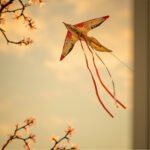
A Chinese kite is a bamboo frame covered in paper or silk and held taut by a single line. The frame is built in matched pairs of spars and the stiffness deliberately unequal: the leading edge rigid, the trailing edge flexing, so the whole thing sits in moving air without tearing apart. The name, feng zheng, means wind zither, and older kites carried a bamboo whistle so passing air produced a note. It was never only a toy but a device for reading invisible conditions at a distance.
Wind and Water: The Element the Kite Reads
Every other feng shui correction is applied to a surface: a wall, a door, a bed. The kite is applied to a volume. Moving air has direction, speed and pressure, and the kite makes all three visible at once. When it climbs steadily the air is layered and calm; when it luffs and stalls the air near the ground is broken. Anyone who has flown one for an afternoon has learned to read chi the way the tradition intended, by watching how air behaves rather than by pointing at a chart. That habit is worth more than any ornament.
Height as Yang: Why the Kite Works Above the Roof
Classically the upper part of a space is yang and the lower part yin, which is why sleeping low is restful and working high keeps the mind alert. A kite is the extreme case: it occupies the band of air above head height, above the eaves, above the ridge, where no furniture can reach. Flying one lifts attention up and out, taking a person out of a low, enclosed posture and putting them under open sky. Kite flying is a spring custom for exactly this reason, since spring is when a household needs pulling out of winter stagnation.
The String: One Channel, Held Under Tension
The most instructive part of a kite is not the paper but the line. Two forces act on that thread at every moment, the kite pulling away and the hand holding on, and flight exists only because neither wins. This is a precise model of a healthy connection: a bond with no tension is slack and transmits nothing, while a bond pulled too hard snaps. What the kite demonstrates is controlled tension, one channel held at the right load, a better teaching image for family and business relationships than any lecture on harmony.
Qingming and the Deliberate Loss
Around Qingming, the spring festival for tending graves, kite flying carries a second layer. People wrote illnesses on the paper, flew the kite high, then cut the string and let it drift away. The custom is called fang hui qi, releasing stale energy, and it is rare in feng shui because it works by subtraction. Nothing is bought, placed or rearranged. In a tradition that can become obsessive about accumulating cures, the cut string reminds us that some problems are solved by letting go of the object that carries them.
Shapes and What They Carry
Traditional shapes are not random. Each carries a settled meaning, so the choice states what a household wants more of.
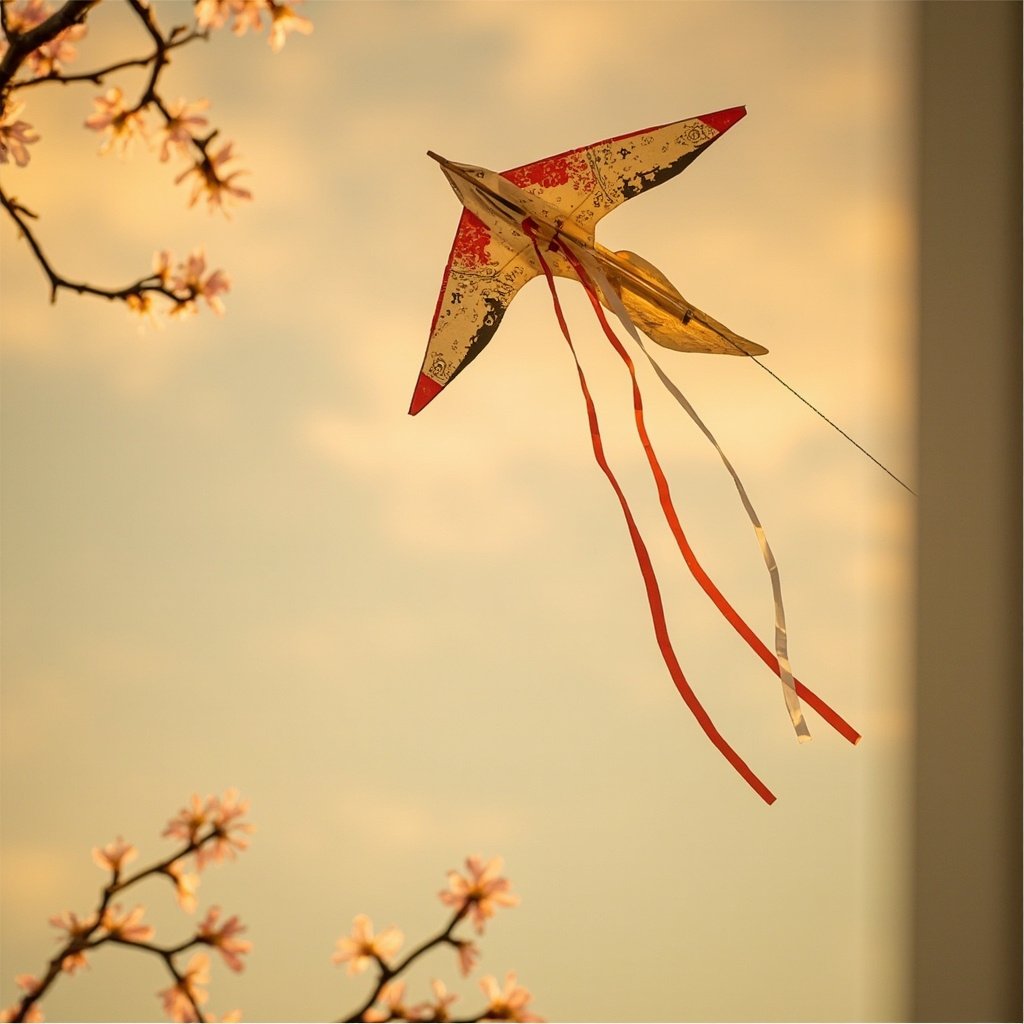
- The swallow. The classic Weifang form with scissor-like wings. Swallows return in spring and nest under eaves, so it reads as seasonal return and family continuity.
- The butterfly. Paired wings and long antennae, associated with joy, courtship and long life, often given between couples.
- The goldfish. A homophone for surplus, carrying the abundance logic of the fish bowl into the air.
- The centipede. Long segmented bodies of many small discs, hard to fly and impressive aloft: coordinated power and patience under load.
- The dragon. A head with a train of linked sections, the most ambitious form, a public object for festivals rather than the home.
For a house, small and calm works best: a single swallow or butterfly reads as spring arriving, while a dragon looks like a festival prop.
Bamboo, Paper, Silk: Material and Element
The material logic is wood and fire together. Bamboo supplies the frame, the most elastic wood in the tradition: it bends without breaking, which is why it also serves flutes and furniture. Paper and silk supply the skin, and both belong to the fire family, being light, warm to the eye and quick to take colour. A kite is a wood frame carrying a fire surface, the combination that lifts. Condition therefore matters: a split spar or torn skin changes the balance, and a damaged kite on display reminds us of something that no longer works.
Hanging a Kite Indoors: Placement Rules
Used as decoration, a kite needs the same care as any hanging object.
- High and light. The upper third of a wall, in a room with daylight. A kite at waist height reads as a broken bird.
- Study, hallway or child room. Rooms where upward, forward energy is welcome. A study benefits most, since the shape suggests aspiration carried on something thin.
- Not the bedroom, and never above a bed. A suspended object overhead in a room for rest creates pressure instead of lift, one of the few hanging rules nearly every school agrees on.
- Not at eye level facing the front door, and never several in a row. One kite is a gesture. Four become clutter, and clutter cancels every other remedy in the room.
Common Mistakes
- A broken or warped frame, since a deformed structure sends a deformed message.
- Storing silk in a damp cupboard, where moisture turns a lively object into a heavy one.
- Treating the string as packaging. The line is half the object, so hang the kite by its own bridle.
- Flying only on perfect days. The useful afternoon is the one with uneven wind, when you learn what your site does.
Flying as a Practice, Not a Performance
The kite is the only piece of feng shui equipment that asks you to go outside. Its value is the twenty minutes spent watching air move over a roof, adjusting a line by a few centimetres and feeling the system respond. That is the skill a consultant applies indoors, without the compass. A house that keeps one kite and flies it owns an instrument for reading the sky above its ground; a house that owns four has bought paper.
Most feng shui objects correct a position. The kite corrects a relationship: between hand and air, household and season, holding on and letting go. Keep one light, hang it where light reaches it, and once in a while write down something you no longer want and cut the string.