Blog

Folding Screen Feng Shui: The Room Divider That Shapes Chi
A folding screen is the quietest object in Chinese furniture. It has no glow, no weight in the hand, no ritual to perform. Yet among all the tools of feng shui it does something the others cannot: it edits a room without rebuilding it. A mirror deflects, a crystal purifies, a fountain activates. A screen subtracts. It takes an open, undefended space and gives it a boundary, and in doing so it answers the single most common problem in modern homes, which is not a lack of decoration but a lack of edges.
What a Chinese Folding Screen Actually Is
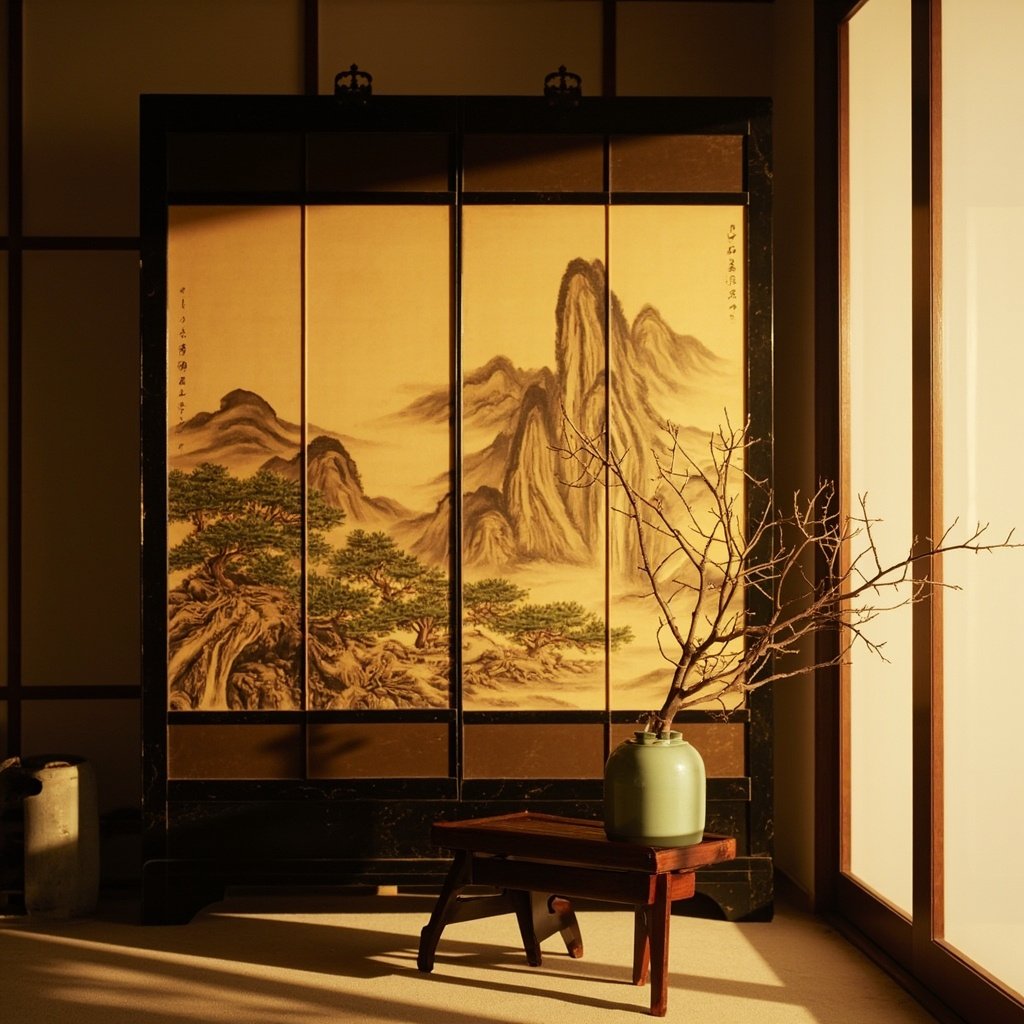
The classical name is pingfeng, wind screen, and the name is literal. The object was built to stop moving air from reaching a person who was seated and still: the earliest versions were practical defences against draughts. Structurally it comes in two families. The many-panelled screen joins four to twelve leaves with cord or brass hinges and stands in a zigzag, supporting itself by geometry; the single-leaf screen rests on its own carved base, often a slab of stone or a framed painting. Bed screens folded around a sleeping alcove. Desk screens stood at the elbow of a scholar. Throne screens stood behind a ruler, and that last use explains most of what the object still means.
Why Feng Shui Uses a Screen Instead of a Wall
A wall stops chi. A screen slows it, and the difference is the whole discipline. Feng shui wants circulation, never stagnation, and a hard partition in a small flat creates a dead pocket where air and attention stop. A screen interrupts the sightline while letting light and sound through, and the sightline is where most sha chi actually lives. Stand in a doorway and look straight at a window across the room: the eye reads that as a chute, a line along which energy and privacy both leave. One panel placed across that line breaks the read without sealing the space. Nothing is blocked. The rush simply becomes a turn.
The Screen as a Mountain: Backing Without Building
The commanding position asks for a solid back, and real life rarely supplies one. Desks sit in open-plan flats, sofas float in rented living rooms, beds back onto a corridor. A screen is a mountain you can carry from address to address. Set it behind the chair or the head of the bed, wide enough to cover the seated shoulders and tall enough to rise above the crown of the head. That is the same logic the throne screen followed: authority does not come from the seat, it comes from what stands behind the seat. In a studio flat this often does more for concentration than anything placed on the desk itself.
Where a Folding Screen Earns Its Place
- Entry sightline. Place it offset from the door rather than flat against it, so a visitor steps in and turns rather than walking into a wall.
- Behind the desk or the bed. Creates backing and removes the sensation of being approached from behind.
- Between a kitchen or bathroom door and a living area. Separates two incompatible atmospheres without closing either one.
- Across a long corridor. One panel near the far end interrupts a straight run and stops chi from accelerating.
- Around a meditation or reading corner. Folds a defined room out of a large, undefined one.
Where a Screen Works Against You
Do not press a screen against the front door. The mouth of chi becomes a barricade, guests enter sideways, and the entrance reads as defended rather than welcoming. Do not block the only window that gives a room its daylight; a screen that darkens a space trades one problem for a worse one. Do not stack three screens into a maze in a small apartment, which is clutter with better manners. Keep screens clear of radiators, air returns, and door swings. And do not cage the bed so tightly that the sleeper loses the sense of the room; a sealed sleeping box creates the pressure a screen was meant to relieve.
Reading the Panel: Motifs and Their Work
A painted panel is not a passive ornament; each traditional motif carries an instruction that should match what the room needs. A landscape with mountain and water repeats the screen’s own job, which is backing plus flow, and suits a room that needs calm. The four seasons signal a cycle and belong where a household is in transition. Bamboo speaks of resilience and steady rise, useful in a study. Dragon and phoenix together mark paired completion and are traditionally a marriage motif. Calligraphy lends scholarly weight without adding colour. Plain black lacquer with a single gold line suits a small room, where pattern would overload a surface already occupying space.
Materials, Light, and Weight
Translucent silk or rice paper passes light, so it can stand in a dark hallway where a solid lacquer board would cast the entrance into shadow. Lacquered wood and carved panel work give genuine backing but read heavy in a compact room. Glass and mirrored panels reflect, so treat them as mirrors rather than screens: never aim a mirrored leaf at a bed, or where it throws the front door back at itself. Carved stone single-leaf screens belong outdoors, where their weight is an asset.
Size, Height, and Proportion
Three measurements decide most placements. Height should interrupt a standing sightline while leaving air above the screen, generally fifteen to twenty-five centimetres below the ceiling, because a screen that touches the ceiling reads as a wall. Width should exceed the thing it is protecting by at least one panel on each side. And the fold should leave a walking gap of roughly sixty centimetres, so the screen guides traffic instead of obstructing it. In a room under twenty square metres, one screen is enough; the second one is usually the beginning of a maze.
Common Mistakes
- Buying a screen as an ornament and leaving it folded in a corner, where it does nothing at all.
- Using it to hide disorder rather than organize it, which buries the problem instead of resolving it.
- Placing it where it fights the room’s only source of light.
- Choosing a bold motif for a quiet room, so the screen argues with everything around it.
- Treating it as a permanent wall, then wondering why the space feels tight and airless.
A Screen Is a Sentence, Not a Wall
The method is simple to state: find the straight line the eye and the air both take, then put one panel across it. Everything else, the motif, the material, the number of leaves, is refinement. A folding screen is a sentence written into a room, and like any good sentence it exists to make the reader pause at the right moment rather than stop altogether.