Blog

Chinese Door Knocker Feng Shui Meaning: The Pushou Guardian Guide
Every house has a boundary, but few objects mark it as precisely as a Chinese door knocker. Two metal rings on a beast-faced plate, set at chest height: it is the smallest piece of architecture in the house and the first thing a visitor touches, and in classical practice it was never mere decoration. The knocker sits where the street ends and the household begins, and feng shui has always treated that seam with care. This guide explains what the pushou is, why its face is carved as it is, and how to place and read one at home.
What Is a Chinese Door Knocker?
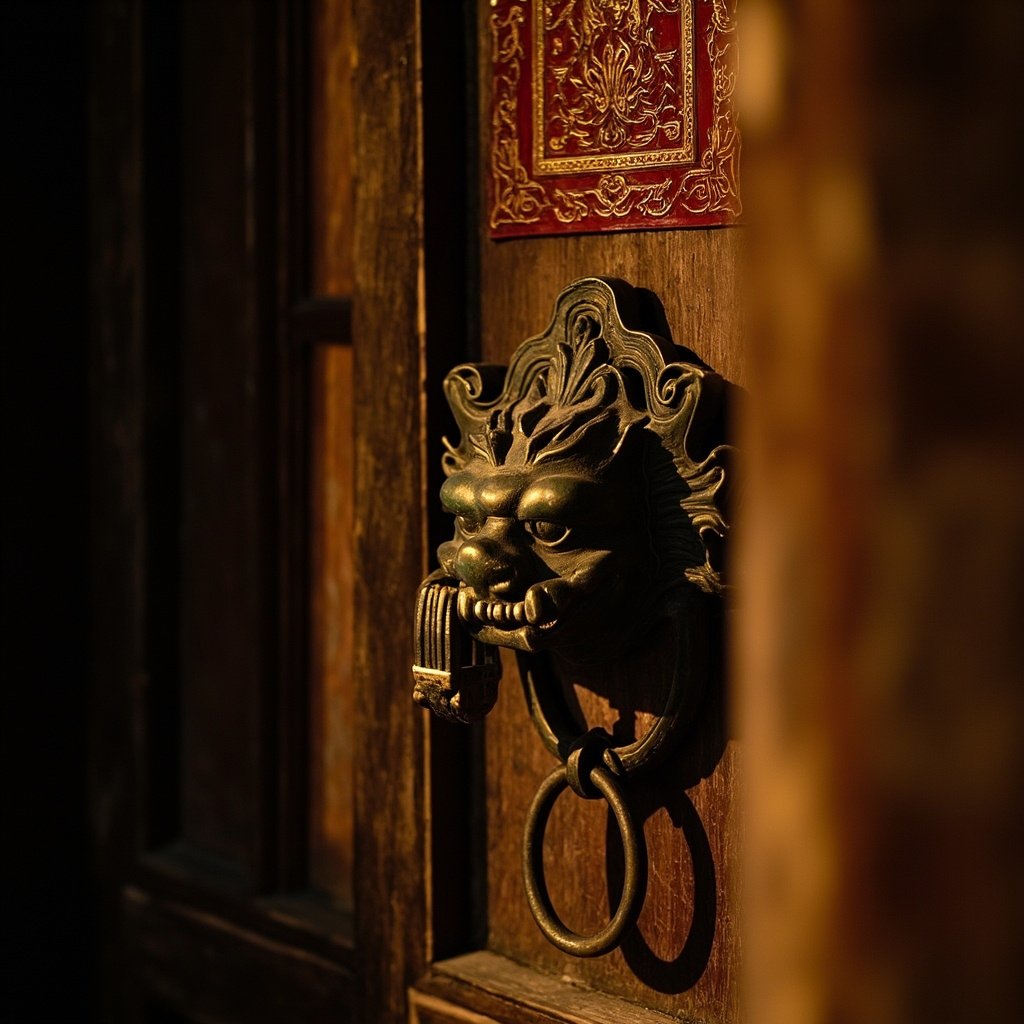
The traditional form is called pushou, sometimes translated as “spread beast,” and its parts are simpler than they look. A flat plate is fastened to each wooden leaf, and from it projects a ring the visitor uses to strike the timber. The plate carries a face, usually a lion, a taotie mask, or a stylised beast with a ring in its mouth. Bronze, brass, and iron were the common metals; temples used cast bronze with deep relief.
Three parts matter. The face is the guard, the ring the instrument, and the plate the anchor that ties both to the door. When all three are intact, the knocker works as one object: guardian, voice, and foundation.
Why the Beast Face?
The grinning mask is doing specific work. A lion announces that the household is protected and not to be trifled with. The taotie, an older motif borrowed from bronze vessels, is pure appetite: it stares outward and consumes what approaches. Other doors carry bats or a pair of fish. The face always turns toward the street, never toward the room. The guardian looks at the world, not at the family.
This is the difference between decoration and a threshold object. A wreath is placed for the people inside; a beast face is placed for whoever arrives.
The Ring as a Threshold Instrument
Sound is the function most modern homes have lost. On a timber door the ring produces a low note that reaches the inner rooms before the visitor does. That note is the point. In traditional etiquette the knock was a request, not a demand, and three measured strikes were the standard; loud hammering marked poor breeding.
The metal serves a subtler purpose too. A dull ring that rattles loose tells the household something is wrong with the door before anyone opens it. Sound is a diagnostic, and a solid knocker keeps it honest.
The Only Point a Visitor May Touch
Feng shui language is full of boundaries, and the knocker is the most literal one in the house. A stranger does not touch the frame, does not lean on the jamb, and does not look through a gap. The visitor makes contact at one sanctioned point, announces themselves, and waits. That restraint is the whole etiquette of the threshold in a piece of hardware.
For the household the logic runs in reverse: the knocker is kept true because it is the hand of the house extended outward. One seized with rust, or buried under parcels, suggests a household that has stopped minding its gate.
Rank Written in Bronze
In imperial Beijing the knocker was a readable sign of rank: door studs and knocker size were graded by office. Commoners used plain iron rings on unpainted timber. A visitor could assess a household from the street without asking a question, and the knocker carried that alongside the beast’s protective role.
This is why old knockers are collected rather than scrapped. The weight of the bronze and the depth of the casting encode a social world that has otherwise disappeared.
Material, Patina, and Stored Qi
Metal holds energy in a way paint and plastic cannot. Years of hands on the same ring leave a polished patch, and patina building in the recesses deepens the relief until the beast reads clearly from the street. That wear is not damage. It is the record of a functioning threshold.
- Bronze and brass age into a warm, stable patina and suit a main entrance.
- Iron is heavier and colder, the commoner’s metal, and needs oiling in humid climates.
- Plastic or thin plated alloy reads as imitation up close and ages badly.
Where the Knocker Sits
Placement follows the door, not the compass. Each leaf gets its own plate at the centre of that leaf, the pair balanced so the rings meet at one height when the doors close. Too high and the knocker belongs to the lintel; too low and the entrance becomes a work surface. A standing adult should strike it without lifting the shoulder or bending.
On a single-leaf door the plate goes on the centre line of the leaf, not of the frame. Symmetry between two leaves is the strongest signal of a well-kept house, and an offset plate reads as an unfinished repair even to visitors who know nothing of feng shui.
Signs the Knocker Needs Attention
Old knockers fail in predictable ways, and each failure has a plain correction.
- A silent ring means the pivot is dry; a drop of light oil restores the note.
- A rattle on every knock means the screws have worked loose. Tighten them before the timber enlarges.
- A crooked plate is a hinge problem: fix the door, then re-level.
- Green corrosion on bronze should be wiped and dried, not scoured; abrasive polish takes the patina with it.
A knocker broken and left broken is the one condition worth taking seriously. A dangling ring is the clearest visible statement that the threshold is not being maintained.
Knockers in Modern Apartments
Most apartments have steel doors and no place to mount a cast beast. The usual solution is a small brass plate with a ring, screwed into the flat panel at the striking height a traditional knocker would use. It is a compromise, but it keeps the two things that matter: a sanctioned point of contact and a sound a visitor makes deliberately.
Renters who cannot drill should not hang a heavy knocker from an adhesive hook; one that falls off is worse than none. Choose a lighter ornament carrying the same beast motif and place it at the mounting height, so the doorway still reads as guarded.
Final Thoughts
The Chinese door knocker is a small object with a large brief. It faces the street, speaks in metal, and marks the exact point where a stranger becomes a guest. Its face is a guard, its ring a voice, and its plate a promise that the house is looked after. Whether it is a museum-grade bronze from a Beijing courtyard or a modest brass ring on an apartment door, the meaning holds as long as someone keeps it true and lets the household hear that a visitor has arrived.