Blog
Chinese Ancestral Tablet Feng Shui Meaning: Spirit Tablet and Ancestor Hall Guide

Chinese Ancestral Tablet Feng Shui Meaning: The Spirit Tablet and the Ancestor Hall
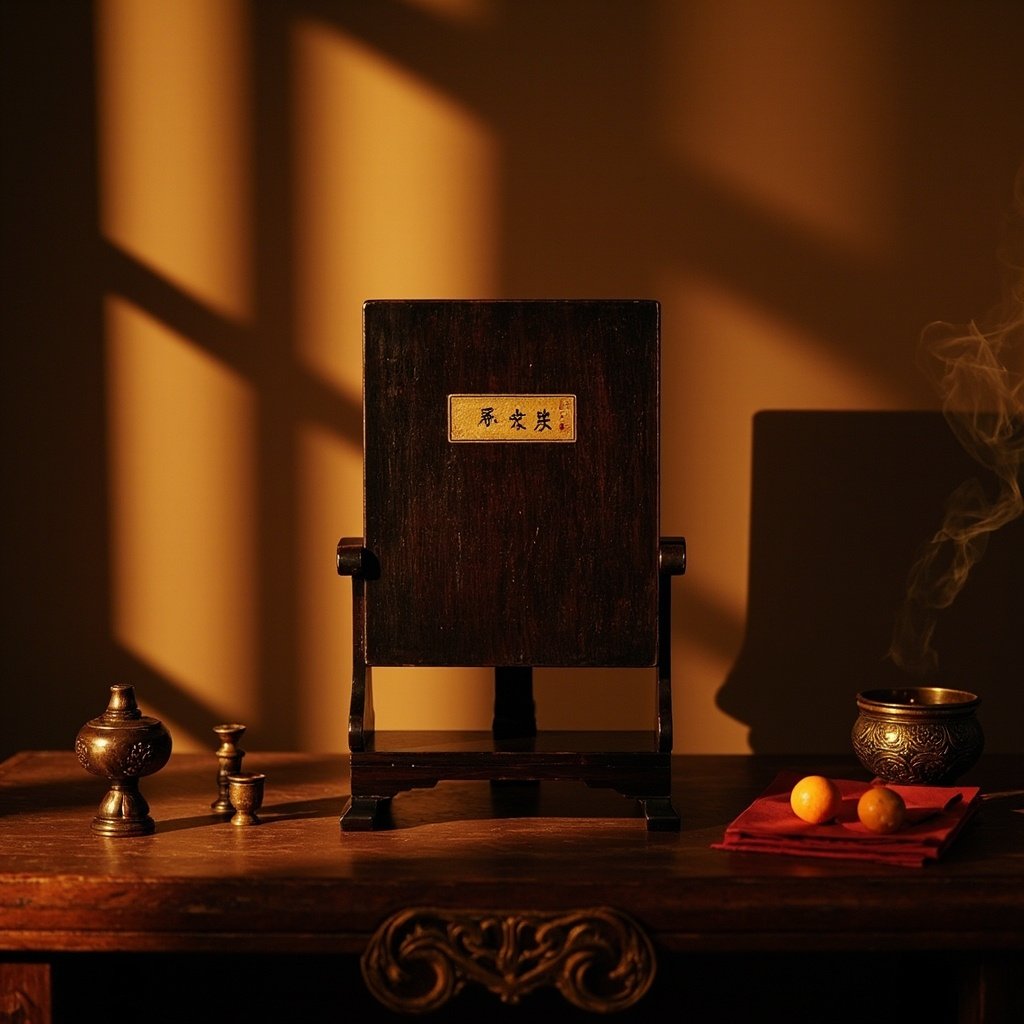
Walk into an old Chinese family home and you may find, on a high shelf in the main room, a narrow wooden plaque standing upright on its own base. It carries a name in gilt characters and, beside it, a thin stick of incense. Visitors often mistake it for decoration. The ancestral tablet, known in Chinese as the spirit tablet or shen zhu pai, is treated as the physical seat of a family line. In feng shui terms it is one of the few objects in a house read as yin rather than yang, and its placement follows its own rules. Those rules explain why an object barely a foot tall can outweigh a whole wall of furniture.
What an Ancestral Tablet Actually Is
A spirit tablet is a small upright plaque, usually of lacquered wood, bearing the posthumous name of a deceased family member with their lineage and generation marker. The classical form has two parts. The outer shell, or seat, is the visible body. The inner board carries the fuller name and dates, and strict tradition sets it into the shell during installation. That construction matters for feng shui: the shell is the house and the inner board is the guest. A properly installed tablet is understood to have somewhere for the ancestor to rest, the same logic applied to any Chinese altar.
Tablets are kept in two settings. The grand version stands in an ancestral hall shared by a surname lineage, sometimes holding dozens of plaques in ranked rows. The domestic version stands in a family home for one generation, and it obeys the same spatial grammar with far less tolerance for error.
Why a Tablet Reads as a Feng Shui Object
Three properties make the tablet a genuine feng shui consideration rather than a religious curio. First, it fixes a point. An installed tablet stays put for decades, so it behaves like a small mountain: a stable reference for the room. Second, it accumulates. Incense and regular attention build a slow density of association in one corner. Third, it orients. The tablet faces a direction, and everything nearby is then read relative to it.
This is why a misplaced tablet is treated more seriously than a misplaced ornament. An ornament only looks wrong. A tablet that faces a bed, sits below waist height, or backs onto a window puts the family line in an unsupported position, and the discomfort is usually real.
The Two Parts and the Idea of a Seat
The Outer Shell
The shell should be solid, well jointed, and free of cracks. A split shell is repaired immediately, because the container is meant to be intact. Deep red or black lacquer is traditional, and faded characters are restored rather than left, since the name is the working part of the object.
The Inner Board
The inner board is rarely seen, but it is the reason the rite exists. It is inscribed before installation and should not be pulled out for inspection. The practical consequence is simple: commission a tablet finished inside, not a decorative plaque with a hollow back.
Where an Ancestral Tablet Belongs
The rules are short, and each has a spatial reason behind it.
- High, never low. The base should sit above waist height, with the name at or above eye level when standing. Floor height reads as discarded.
- Facing the entrance, without sitting in its path. It should be visible from the door, so the line looks toward the household, but not aligned directly with the doorway.
- A solid wall behind. The backing wall is the mountain. A window or mirror behind the tablet leaves it unsupported.
- Away from bedrooms and bathrooms. A yin object in the most private yang rooms is unsettling. It should never face a bed or share a wall with a toilet.
- Out of the kitchen and out from under the stairs. Cooking fire and the compression of a stair run both degrade the position.
- Clear of clutter and glare. Direct afternoon sun and a shelf crowded with household odds and ends both read as neglect.
The Ancestral Hall and the Yin Dwelling
Chinese architecture separates the house of the living from the house of the dead. The ancestral hall, or citang, is built as a counterweight: quieter, cooler, more symmetrical, usually set apart. The distinction is yang zhai for the living and yin zhai for the dead, and the reason is balance rather than fear. A lineage needs one place where memory is concentrated.
The domestic tablet borrows that logic at small scale. A single plaque on a cabinet turns one corner of an apartment into a small hall, giving the family a place to put grief, obligation and continuity.
Materials, Height, and Proportion
- Wood is preferred: jujube, camphor and rosewood are dense and warm in tone.
- Metal and glass are avoided; both are cold, reflective materials.
- A tall tablet on a low shelf looks precarious; a small one on a deep altar looks lost.
- The base should be wider than the plaque, so the object reads as standing rather than balancing.
Common Misunderstandings
- The tablet is not a portrait, though many families add a photograph.
- It is not a deity image; offerings are gestures of continuity, not petitions.
- It does not require a room; a cabinet that closes works in a small flat.
- Relocating a tablet is not automatically unlucky, but it should be deliberate and done with the family present.
Modern Homes Without an Ancestral Hall
Most overseas Chinese households have no hall and no spare room. The workable substitute is a cabinet at eye level in a quiet corner, with a solid wall behind it and no television facing the plaque. A screen facing the tablet turns the corner into an entertainment wall and undoes the separation. Where no suitable corner exists, many families place the tablet in a temple, which is more respectful than a bad position kept for convenience.
Caring for the Tablet Through the Year
Attention is the actual mechanism. A tablet that is dusted, offered incense, and given fruit at the new year, at Qingming, and during the seventh lunar month keeps its corner active. One ignored for years acquires the flat quality of any abandoned shrine, and correct orientation cannot compensate. Consistency beats volume.
Conclusion
The ancestral tablet is a compact object with a large spatial job. It anchors a lineage in one fixed, well-supported, quiet position, giving a home a centre that is not commercial and not decorative. Whether it stands in a village hall or on a city cabinet, the same three requirements apply: height, backing, and attention. Get those right and the corner reads correctly to anyone who walks in.