Blog

Chinese Incense Clock Feng Shui Meaning: Time Measured by Burning
Most objects in a feng shui room are judged by where they stand: a mirror faces a door, a crystal catches light, a screen divides one space from another. The Chinese incense clock belongs to a different category. It is read by how long it lasts, a device that measures duration by destroying itself, and that fact gives it a meaning no compass placement can supply.
What an Incense Clock Actually Is
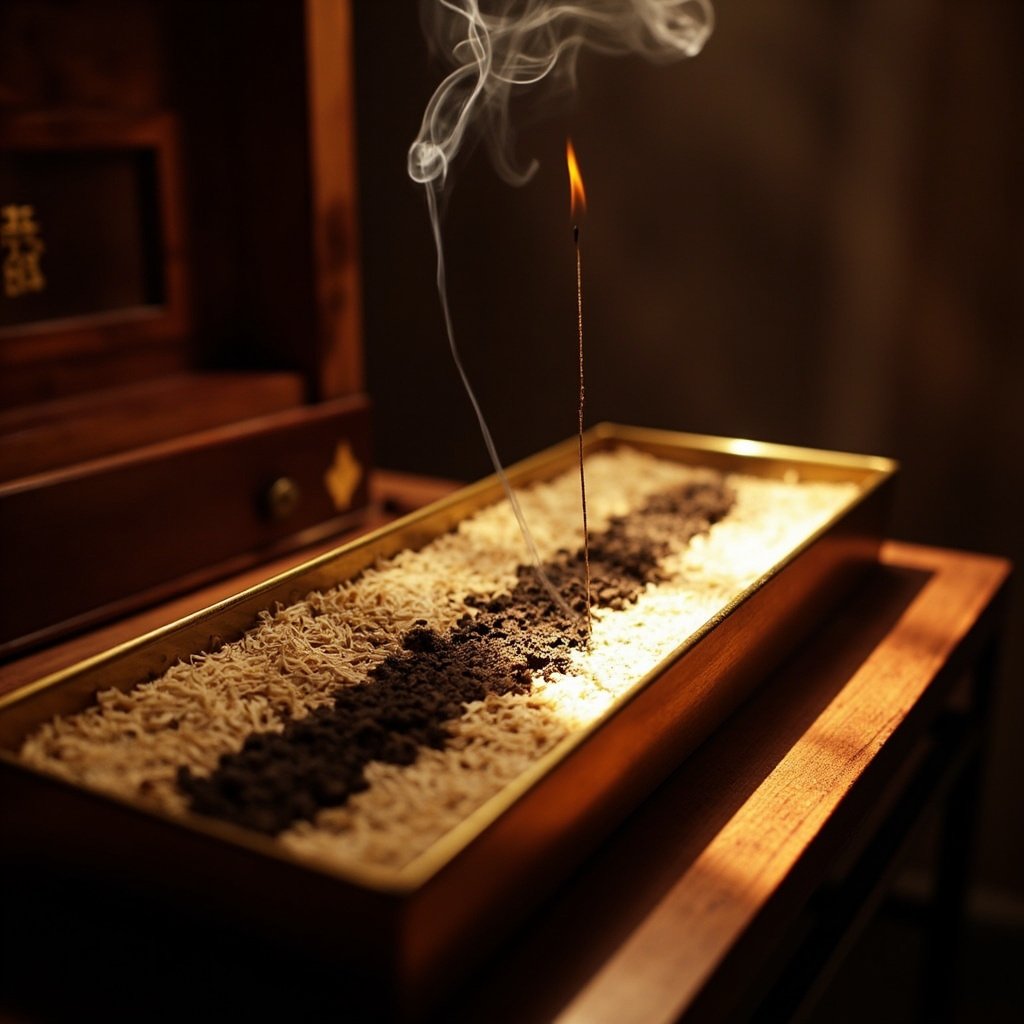
An incense clock is a shallow bed or brass trough filled with fine leveled ash, on which a continuous trail of incense powder is laid and lit at one end. The trail burns at a steady rate, and the position of the glowing tip reports how much time has passed. There is no dial, no hand, and no shadow. Some versions sit inside a small cupboard with a glazed or paper window, which protects the trail from draughts and lets the household see the burn without disturbing it. The object works because it is consumed. Nothing about it survives the reading except the ash.
Duration Instead of Direction
The sundial and the incense clock are often described as cousins, but they answer different questions. A sundial reads the position of a shadow, which gives both the hour and the direction of the sun. An incense clock reads only elapsed time, and has no interest in where the sun is. That makes it useful in the conditions that defeat a sundial: indoors, at night, in a courtyard shaded by walls, on an overcast afternoon. One instrument asks where you are in the day. The other asks how long you have been at your work.
How the Trail Was Read
Because a straight line of powder would burn out too quickly, the trail was laid in a spiral or a folding maze, packing several hours of burn into a footprint small enough for a table. Three methods of reading it appear in the historical record and in surviving examples:
- The glowing tip. The simplest and oldest reading, done by eye through the window of the cabinet.
- Thread markers. Silk or cotton threads tied across the trail at intervals; each burns through at a known time and releases a small bead.
- Falling weights. Tiny bronze weights balanced on the trail drop onto a metal plate below, sounding a soft chime at the appointed interval.
The third method changes the object’s character. A clock that sounds is no longer only something you consult; it interrupts, and interruption is how a schedule is enforced in a house without bells.
The Seal Clock
A refined variant presses the powder into a carved mould instead of laying it freehand. The mould carries characters, a grid, or a geometric pattern, and each segment represents a named interval, usually one of the old double hours. A thin sheet of mica is sometimes laid between segments, slowing the burn at the boundary so each transition is legible rather than gradual. These are the clocks of temples and large households, where the point was not knowing the time but keeping everyone inside the same one.
Why a Measured Interval Has Feng Shui Value
Nearly every remedy in a feng shui room is permanent. You hang the mirror, place the plant, close the door, and the correction stays in service. The incense clock is the exception. It corrects nothing by position and everything by rhythm, because the quality of chi in a room depends on more than arrangement. A space used at random hours, for randomly long stretches, develops a scattered quality that no object can fix. A space used at fixed hours, for fixed lengths of time, develops a pulse.
This is the clock’s real contribution. It marks the boundary between activity and rest, and boundaries keep energy from leaking across an entire day. Burning a trail before a period of work says, physically, that the period has begun and will end. The end is visible in the ash.
The Frame, the Bed, and the Desk
Practical questions about this object concern surfaces, not sectors of a house. It belongs where the practice happens: a scholar’s desk, a side table beside a meditation cushion, an altar already in daily use. An enclosed frame suits a room with draughts, since moving air distorts the burn rate long before it disturbs anything else. Set the bed on a stable surface above the floor, clear of fabric that could catch a falling ember.
Materials and the Powder Itself
A working clock has four parts, and the quality of each affects the reading:
- The bed. A shallow trough of wood, brass, or porcelain, filled with fine white ash that is leveled and lightly pressed.
- The powder. Sandalwood, agarwood, or a blended incense ground fine enough to burn evenly along a narrow line.
- The mould or guide. A carved form for the seal clock, or a simple brass bridge for laying a freehand trail.
- The cover. A cabinet with a window, which stabilizes the burn and keeps the trail from being disturbed.
Decoration on such pieces is restrained. The frame may carry a few characters or a plain lacquer finish, because the object’s ornament is the pattern of the trail itself.
Keeping Time Without a Screen
The most useful modern application has nothing to do with antiques. A trail set for twenty or thirty minutes gives a defined session with no phone in the room. You lay the trail, light it, and begin. When the burn reaches the end, the session is over. Nothing buzzes, nothing glows from a pocket. For meditation, reading, calligraphy, or practice on a stringed instrument, it does something a timer cannot: it makes preparation a ritual. Laying the ash and shaping the line takes a few minutes, and those minutes signal that the work is about to start.
Common Misunderstandings
Several assumptions about the incense clock are worth correcting. It is not a clock face; there are no numbers, and reading it requires only that you know where the trail began. It is not primarily a scent device, even though the powder may smell pleasant, and treating it as aromatherapy misses the mechanism. It is not a divination tool that produces an answer. And it does not measure absolute time, because humidity, powder density, and draught all change the burn rate, which is why traditional users calibrated a trail against a known interval first. A clock of this kind is accurate about its own duration, not about the world’s.
A Final Word
A mirror tells you where energy goes. A well-placed screen decides what a room is for. The incense clock does something quieter: it decides how long. In a tradition that treats a house as an arrangement of time and direction rather than a set of objects, that is a genuine contribution. It is the one piece of feng shui equipment whose meaning arrives as it disappears, and whose value is measured in inches of ash.