Blog

Hanfu Feng Shui Meaning: How Chinese Traditional Dress Shapes Personal Qi
Most Western students meet feng shui through furniture. A bed moved away from the door, a mirror covered, a plant placed in a corner. All of that is real, but it addresses only the outer ring of the tradition. Classical Chinese thought holds that a person carries a field as well as inhabits one, and that the field is shaped by what touches the body hour after hour. Clothing sits closer to the skin than any wall ever will. This is why hanfu, the traditional dress of the Han Chinese, deserves attention from anyone studying feng shui seriously. The garment is not a costume worn for photographs. It is an older technology for arranging a human being.
What Hanfu Actually Is
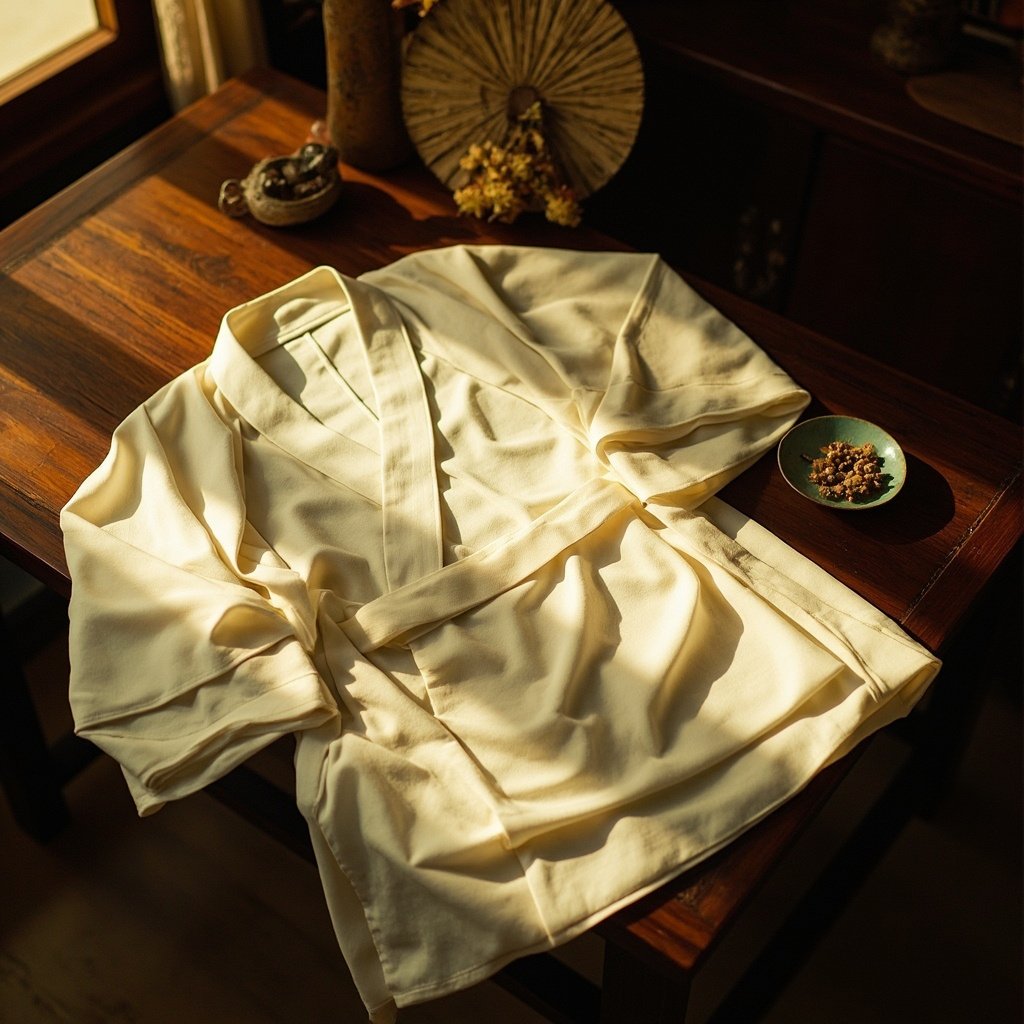
The word hanfu covers a family of garments worn before the Qing dynasty, roughly from the Han era through the Ming. Its defining features are consistent across that long span. The collar crosses at the chest, with the wearer’s left panel folding over the right. Sleeves are wide and weighted rather than fitted. The body is composed of two parts, an upper garment called yi and a lower one called chang, which may be a skirt or trousers. Fastening is by sash and tie rather than button or zip.
None of these choices are accidental. Each encodes an idea about how a person stands in relation to the world, and each has a direct feng shui reading.
The Crossed Collar as a Seal
The right-over-left closure is the single most important feng shui detail in hanfu. The overlapping panel forms a continuous diagonal across the chest, the area the tradition links to the heart and upper dan tian. A continuous line here reads as protection: qi enters and leaves through openings, and a smooth overlap at the chest presents no gap at the front of the body.
Notice also the direction. The left panel covering the right is the living form. Reversing it, right over left, was reserved for the dead and for the shroud. Rarely in Chinese material culture does one fold carry such unambiguous meaning, which is why traditional tailors were strict about it.
Wearing Qi: Why Cut and Fabric Matter
A fitted synthetic shirt traps heat and moisture against the skin, and after hours the body feels restless without obvious cause. Wide natural fabric behaves differently. Linen and ramie breathe, silk moves coolly, and the loose cut lets air travel between the garment and the body instead of pressing down on it. Practitioners describe this as keeping the wei qi, the defensive layer at the surface of the body, uncluttered.
Weight matters too. Hanfu sleeves hang from the shoulder rather than gripping the arm, so the shoulders stay low and the breath stays deep. Anyone who has spent a day in tight sleeves knows how quickly the chest shortens. Posture changes a person’s field faster than almost anything else, and traditional dress was built around that.
The Five Elements in Hanfu Colour
Colour in hanfu followed wu xing, the five phases, far more closely than modern fashion follows any system. Green and blue-green belonged to wood and to spring. Red belonged to fire and to summer, and to joy and celebration. Yellow sat at the centre and belonged to earth, which is why it became the imperial colour. White belonged to metal and to autumn, and black to water and to winter, and to depth and formlessness.
Several dynasties adopted the colour of the element they claimed, so the court palette shifted with each new house. For a modern wearer the practical rule is simpler. Choose the colour of the element you want to strengthen, and wear it near the body rather than only as an outer layer. A red under-robe does more for fire than a red scarf, because it touches the skin.
Layering and the Three Levels of the Body
Hanfu is built in layers, and the layering mirrors the way the tradition divides the body. The inner robe covers the lower dan tian and the belly, the middle layer covers the chest, and the outer robe falls over the shoulders and arms. Each level has a boundary, and each boundary is a place where qi can be gathered or scattered.
This is the opposite of how most people dress now, where a single shell does all the work. Layers create small transitions at the waist, chest and collar. In feng shui, transitions are where energy changes quality, and several of them keep the field from going flat.
What Hanfu Feng Shui Is Not
Three misunderstandings are common enough to name. The first is that hanfu is a lucky charm, and that wearing it will produce wealth or protection on its own. It will not. The garment supports a state; it does not substitute for one. The second is that older and more elaborate means stronger. A heavy ceremonial robe worn once has less influence than a simple garment worn well. The third is that hanfu must be authentic in every stitch. Fabric and cut carry the feng shui reading, so a well-made modern piece in linen with a correct collar does the work.
Putting It Into Practice
You do not need to rebuild a wardrobe. Start with a few choices that follow the logic of the garment.
- Keep the collar crossed the living way, left panel over right, on anything you wear regularly.
- Choose natural fibre for the layer that touches the skin, and let the cut stay loose at the chest.
- Match one garment to the element you are working with that season, and wear it often.
- Avoid synthetic fabric against the belly and upper back for long stretches, where stagnation is felt first.
- Retire a garment that has become tight at the shoulders. Constraint there shows up in the breath before it shows up anywhere else.
Dressing as a Daily Ritual
Traditional dress went on in a fixed order: inner robe first, then middle, then outer, sash tied last. The sequence turns getting dressed into a practice of attention, and attention is the real mechanism behind most feng shui adjustments. A room arranged with care changes how a person moves through it. A garment put on with care changes how a person stands inside it.
Hanfu offers Western students something the furniture tradition cannot. You can move a bed once. You can dress deliberately every morning, and each time the body is reminded of the order it belongs to. That repetition, more than any single robe, is what the old tailors were preserving.
Wear it simply. Keep the collar correct, keep the fabric honest, keep the shoulders free, and let the colour follow the season. The rest of the tradition will follow from those four habits.