Blog

Chinese Tea Caddy Feng Shui Meaning: The Sealed Vessel That Holds Qi
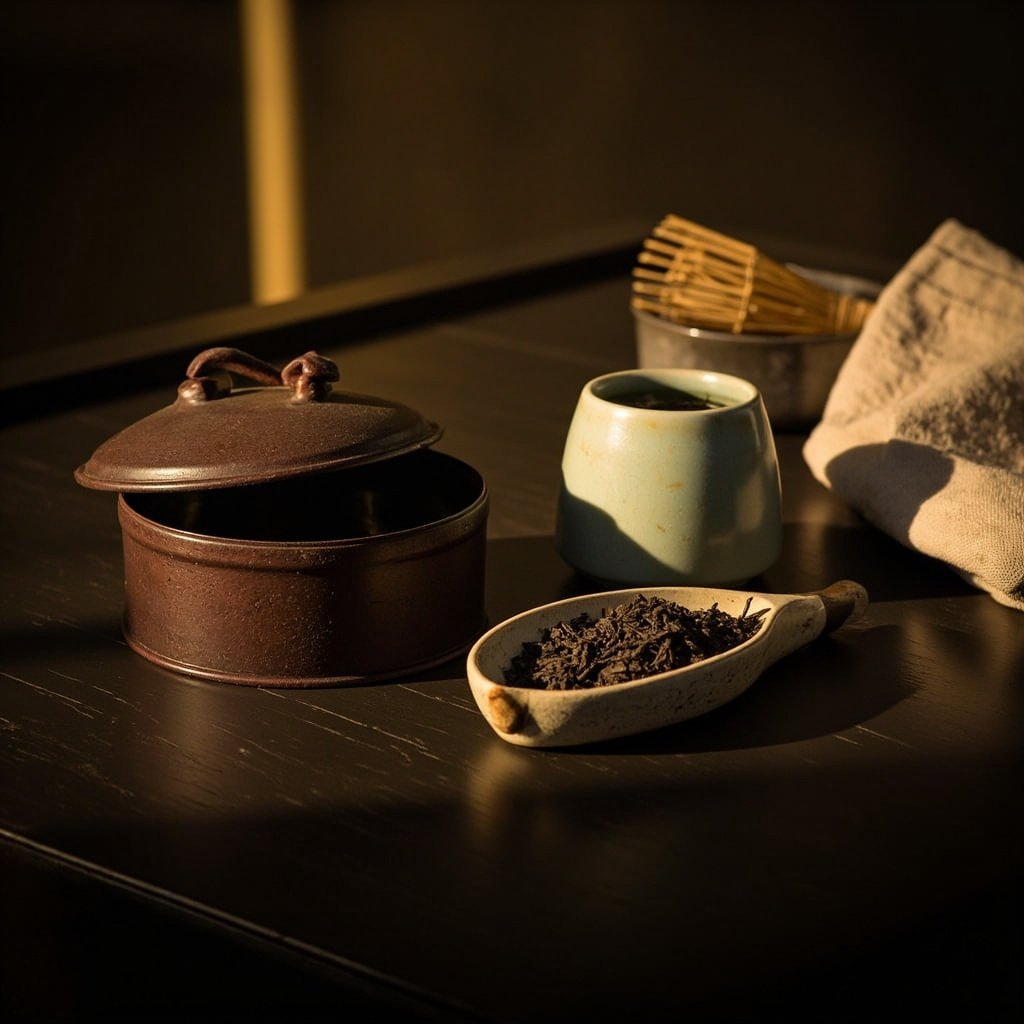
Walk into an old Chinese tea room and the most ordinary object is often the one that matters most. Beside the kettle sits a small lidded jar, plain enough to be overlooked. It holds no carving and no gold. Yet tea masters have always treated it with more care than the pot itself, because the caddy is where the leaf rests between sessions. In feng shui terms it is the vessel that decides whether the energy of the tea is kept or quietly lost. Once you understand that small jar, you begin to read an entire room differently.
What a Tea Caddy Actually Is
A tea caddy, or cha guan, is any container built to protect dry leaf from air, light, heat, and smell. Chinese households have used them for well over a thousand years. Early examples were glazed stoneware sealed with cloth and rice paste. Later came Yixing clay, pewter, brass, lacquered wood, and the tight tin canisters that dominate kitchens today. The best designs share one feature: a double seal. A close-fitting inner lid excludes air, and an outer lid excludes light. Everything else is decoration wrapped around that single purpose.
Why Storage Is a Feng Shui Question
Feng shui is largely the study of how qi gathers, moves, and escapes. A room with no containers feels unsettled, because objects lie scattered and energy has nothing to settle into. A well-sealed jar is a small working model of the same principle: qi is invited in, then held. Chinese tea culture calls this keeping the spirit of the leaf. A caddy that leaks air does not merely stale the tea. It demonstrates, in miniature, the household habit of letting good things drift away unguarded.
The Five Elements Inside One Small Jar
- Metal — tin, pewter, and brass caddies are the classic choice for long keeping. Metal cuts light and odour, and its contracting quality supports the gathering of qi.
- Earth — glazed porcelain and Yixing clay are fired earth. They breathe very slightly, which suits teas meant to mature rather than stay frozen in time.
- Fire — the kiln that hardens the clay, and the warmth of a hands-warmed cup, complete the earth pair.
- Water — the water that will eventually meet the leaf. The caddy never touches it, but it exists in anticipation.
- Wood — the shelf, the tray, and the leaf itself. Wood is the element of slow growth, and tea is a slow pleasure.
Seen this way, a modest jar on a shelf contains all five phases in correct order, each in its proper place, which is precisely what a good feng shui arrangement does at the scale of a house.
Choosing a Material
Tin and pewter remain the safest general choice. They are opaque, nearly airtight, and neutral in smell, so delicate green and white teas keep their fragrance for months rather than weeks.
Glazed porcelain suits anyone collecting tea for pleasure rather than long storage. It is easy to clean, shows no odour, and its pale surface reads as calm on an open shelf.
Yixing clay is for puer and roasted oolong. The unglazed body absorbs a trace of the tea over years, and many drinkers keep a separate jar for each style so the aromas never argue.
Placement Rules for the Caddy
- Keep it on a stable shelf at chest height or above, never on the floor where qi is heaviest and dust settles.
- Place it away from the stove. Kitchen fire is active and impatient, and tea is a quiet, wood-and-water pleasure that fire will scatter.
- Avoid the wall shared with a bathroom, and never store tea above a toilet or drain.
- Keep the jar out of direct sun. Light is the fastest way to empty a caddy of its value, whatever the material.
- Group caddies in odd numbers when displayed, three or five together, so the arrangement gathers rather than scatters.
- If the tea corner doubles as a work desk, keep the jar slightly to the left of the kettle, the side associated with stillness and stored resources.
The Seal as a Metaphor for Wealth
Chinese domestic culture has a long habit of reading containers as statements about the household. A sealed jar says that what comes in is not immediately spent. It is no accident that the same three-part seal appears on tea caddies, medicine chests, and the boxes that once held family documents and silver. The lesson travels well beyond tea. A home where nothing is sealed, where every bag is open and every drawer loose, tends to feel generous but porous. Closing a lid is a small act of respect for what you already own, and that habit is worth more to a household than any single object placed in the wealth corner.
Common Mistakes
- Storing tea in the refrigerator. Cold surfaces condense moisture, and moisture is the one thing dry leaf cannot forgive.
- Using a clear glass jar on a sunny sill. Pretty, and ruinous. Light degrades leaf within days.
- Mixing styles in one caddy. Jasmine will colonise a green tea, and the loss is permanent.
- Keeping the caddy empty for months. An empty vessel on display reads as an unfilled intention. Store something in it, even a folded cloth, or put it away.
- Washing a tin and sealing it damp. Let it air completely dry for a full day before the lid goes back on.
A Simple Weekly Practice
Once a week, open the caddy in the morning, smell the leaf, and close it again. It takes ten seconds. The practice does two things at once: it catches tea that has turned before it reaches the cup, and it turns an overlooked object into a small ritual of attention. In feng shui, attention is the real currency. A household that notices its jars is a household that notices its doors, its drains, and its light.
Conclusion
The tea caddy is the quietest object in a Chinese tea room and one of the most instructive. It teaches that feng shui is less about where you put things than about whether you hold them properly. A tight lid, a dark shelf, a separate jar for each style, and a moment of attention each week will do more for the atmosphere of a home than most decorative remedies. Choose a caddy you can seal with one hand, place it where the room is calm, and let it remind you that good energy is not only invited in. It is kept.