Blog

Erhu Feng Shui Meaning: The Chinese Two-String Fiddle Guide
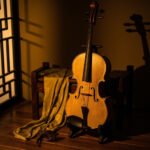
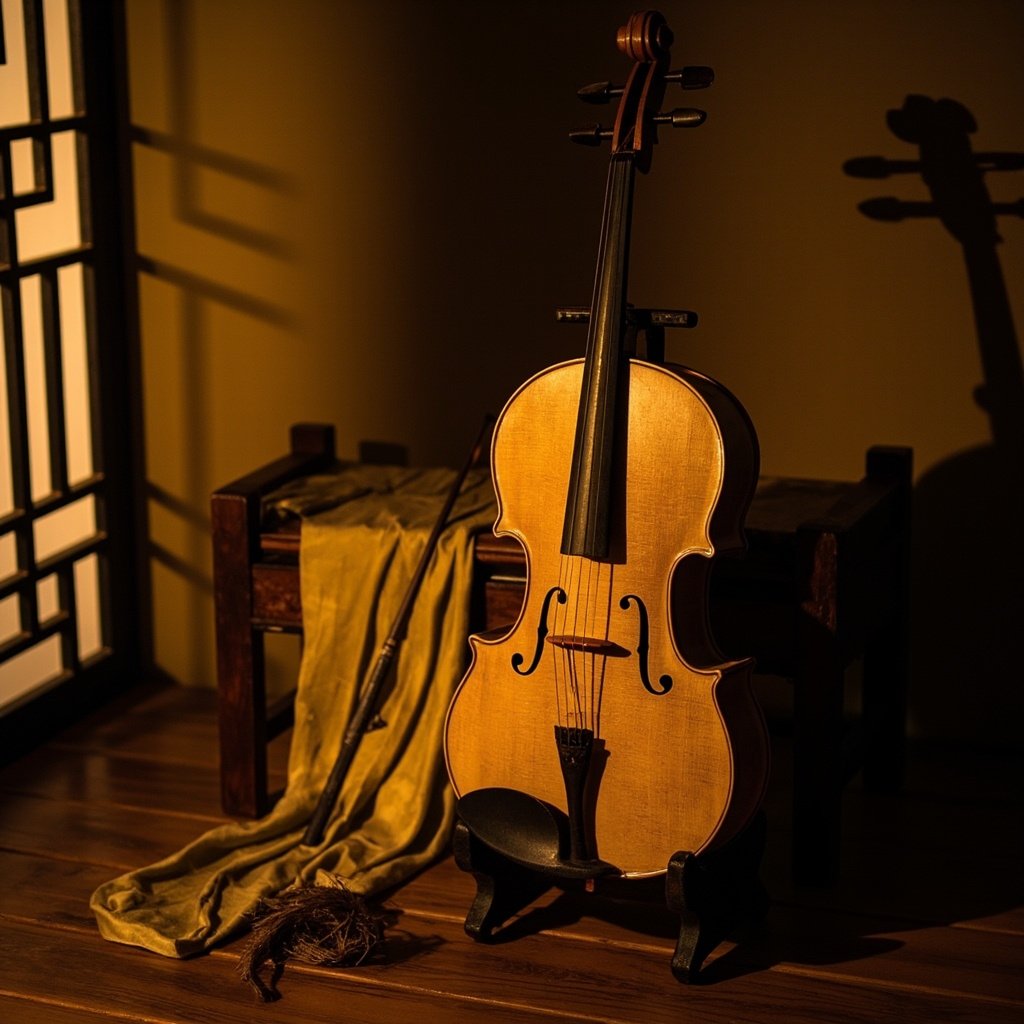
The erhu is the most recognized Chinese instrument in the world and the least understood. Western listeners hear a single expressive line and reach for a comparison: the Chinese violin. That label is convenient and wrong. The erhu has two strings, no frets, a python-skin resonator, and a bow threaded permanently between its strings. It cannot play a chord, and it cannot hide a mistake. Every note is placed by a human hand on a smooth, unmarked surface.
For students of Tian Xing Feng Shui, that design is a working model of how chi behaves in a house, and the object carries its own rules of care.
What the Erhu Is
The erhu belongs to the huqin family, a group of bowed instruments that entered China along the northern trade routes and were absorbed into regional opera and street performance. Its name is disarmingly plain: er means two. The body is a small wooden soundbox, usually hexagonal, covered at the front with stretched skin. A long neck passes through it, and the instrument rests on the left thigh rather than under the chin.
The strings are tuned a perfect fifth apart, most often to D and A. The range covers roughly three octaves from a box that fits under one arm.
Two Strings: Heaven and Earth
Chinese instrument making has always liked pairs, and the erhu is the clearest case. The two strings are read as heaven above and earth below, with the player standing between them as the third term. The upper carries the yang register, bright and penetrating; the lower carries yin, dark and grounded. The interval between them is not decorative — the perfect fifth, a ratio of three to two, generates the classical Chinese pitch system itself.
This is why the erhu sits naturally inside Tian Xing Feng Shui reasoning: it is tuned by the same arithmetic that organizes the calendar, the twenty-four mountains, and the flying star cycles. A fifth is not a mood but a proportion.
The Fretless Fingerboard: Pitch as a Continuous Line
Nothing on an erhu neck tells you where the note lives. There are no frets, no dots, no keyboard. The player stops the string wherever the ear demands, sliding between positions in one unbroken motion. This is its signature sound: the portamento, a glide Western notation can barely describe.
A piano fixes pitch by manufacture, leaving the player to choose among ready-made steps. The erhu reverses the arrangement: the instrument supplies the conditions, the human supplies the measure. Feng shui makes the same claim about a dwelling. A site gives you light, orientation, and constraint; it does not give you the life lived inside it. The occupant supplies the measure, and its quality is audible in the first phrase.
The Skin Soundbox: A Living Membrane
The erhu front is a membrane under tension, traditionally python skin. It is why the instrument sounds as it does — thin, vocal, closer to a human throat than a wooden box. A membrane is the most responsive part of any resonant system, and it answers to humidity first.
This has consequences. Skin that dries tightens, sharpens, and eventually splits; skin that absorbs too much moisture sags and turns dull. A healthy erhu lives between roughly forty and sixty percent relative humidity — also the band most comfortable for human occupants. The instrument and the person want the same room. That agreement is not sentiment but physics, and it is the agreement feng shui tries to extend to a whole house.
The Bow That Never Crosses Over
The bow hair is threaded between the two strings and stays there; it cannot be lifted away. That constraint shapes the whole technique. The player bows one string at a time, and the hand must stay disciplined because there is no way out of the frame.
Traditional teachers read this as a lesson in containment. A remedy that oversteps becomes a new problem — an oversized mirror that cuts a corridor in half, a fountain loud enough to make a living room tiring. A well-made instrument is defined as much by what it refuses to do. The erhu has two strings and it uses them.
Sound as a Single Thread
An erhu cannot produce harmony. It produces one line, continuous and unbroken, which makes it an unusually honest diagnostic tool. Play in a room and listen: whether the tone blooms or dies, whether corners swallow it, whether bare walls throw it back at you. Rooms that sound tight usually feel tight, and the correction is the same — soften, break up parallel surfaces, give the sound somewhere to travel.
Placement and Care at Home
- Keep it out of bathrooms and damp exterior walls. The skin is the first thing to fail, and it fails silently.
- Protect it from direct sun and air-conditioning drafts. Moving dry air does more damage than still air of the same temperature.
- Store it horizontally or in its case, never standing on the tuning pegs. Weight on the neck distorts the joint over years.
- Tune before you play, every time. The five-minute act of calibration is the instrument’s equivalent of reading a compass — a small discipline that keeps the larger one honest.
How you keep it matters more than where. A dry, ordered shelf beats a damp corner whatever the facing direction.
Common Misunderstandings
The most persistent myth is that the erhu is inherently mournful. The repertoire is broad: Liu Tianhua wrote ten solos in the 1920s and 1930s, ranging from the bright March of Brightness to the quiet Beautiful Night, and opera accompaniment is brisk and dramatic. The melancholy reputation comes from one piece heard out of context — Moon Reflected on the Second Spring, recorded by the blind street musician Abing in the 1950s.
A second misunderstanding concerns the skin. International trade in python skin is restricted, and many contemporary instruments use synthetic membranes. This is a legal and ethical question, not a tonal one; a well-made synthetic head can sound excellent. Buyers outside Asia should ask rather than assume.
Frequently Asked Questions
Is an erhu a feng shui cure?
No. It does not ward off sha chi the way a mirror or a bell is said to. It refines a room rather than defends it.
Can I hang an erhu on a wall?
Yes, provided the wall is dry and out of direct sun. Hang it vertically by the neck, not by the strings.
A Single Voice, a Straight Line
The erhu teaches three things. Proportion matters, because a fifth is arithmetic. Conditions are not outcomes, because the player supplies the pitch. And containment is strength, because a limited instrument played well sounds complete.
An erhu does not need to be played daily to do its work. It needs to be kept in condition, tuned honestly, and placed where the air is calm — which is most of what any object in a house requires, and most of what feng shui asks of us.