Blog

Celadon Feng Shui Meaning: Qing Ware and Calm Energy at Home
Celadon is the blue-green glaze Chinese potters refined over a thousand years, and its feng shui meaning is quietly powerful. Where many decorative objects carry a loud symbolic charge, celadon works on a subtler register: it cools a room, softens glare, and settles the nervous system of the space. Collectors know it as the green of the Song dynasty kilns. Feng shui practitioners have long known it as a form of the wood element that can be directed and balanced like any other material. This guide covers the history behind the name, the great Song kilns, the rain-cloud glaze, the forms to choose, and where to place them for real effect.
Why Celadon Is Called the Green of Ages
The English word celadon was borrowed in the nineteenth century from the French, and the French took it from a seventeenth-century porcelain painter named Celadon Patenier. The colour name followed the glaze. What they meant was the soft, grey-tinged blue that decorators still use for aged jade and oxidised bronze. Chinese potters had described the same quality for centuries, comparing the glaze to jade, to a lake after rain, and to the pale green of new willow leaves. The naming history matters because it explains the intent. This is a mineral colour, not a pigment, produced by chemistry in a kiln at temperatures near 1300 degrees Celsius.
The Five Great Kilns of the Song Dynasty
The Song dynasty is the reference point for celadon quality, and connoisseurs name five kilns whose output defined the period.
- Ru kiln (Ru ware). Sky-blue glaze and fine crackle, tied to the Northern Song court. The most refined rain-after-cloud tone of the group.
- Guan kiln (Guan ware). Imperial Southern Song kilns with thick opalescent glaze that pools from blue to green. Depth and stillness.
- Ge kiln (Ge ware). Recognised by its deliberate crackle network. Texture, structure, and the discipline of visible craft.
- Jun kiln (Jun ware). Opalescent lavender, rose, and sky tones from copper reduction. The most dramatic colour range of the five.
- Ding kiln (Ding ware). Pale ivory glaze, often carved or incised, made in the northern kilns. Clean, restrained, geometric.
The Rain-Cloud Aesthetic and What It Means
The most quoted line in the history of celadon describes the glaze as the moment after rain has passed, when the sky breaks and the clouds part. That image does more work in feng shui than any technical description. It names a state of transition: the storm is over, the air is washed, and the sky opens into a clear, even blue. A celadon glaze is also low in glare, because its depth comes from layers of translucent glaze rather than pigment sitting on the surface. It never flashes the way high-gloss lacquer does, which makes it useful in busy rooms.
Celadon and the Wood Element
Read through the five element system, the blue-green hue of celadon belongs to wood. Wood governs growth, upward movement, expansion, and the early stages of a project. It is the element of the east and of spring. Because the colour is cool rather than hot, celadon expresses the disciplined side of the wood element: the side associated with study, planning, and steady increase rather than sudden windfall. This is why a celadon piece suits a work desk better than a sales counter. Read as wood, it supports sustained effort.
Choosing the Right Form: Vases, Bowls and Washers
The form of a celadon piece decides what it does in a room, because every classic shape was designed for a purpose.
- Meiping (plum vase). Tall, narrow shoulders and a small mouth, traditionally filled with blossoming branches. Concentrates upward, used for growth and honour.
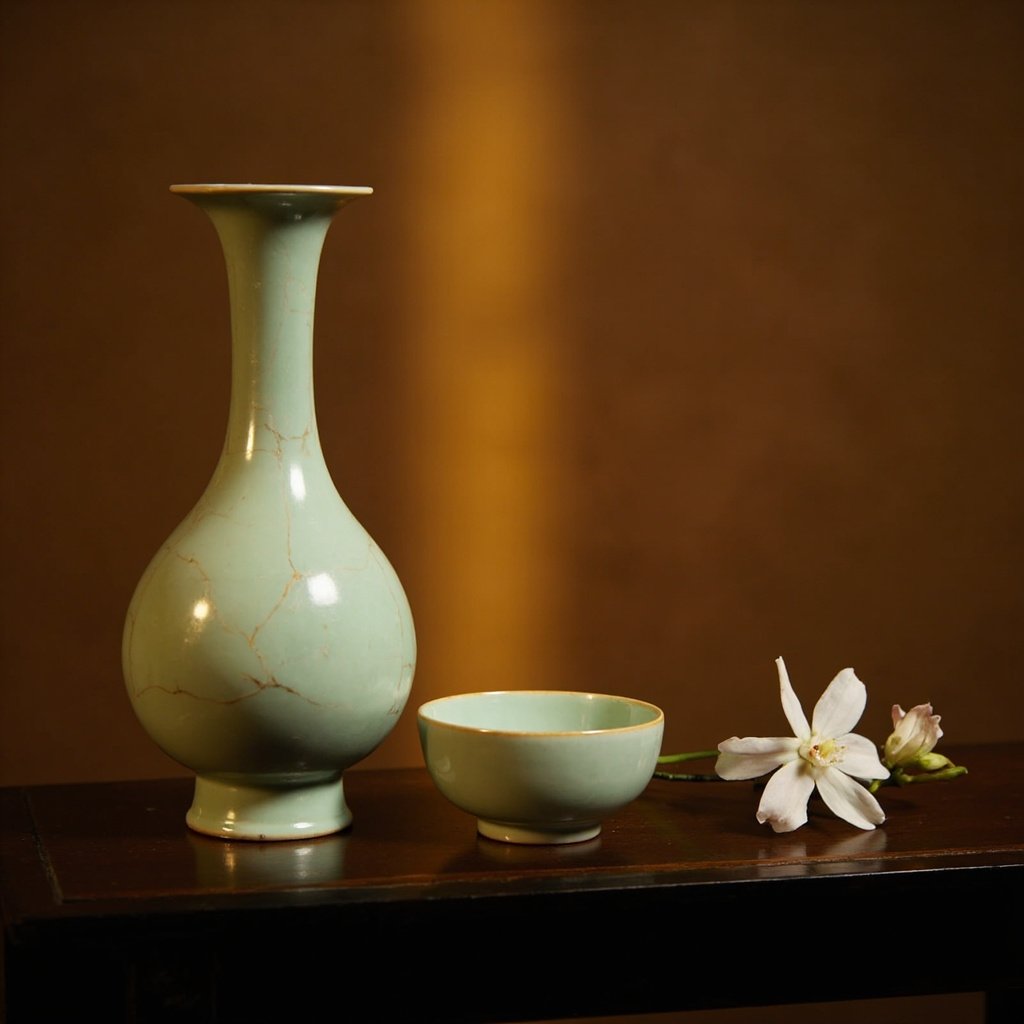
- Yuhuchunping (peach-shaped vase). Full belly, fine neck, light foot. A scholar shape that reads as composed rather than expansive.
- Washer (xi). A wide shallow bowl once used for rinsing brushes. Holds water by design, so it suits an east-facing position.
- Bowl and cup. Everyday forms placed near the dining table, softening metal and glass and slowing the pace of a meal.
Choose one piece with clear space around it rather than a crowded shelf, and keep its opening near eye level when you stand.
Where to Place Celadon in Your Home
Placement determines whether the piece is decoration or an active part of the room’s energy. Three positions are classic. The first is the study, where a single vase on the side table supports the wood element that governs learning. The second is the east side of the living room, because east is the wood direction and morning light from an eastern window falls most naturally across a pale glaze. The third is the entry table, where a low bowl greets arrivals and sets the tone of the house.
Crazing, Care and Everyday Living
The fine crackle in a celadon glaze is called crazing, and collectors have long read it as ice breaking across a frozen pond. In feng shui terms, crazing introduces the character of water into a wood-toned object, a quiet pattern that moves across the surface without breaking the form. Because crackle deepens with age and handling, these pieces were made to be lived with. The old practice was to keep a piece in daily use, wash it in warm water, dry it, and let the glaze register every season.
Care is simple: warm water, a soft cloth, no dishwasher, and dry the foot ring so the vessel leaves no wet mark on wood. Sudden temperature changes widen crazing, so keep pieces away from radiators and vents.
Used with that kind of attention, celadon does what a good feng shui object should do. It brings a particular kind of weather indoors: cool, even, and clear, the sky after the rain with the clouds breaking. Read it as wood where you need growth, as water where you need depth, and let the glaze do the rest. In a modern home, celadon becomes the quiet note in a room of warm wood, stone, and linen, and a single vase on a console table gives the eye somewhere to rest.