Blog

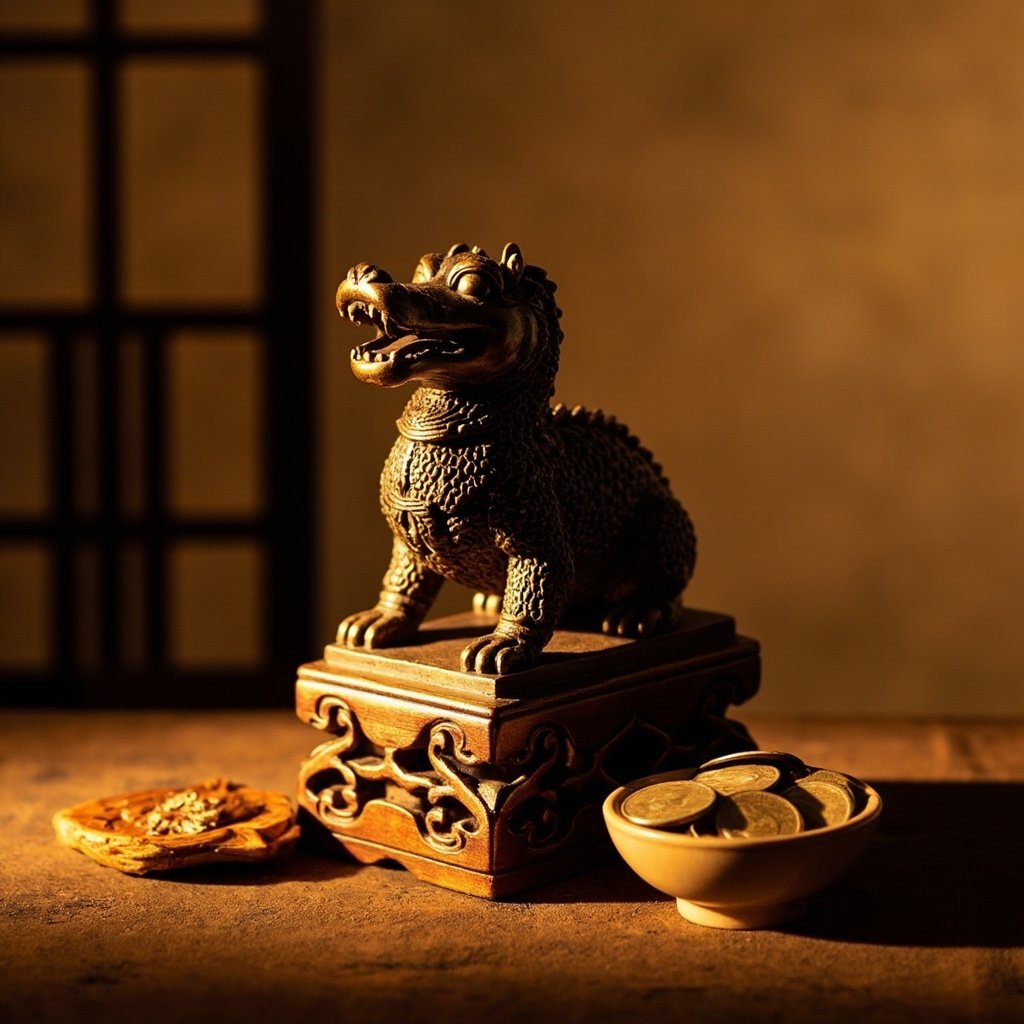
Alligator Feng Shui Meaning: The Water Guardian Guide
The alligator is an unusual feng shui symbol, because it is genuinely dangerous and genuinely useful at the same time. Chinese tradition did not treat it as a pet but as a resident of the water with a temper, and the correct response to such a creature was never to banish it but to give it a position where its strength worked for the house.
This guide covers the place of the alligator in water control, the bronze beasts that guarded imperial waterways, how the animal reads in five element terms, the regional traditions of the south, and the rules for placing an alligator object or carrying crocodile skin.
The Beast That Holds the Riverbank
Classical descriptions place the alligator in the deep and slow places: the estuary, the flooded plain, the standing water behind an embankment. It is a creature of the water element that surfaces, and it is described as calm until disturbed, then overwhelming. The traditional fear was never that it would hunt people, but that it would pull down the riverbank.
A dam, an embankment and a water gate all depend on the same principle: something heavy and rooted must hold the force of the water. The alligator becomes the emblem of a force held in check by the one thing it cannot move. The animal that could destroy the wall is placed in the service of the wall.
Bronze Water Beasts and the Imperial Courtyard
The best-known example is a pair of bronze water beasts in the imperial garden of the Forbidden City, each cast with a long serpentine body and the head turned toward the surrounding water. Their function was defensive rather than decorative, since the courtyard held a broad body of water and a ferocious guardian was the accepted way to secure it.
They are also tied to a well-known narrative about a scholar said to have been cast into the water as a sacrifice, and about the beasts that took the place of the intended victim. Whether legend or casting came first, the story did the work feng shui theory requires: it made the object a protector that acts without being asked.
Water Element, Heavy and Still
In the five element system the alligator is water in its heavy, still and cold form, which places it with the north rather than with the mild rain and cloud of the west. Water at rest inside a container is the classical image of stored wealth, so an alligator object is read as a vessel that holds what has been gathered rather than spends it.
The south is the direction of fire and of summer, and it is also the direction in which the creature was traditionally held to live. Southern tradition therefore places the alligator at the boundary between two forces, and objects of this kind are positioned where a water feature or a low point meets the warmer part of a home.
Geography, the Southern Provinces and the Luo Shu
The alligator appears in the classical geography of the south as a resident of the lower rivers, and it is one of the animals associated with the old provinces described in the Luo Shu system, where the southern lands were set down as warm, wet and rich in creatures with no counterpart in the cold centre. Its presence there signalled abundance, not danger.
Descriptions of the animal in the older texts stress its stillness. It lies with its eyes open and appears inert while the current runs strong, so the practical question was never how to fight it but how to read it. That is the model for the feng shui attitude to a fierce object: study the behaviour first, then place it where it serves you.
Turning a Fierce Form into a Guardian
Every fierce object faces the same question: how does a thing built to harm become a thing that helps? The classical answer is placement and framing.
- Point it outward. The head of a guardian is directed at the approach, never back into the room. A guardian facing its own house turns protection into pressure.
- Give it a base. A water beast that stands on stone or a low plinth is anchored, while the same figure balanced on a table edge reads as unsettled.
- Name the function. A feng shui object is given a job where it stands, and the job is stated in words. An object with no assigned function is decoration, and decoration has no effect.
Because the alligator is water in its heavy form, its job is usually to hold, to contain, or to keep something from moving on its own.
Crocodile Leather, Carved Figures and Craft
The animal reaches the household in two different ways. The first is material: crocodile leather, used for wallets, belts, watch straps and handbags, among the most durable leathers in the world. The second is the carved figure in bronze, stone or wood, made for a desk, a cabinet or a water feature.
The leather carries the same reading in miniature. It is water element made portable and attached to the body, which is why practitioners advise against carrying a crocodile item in the same pocket as a fierce talisman. Two strong characters competing in one place cancel each other, and the weaker one wins.
Placement Rules and Wearing Taboos
Two practical questions come up constantly: where an alligator object may sit, and what may be worn with it.
- In the living room, on a low side table, facing the entrance. This is the working position for a guardian animal.
- Away from the cash register. A water creature that holds and never releases is the wrong presence where money changes hands, where the correct image is flow rather than storage.
- Not in a bedroom. The object carries aggression, and bedrooms are meant to hold rest rather than vigilance.
- Never above a person. A heavy water beast overhead presses down on the chi of the head.
- Not with another fierce talisman on the body. Two fierce objects worn together compete, and the wearer becomes the contested ground between them.
The alligator shows why feng shui treats animals seriously rather than decoratively. The tradition is not describing a mascot but a force with a temperament, and it says that the correct response to a dangerous force is not banishment but position. Place the water beast where water gathers, anchor it, point it outward and give it one job. Guarded properly, a fierce object is the most loyal thing in the house.