Blog

Tea Set Feng Shui Meaning: The Gongfu Tea Ceremony Guide
Ask any practitioner what the most underrated feng shui object in an ordinary home is, and the answer is usually the tea set. It sits in the middle of the family day, it is handled by nearly everyone who enters the door, and it quietly organizes the room around a table. A well placed tea set does more than serve a drink. It decides how a household receives a guest and how a conversation begins.
The ritual form of tea service is gongfu cha, a phrase meaning tea made with skill. Its tools are small, specific, and full of meaning.
Why Tea Belongs to the Wood Element
In the five phase system, tea is assigned to wood. The leaf is a living plant that rises, spreads, and is harvested by cutting; its character is upward, expanding, and seasonal. Wood corresponds to spring, to morning, to the color green, and to the trigram Zhen, which governs beginnings and initiative.
A tea service is therefore a wood remedy that sits on the table. A household that feels stuck, slow, or out of season benefits from warm, growing imagery near the center of the home, and a tea set placed and used daily does that quietly.
What the Gongfu Set Contains
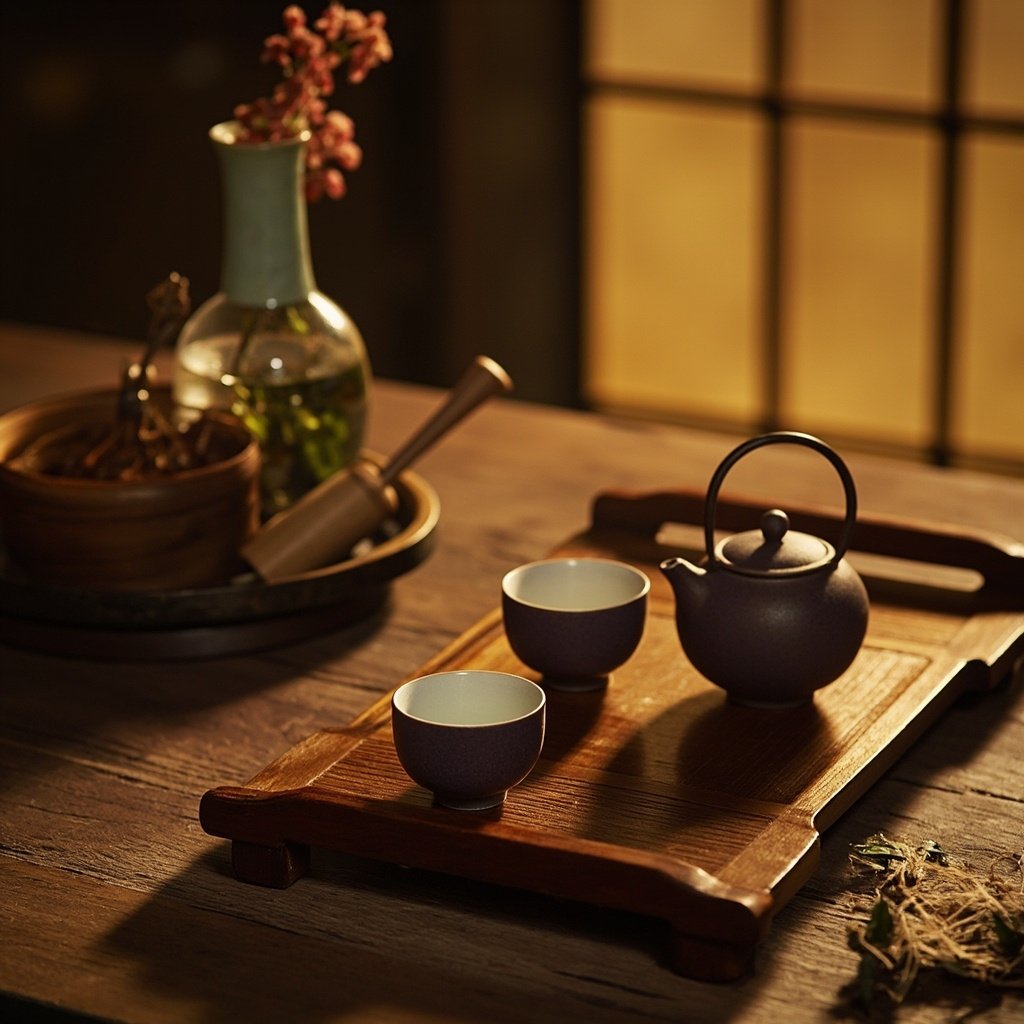
A full service is compact and each piece has a job:
- The teapot (chahu). The host of the ceremony. Its body is the source of the flow and its spout defines the direction the tea travels.
- The fairness cup (gongdao bei). The vessel that catches and redistributes the brewed tea so every cup is equal in strength.
- The tea boat (chuanfang). A shallow tray that holds the pot and cups during service, keeping the working area clean and calm.
- The water vessel (shuihu). Usually a lidded pitcher holding the heated water, sometimes with a charcoal brazier nearby.
- Tea cups, a tea towel, and a tea pick. The small working implements that make the service orderly and calm.
Placement: The Spout Rule
The spout of the teapot is the most discussed rule in tea set feng shui, and it is worth understanding rather than memorizing. The spout directs chi, the same way a faucet directs water. Pointed at the front door, it pours the living energy of the home out as it arrives. Pointed straight at the seat of a guest, it pushes an aggressive quality into the conversation. The correct orientation is toward the person being served and slightly inward toward the center of the table.
- Turn the spout away from the main door and away from any corridor the household walks through.
- Turn the spout toward the guest, or toward the place where you want conversation to focus.
- Never let the spout point at a wall, a window, or a television screen.
- Keep the whole set on one side of the table, not straddling the center line, so it does not block the axis of the room.
The Fairness Cup and the Meaning of Gongdao
The gongdao cup is often described as the fairness cup, and the name carries a lesson. Strong tea is drawn into the fairness cup and then distributed to the small cups, so every guest receives a drink of identical strength. Where one person gets the first and strongest pour, the tradition says the host has lost the sense of measure.
For a business this reads as fairness, even sharing, and honest dealing. A tea service set this way in a reception room is a quiet statement that the person who receives it here will be treated without favouritism. For a family it is a daily rehearsal of the same principle: the host measures out, and the household drinks the same.
The water vessel deserves a similar note. Water is the element of the north and the domain of career and income, so a lidded pitcher of clean water near the service is a legitimate water remedy. Keep it covered; an open pitcher of stale water works against you.
Yixing Clay and the Element of Earth
The famous teapots of Yixing, in Jiangsu province, are made from unglazed purple clay. In five phase terms this is earth: grounding, stabilizing, and holding. A yixing pot is not merely a vessel. It is a vessel that improves.
The practice is called nurturing the pot. Because unglazed clay is porous, it absorbs the oils and character of the tea brewed in it, so a pot used regularly for one style of tea develops a deeper flavour and a warm patina. This is the practical version of the earth element: it accumulates slowly, keeps what it receives, and improves with use rather than with replacement.
- Assign one kind of tea to one pot, and use that pot often.
- Rinse with hot water only. Soap strips the clay of what it has absorbed.
- Never put a clay pot in a dishwasher, and let it air dry fully before refilling.
- Keep the pot away from sudden temperature swings, which crack unglazed clay.
Tea as Social Feng Shui
The deepest level of tea set feng shui meaning is social. A tea table is one of the oldest domestic institutions in Chinese culture, and it is designed around a single idea: the host pours, the guests receive, and the difference in status is set aside for the length of the service.
Practically, that makes the tea set a diagnostic instrument for the household. If the service is rushed and the pot is pushed to the back of the cabinet, the household is treating hospitality as an obligation. If the pot is rinsed, warmed, and set out before guests arrive, the household is treating hospitality as a value.
For a business, the same service becomes a client-facing ritual. Offering tea before a meeting in China is not a courtesy added on top of the meeting. It is the meeting’s opening move, and the quality of the service is read as a preview of the quality of the deal.
Placement Rules Worth Remembering
- Keep the set off the floor and off the top of a refrigerator, both of which read as unstable or disrespectful.
- Place it where the family gathers, or in the reception area, rather than in a corner nobody walks past.
- A round or oval tea table softens the direct lines of a rectangular room; a square set in a very angular space feels harder than it needs to.
- Do not stack the pot, cups, and boat into a storage corner and call the arrangement a tea service.
A tea set that is used every day is worth more than a flawless one in a cabinet. The feng shui reading and the cultural meaning point to the same conclusion: this is an object of relationship, and relationship only works when it is alive.