Blog

Chinese Mortar and Pestle Feng Shui Meaning: The Medicine Bowl and Its Elemental Power
In feng shui practice the mortar and pestle is not a rustic ornament but a working vessel with an elemental signature and a protective role. For centuries it stood behind the counter of the herbal shop, reducing roots and seeds to the powder from which a remedy was weighed and handed to a waiting customer. This guide covers its traditional meaning, how material changes its reading, and where to place it so the symbolism does real work.
The Mortar and Pestle in the Working Tradition
In a traditional apothecary the mortar was never decoration. It stood at the centre of preparation, where raw herbs were sorted, inspected, and processed by specific methods: one herb soaked, another roasted over a low flame, another stir-fried in sand until it popped. The mortar is where that transformation was performed, which is why the tool carries so much weight in folk memory.
Pounding was understood to release the active essence of the plant. A dried root lying inert on the shelf was considered potent only once it had been broken and ground, and the circular motion of the pestle was the way the practitioner drew the useful part of the raw material into itself.
- Crushed hard roots and seeds into fine, mixable powder.
- Blended powders evenly so a compound held a constant strength.
- Ground minerals and resins no simpler means could reduce.
- Prepared material for pills, powders, pastes, and decoctions.
Why the Mortar and Pestle Carries Feng Shui Meaning
The object maps onto several feng shui principles. It is a container, a bowl that receives, holds, and releases, and containment is what protects a household. It represents transformation from coarse to fine, from disorder to order, and it stands for the belief that illness can be met with attention rather than fear. The pairing of bowl and pestle also carries an image: the mortar sits still and absorbs the force while the pestle is the moving agent.
Material and the Five Elements
The material of a mortar is not a decorative detail in feng shui. It is the element, and it determines how the object is read in a room.
Clay and Fired Earth
A brown-glazed or unglazed earthenware mortar belongs to the earth phase, the element of stability, nourishment, and the middle ground that supports everything else. Earth also carries the idea of containment, because earth holds and stores. A clay mortar therefore reads as a grounding presence for a kitchen where food is prepared and for a room that has grown too scattered.
Stone
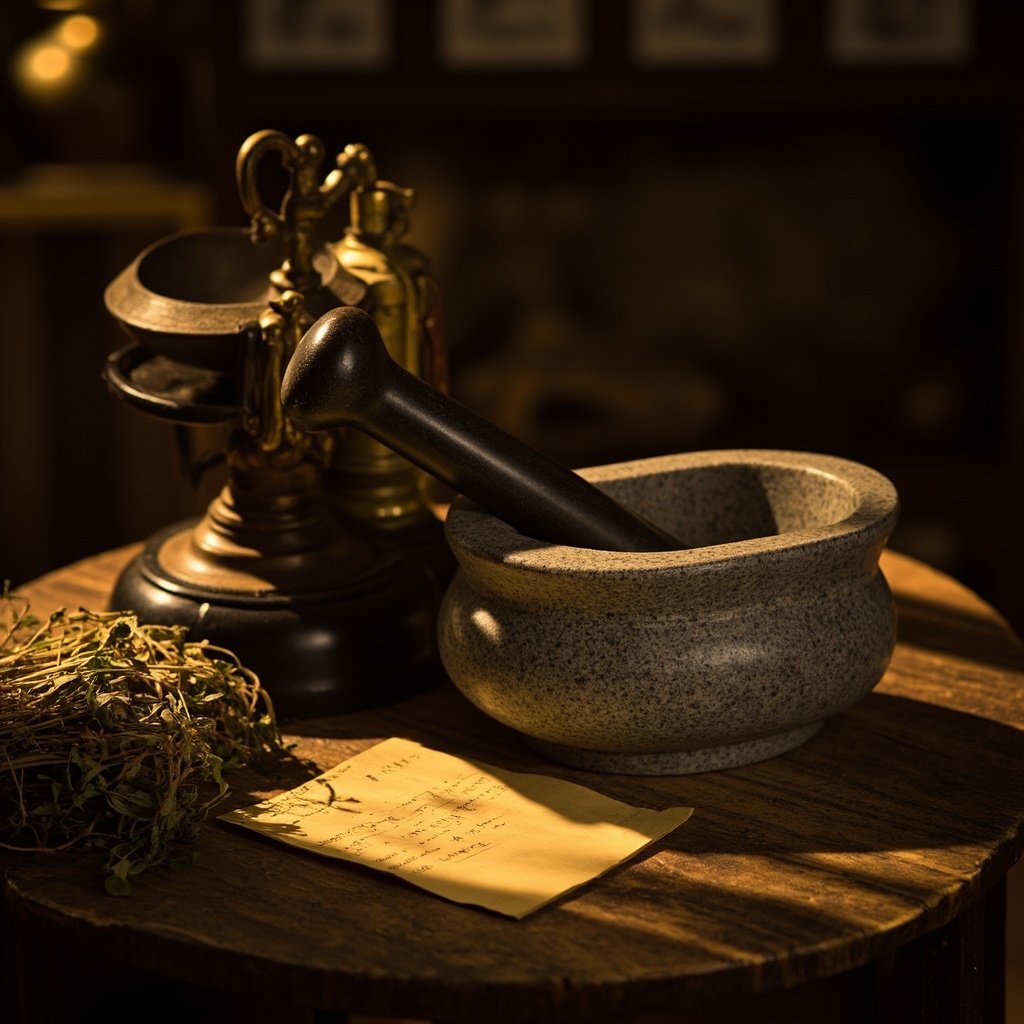
A granite or marble mortar is earth in the literal sense, the hard immovable stone associated with a foundation and with stabilising a location. A heavy stone mortar has a grounding quality that a light clay one does not, and since stone warms slowly and changes slowly it reads as a steady, non-reactive presence, the counterweight to a busy household.
Metal
A cast iron or stainless steel mortar belongs to the metal phase, associated with authority, focus, decisiveness, and circulation. Metal gathers and concentrates, so a metal mortar reads as a precision instrument rather than a nurturing vessel, which suits a study. Metal is also the phase traditionally linked with wealth, so a metal mortar is often described as an asset that stays in the household.
The Belief That Medicine Cures the Illness
The most widely held belief attached to the object is stated plainly: the medicine arrives and the illness departs. This was the promise of the herbal shop and the reason the mortar became a protective object rather than merely a useful tool. A household that kept a mortar in the medicine corner was a household with access to remedy.
Feng shui reads this as active protection. The mortar stands for long-term health and recovery, and it is tied to the family line that uses it, so a mortar passed down through a household becomes a compact with that household’s wellbeing. It must be clean, in use, and close to ordinary life, because a remedy kept out of sight is a remedy that cannot arrive in time.
Placement in the Kitchen and the Home Pharmacy
The most important placement rule for a mortar and pestle is that it belongs in a working position rather than a decorative one. Its energy is the energy of use.
- Place it on the counter near the preparation zone, not on a high shelf.
- Keep it away from the sink and the stove, where water and heat break down the material.
- Group it with practical objects such as a wooden board or a spice jar.
- Store dried herbs in sealed jars beside it so the whole reads as one station.
- Keep it out of the bathroom, where damp would be absorbed by porous clay.
For a home medicine shelf, the traditional position is a quiet, stable shelf in the living room or a study, against a solid wall and slightly raised, with the bowl facing outward. It should not sit on the floor and should not be crowded, since a visually crowded container is read as a vessel under pressure rather than one at ease.
The Stone Mortar as a Foundation and Guardian
A heavy stone mortar is sometimes used as a feng shui anchor in the manner of a weight stone, particularly on a low cabinet or in a corner that needs steadying. A mass of stone that casual contact cannot move is a symbol of a position that will not be shifted. It is worth being honest about the scale of this, however: a stone mortar is a domestic object with a domestic reach, not a substitute for a proper floor-level anchor.
The Legacy of the Traditional Apothecary
The mortar also carries the memory of a cultural world that is fading. A Chinese apothecary was a place where the walls were lined with flat drawers, each labelled by hand, and where a scale and its weights were the most valuable objects on the counter. To keep a mortar in a kitchen is to keep a small piece of that intimacy with materials alive.
Using a Mortar and Pestle in the Modern Home
Modern practice has kept the tool useful. Grinding spices releases aromatic oils more effectively than a blade, and a home herbalist can grind dried herbs into a fine powder for tea blends or poultices. Because use is what gives the object its energy, a mortar that is genuinely used will outperform an antique sealed in a cabinet. Wash and dry it promptly after use, and never soak a wooden pestle overnight, because it will crack along the grain.
A Working Summary
To summarize the method: choose the material by the element you want in the room, then place the object where daily life will actually touch it. A clay mortar for a kitchen that needs to be grounded, a stone mortar for a home that needs stability, a metal mortar for a study that needs focus. Keep it clean, keep it near what it serves, and keep it in use.