Blog
Chinese Chopstick Feng Shui Meaning: Table Manners, Prosperity and Symbol Guide

Chinese Chopstick Feng Shui Meaning: Table Manners, Prosperity and Symbol Guide
Chopsticks are among the most ordinary objects in the Chinese world, and that is exactly why their feng shui meaning is instructive. A fork and knife carry almost no symbolic charge; a pair of chopsticks does. The reason lies in the language, in the shape of the object, and in that the chopstick is one of the few daily implements that travels from the kitchen to the family table every day.
Why the Word Chopstick Sounds Like Speed and a Pair
In Mandarin the word for chopsticks is kuaizi. The first character, kuai, is a homophone of a word meaning fast or to hurry, and it is also the root of the word for joy and delight. The second character, zi, is a light suffix used for small familiar objects, as in table, bowl and pear. The sound alone therefore reads almost like a blessing: quick steps and gladness.
The second layer is number. Chopsticks are always used in twos, and two in Chinese symbolism is the number of balance, of pairs that complete each other: husband and wife, parent and child, yin and yang. A pair of chopsticks at a table is a small portable image of a household in harmony, while a single chopstick reads as imbalance and is avoided even in passing.
The Shape Language of Two Identical Sticks
Read a set of chopsticks as a feng shui form: two long, narrow, parallel shafts, mirrored, resting a hand apart on a rest or a bowl. The form is a straight line, the same line that carries qi in classical practice. Two parallel lines are stable and still, their mirrored geometry expresses the balance the whole system rests on, and their identical length expresses equality between the people at the table.
This is also why a matched set is a common gift. Giving a pair at a new home, a marriage or a business opening says, may these two travel together, may there be enough for two, may this household stay in balance.
Table Taboos: Tapping, Standing and Crossing
Most Chinese households know the rules of the chopstick table without being taught them, and those rules are also the feng shui rules of the table.
- Never tap or drum the bowl with the chopsticks. In folk custom this is the gesture of the hungry ghost, and it is read as scattering wealth and calling in restless energy.
- Never point with them, wave them at another person, or use them to fish for food in a shared dish.
Each of these is the same rule seen from a different side. The bowl is a vessel of wealth, the family table is the centre of the household, and the chopstick is the daily instrument that touches both. Tapping scatters. Standing offers the harvest away. Crossing kills the flow. A disciplined table is not etiquette for its own sake; it is a small repeated act of household order.
Materials and the Five Elements
Different chopstick materials carry different five element attributes, and the choice can be matched to a family, a season or a room.
- Hardwood such as boxwood, walnut or rosewood is dense wood with a heavier, settled energy, chosen for durability, authority and a stable centre.
- Metal, stainless or gold-toned, carries decisiveness, structure and refinement. Metal chopsticks were once a status object in the imperial household.
- Black chopsticks, lacquered wood or metal, belong to the water element and temper a room that runs hot or too fast.
Choosing the material of the everyday pair is a slow, invisible form of adjustment, and it works because the object is used daily and sits within arm reach at the centre of the home.
Where to Place Chopsticks on the Table
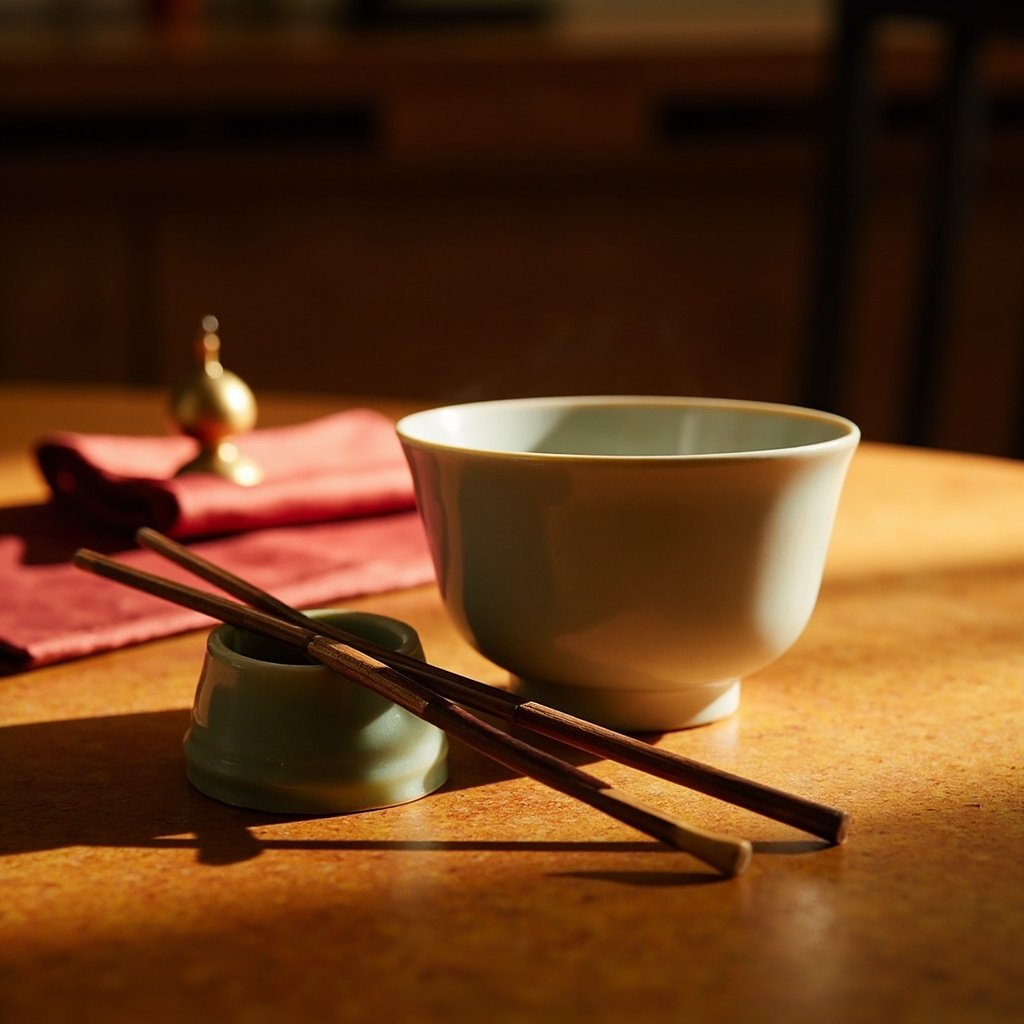
Placement carries as much meaning as material. In many households the chopstick rest sits to the right of the place setting, aligned with the bowl, so the pair lies horizontally and points neither at a person nor at the door. Chopsticks should never point directly at another person, because a directed pair reads as a demand for attention and a drain on that person reserves.
For wealth specifically, a common arrangement is to keep the best set toward the east side of the table, or in a cupboard that opens east, because east is the direction of the sun and of the primary qi entering a home. A set of bamboo or hardwood chopsticks on the east side of the dining table is a modest but consistent way to support the household wealth position. It does not replace a proper wealth corner assessment, but it is a reasonable action for anyone who eats at that table every day.
The Number of Diners and the Marriage Palace
Chinese feasts are counted in odd numbers, because two and four are associated with division and with death. The more personal rule concerns the number of chopsticks laid out for a meal. A pair for one person is correct. Laying out an extra pair, or setting a table for a number that does not match the household, is done only at funerals, where a portion is set for the one who has gone, so a practitioner arranging a home for a couple will check that no permanent place setting belongs to someone who is absent.
The marriage palace in feng shui is read from the position of the woman in the home, and the shared dining table is one of its clearest expressions. Two chopsticks used in parallel at the same table, at the same hour, day after day, is an ordinary domestic rhythm that supports the relationship. A household that eats apart, in different rooms and at different hours, weakens that same palace without ever intending to.
A Working Checklist
- Replace cracked, mismatched or warped chopsticks. A broken pair weakens the pairing symbolism more than any placement question.
- Buy matched pairs in a single material that suits the room, and avoid mixed sets of different lengths or finishes.
- Place the rest to the right of each bowl, with the pair lying flat and not aimed at a person.
- Keep the best pair toward the east side of the dining table if the intent is to support household wealth.
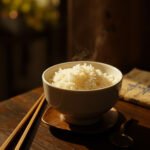
- Never stand chopsticks upright in rice, never tap the bowl, and never cross them.
- Store the set near the table rather than in a general kitchen pile, so the object stays connected to the family.
None of this is exotic. That is the point of the chopstick as a feng shui subject. It is a daily object a family touches dozens of times a day, and because the meaning lives in the word, in the symmetry of the pair, and in the discipline of the gesture, a household can correct its own luck by changing three small habits at a table.