Blog

Wenchang Pagoda Feng Shui Guide: Academic Luck and Study Success
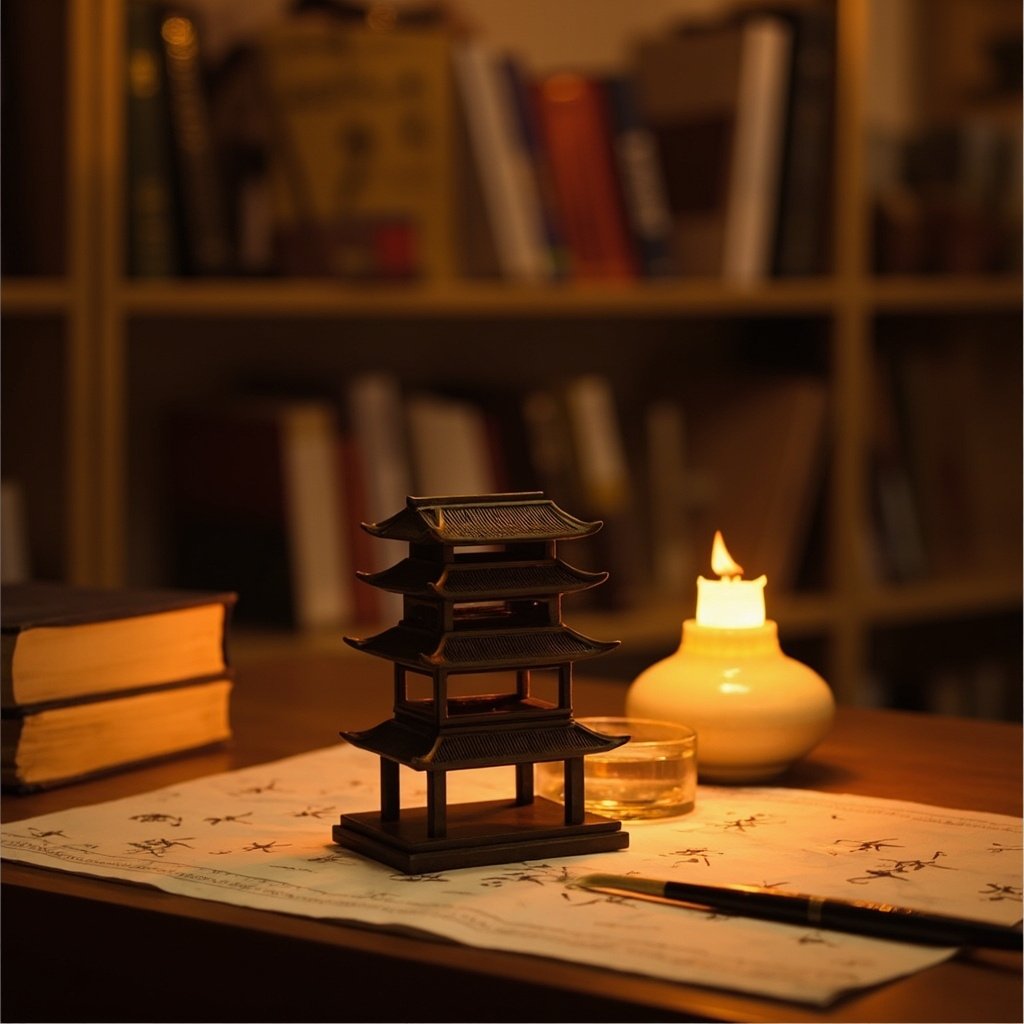
For centuries, Chinese families preparing a child for imperial examinations placed a slender seven-tiered tower on the scholar desk. That object is the Wenchang Pagoda, and it remains one of the most respected academic feng shui tools in the classical tradition. Rather than a lucky ornament, it is a precise instrument for focusing mental energy, honouring scholarship, and inviting the blessings of Wen Chang, the deity of literature and learning.
This guide explains what the pagoda represents, how its form encodes meaning, where to place it, and how to combine it with the broader feng shui of a study so that students, researchers, and professionals pursuing demanding intellectual work can approach their goals with a settled and receptive mind.
What the Wenchang Pagoda Represents
Wen Chang is the Taoist figure associated with literature, examinations, and the scholarly arts. In the older Chinese landscape, families and villages raised real stone pagodas, known as Wen Chang towers, on hillsides and near academies to honour him and to draw talent toward the community. The idea travelled well indoors: a small pagoda on a desk became a concentrated symbol of the same intention.
The tower carries a quiet logic. It rises in orderly tiers, each storey resting on the one below, and that vertical discipline mirrors the way knowledge is actually built. You do not learn a language, a theorem, or a trade in a single gesture. You stack understanding, layer by layer, until the structure holds weight. Positioned in a study, the pagoda is a daily reminder of that patient architecture.
The Meaning Behind the Tiers
Most Wenchang pagodas are carved or cast with an odd number of tiers, and the count is not decorative. Odd numbers belong to the yang principle, associated with clarity, activity, and forward movement, while the tiers themselves are read as ascending levels of achievement.
- Five tiers — a steady, balanced choice, well suited to school students building foundational study habits.
- Seven tiers — the classic scholar pagoda, traditionally favoured for major examinations and long courses of study.
- Nine tiers — the highest common form, connected with senior academic ambition, advanced degrees, and leadership in intellectual fields.
- Thirteen tiers — rare and ceremonial, echoing the grand pagodas of temples and reserved for the most ambitious undertakings.
Choose the count to match the scale of the goal rather than the size of the room. A nine-tier tower on a cramped windowsill can feel visually heavy, while a five-tier piece may seem modest beside the ambitions of a doctoral candidate. Proportion matters as much as symbolism.
Choosing the Material
Classical sources describe pagodas in crystal, jade, brass, wood, and ceramic, and the material carries its own energetic accent.
- Crystal or clear quartz amplifies and clarifies, a natural pairing for research and analytical work.
- Natural stone and jade lend steadiness and endurance, useful for long programmes of study.
- Brass or bronze carries the metal element, associated with precision, discipline, and clear boundaries.
- Wood and bamboo express the wood element, which governs growth, expansion, and the early stages of learning.
A consecrated piece, prepared through a formal blessing ritual, is a common preference among families who want the object charged with clear intent before it takes its place on the desk.
Where to Place the Wenchang Pagoda
Placement is where the practice becomes practical. The traditional reference points are straightforward, and a well-considered location will do more than an expensive object placed at random.
The study and the desk
The northeast sector is the classical position of the Wen Chang star, making it a natural home for the pagoda. If your study occupies that corner of the home, the room itself already supports the placement. Set the tower on the left side of the desk, the dragon or support side, where it accompanies your working hand without crowding your writing space. Keep it slightly behind the line of your keyboard or notebook rather than in front of your face, so it frames your effort instead of intruding on it.
Behind the seat, never at the back of the head
Avoid placing the pagoda directly behind the chair where it might read as weight pressing on the occupant. The support side of the desk is the correct zone. If the desk faces a wall, a small shelf above and to the left works well and keeps the tower at eye level when you look up to think.
One tower, one clear intention
Resist the urge to fill the desk with symbolic objects. A single well-placed pagoda, kept clean and clear of clutter, holds focus better than a crowded arrangement competing for attention. Dust it regularly. A neglected shrine of stacked papers and forgotten mugs undercuts the very clarity the object is meant to support.
Study Room Feng Shui to Support the Practice
The pagoda works within a room, not in isolation. A few sensible adjustments will let it do its job.
- Support the seat. Sit with a solid wall behind you and a view of the door, so the mind settles rather than scanning for movement.
- Lift the light. Bright, warm, steady lighting reduces eye strain and keeps the yang quality of the room high. A dim study produces dim attention.
- Remove the clutter. Let the desk hold only what the current task requires. Visual noise competes directly with concentration.
- Add a living plant. A small healthy plant in the east or southeast brings the growth of the wood element into the space.
- Quiet the electronics at night. Screens left glowing in a study disturb rest, and rest is where learning consolidates.
Families often coordinate the pagoda with the annual flying stars, adjusting the placement each year so the tower sits in the sector where the academic star is currently strong. A practitioner familiar with the cyclical charts can time this precisely.
How to Work With the Pagoda
The object is a support, not a substitute. The traditional attitude is one of honest effort met by favourable conditions. Set your intention when you first place the tower, keep the surrounding space orderly, and return to your work with the consistency the pagoda itself represents. Used this way, it becomes a stable anchor for long, ambitious projects, whether that means an entrance examination, a professional certification, or a manuscript that has waited years for your full attention.
Scholarship has always been treated in the Chinese tradition as a matter of cultivation rather than luck alone. The Wenchang Pagoda simply gives that cultivation a visible form, a small tower on the desk that says the work matters and that the climb is worth the patience it demands.