Blog

Joss Paper and Feng Shui: The Real Meaning of Chinese Spirit Money
Every spring, small fires appear on a sidewalk or in a temple courtyard: a family folding coarse paper into ingots and sending them upward as smoke. To a passer-by it looks like superstition. In Chinese metaphysics it is a technology of relationship in which the living and the dead keep exchanging value.
Joss paper, also called spirit money or paper offerings, sits where ancestor veneration, Taoist cosmology, and everyday feng shui meet. Understanding it explains why so many households keep a small shelf for the dead, and how the chi of a home is shaped by the way a family remembers its ancestors.
What Joss Paper Actually Is
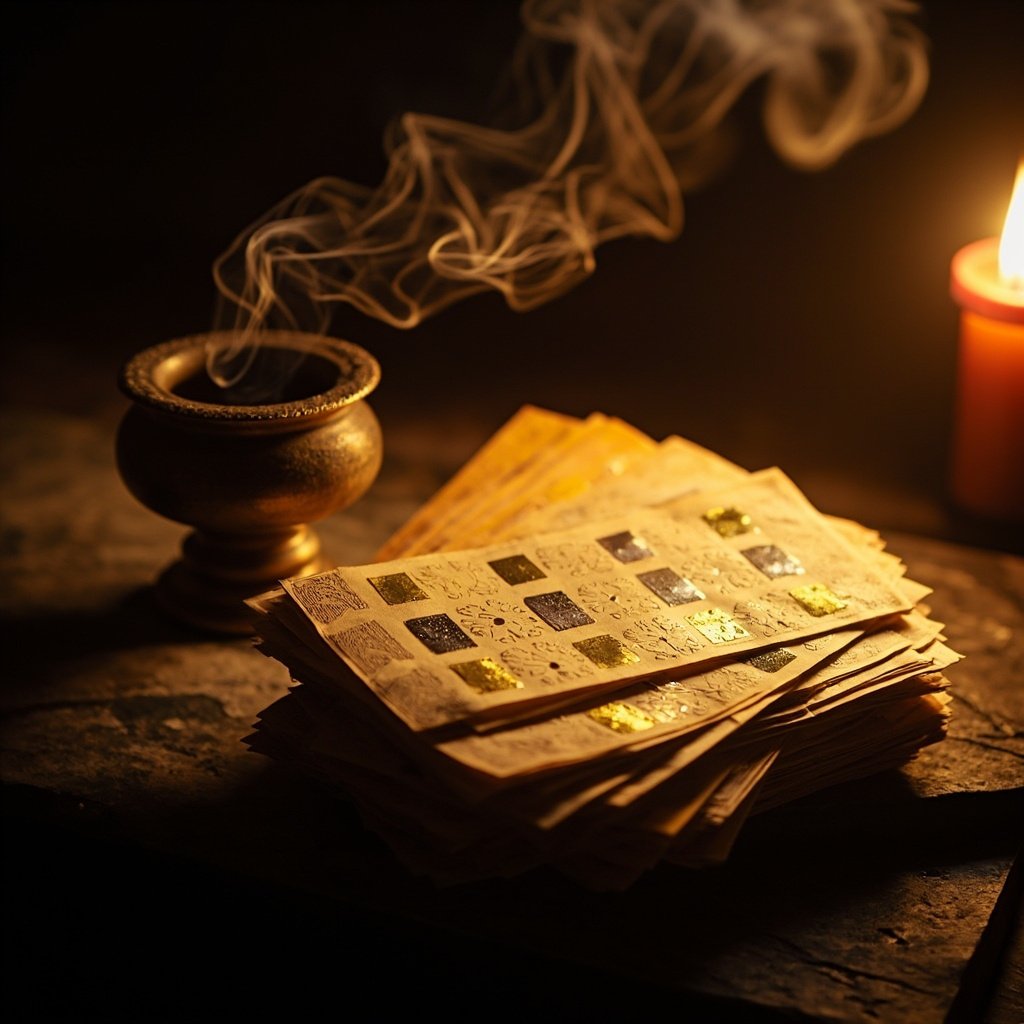
Joss paper is paper made to be burned as an offering. The sheets are printed or glued with gold and silver foil, then folded and set alight so the smoke carries the value into the unseen world. The custom is old: replicas replaced genuine objects in tombs by the Tang dynasty, and by the Ming and Qing the craft had grown elaborate, with paper houses and horses burned before the mourners.
The idea is substitution. Rather than burying a fortune in silver, a family burns a well-made imitation, trusting that intention, not material, crosses over. Every feng shui remedy works the same way: the object carries meaning, it is never the meaning.
Why Spirit Money Belongs to Feng Shui at All
Feng shui studies how chi moves through space, but classical practice never separated space from lineage: the land belongs to ancestors, and a family’s yang luck rests on the comfort of its yin root. Three principles follow.
- Ancestors remain part of the household. They are not gone, merely moved. A family that feeds them keeps a channel open.
- Neglected ancestors become restless yin. Unremembered dead are thought to press on the living: business that will not move, sleep that will not deepen.
- Offerings complete a cycle. The living received life; the dead receive attention. Break the cycle and something in the household feels unfinished, because it is.
The Main Forms of Spirit Money
Any shop selling ritual goods carries a small taxonomy. Each form has its own use, and picking the wrong one is careless rather than fatal.
- Gold and silver paper (jin zhi and yin zhi) is the foundation: rough paper with a square of foil, folded into ingots. Gold goes to deities, silver to ancestors.
- Hell bank notes are printed currencies with enormous face values. They are the most recognizable form abroad and the easiest to overdo.
- Paper ingots (yuanbao) mimic the boat-shaped silver sycee of imperial China. Folding them by hand is a family activity, and the folding counts as part of the offering.
- Paper goods extend the logic to houses, cars, clothing, phones, and laptops. The trend toward ever larger sets draws criticism even inside the tradition.
- The non-paper kit matters as much: incense, two candles, three cups of tea, fresh fruit. Paper without these feels transactional.
How Offerings Relate to Wealth Luck
Spirit money is easily read as bribery, a payment to persuade the dead to release fortune. The classical reading is closer to horticulture: a tree with watered roots fruits above ground. A family that honors its root prospers, not because the dead intervene in markets, but because gratitude changes how the living behave.
One spatial rule trips up enthusiasts. The wealth corner, usually the far left of the entry as you face in, belongs to yang: light, movement, a plant, a crystal. An ancestor shelf is yin. Putting the two together is a common mistake, and the result is a corner that feels quiet and slightly sad. Keep them in separate rooms.
Feng Shui Rules for Burning Offerings
- Burn outdoors, never inside the home. Smoke trapped indoors becomes stagnant sha, and the smell settles into fabric for weeks.
- Keep the burner off the entrance axis. The front door is the mouth of chi; you want clarity there, not an ashtray and a cloud of smoke.
- Choose a stable, clean, sheltered spot. A metal bucket with a lid is the practical standard; wind that scatters half-burnt paper is bad form and, in dry seasons, a fire risk.
- Face the direction that means something. Many families face the burial place or ancestral village; others face open sky. Either is acceptable, done deliberately rather than at random.
- Finish the process. Let the paper reduce to ash, let it cool, then dispose of it respectfully. Do not sweep it into the household bin with kitchen scraps.
Common Mistakes Families Make
- Burning in the living room because it is raining, then wondering why the flat feels heavy.
- Competitive quantity. A modest, well-folded stack beats a bonfire of banknotes; the tradition rewards attention, not volume.
- Burning while angry, drunk, or in a hurry. The state of mind is part of the offering.
- Plastic-coated papers that never fully reduce, leaving melted residue in the burner.
- Attending lavishly twice a year while the ancestor shelf collects dust the other 363 days.
Honoring Ancestors When You Cannot Burn Paper
City apartments, no-burn rules, and life abroad make open burning impractical for millions. Tradition adapts. Set a small ancestor table on a quiet wall: a photograph, three cups of fresh water replaced daily, a plate of fruit, one stick of incense, a low lamp in the evening. Keep it uncluttered; a memorial crowded with old mail is not a memorial.
Avoid placing the shelf in a bedroom, opposite a bathroom door, or behind the head of a bed. Give it a wall where the family passes daily. On Qingming, the death anniversary, and the first and fifteenth of the lunar month, offer something small and speak the names aloud. It costs little and is, by most accounts, what the dead care about.
What Joss Paper Teaches About Chi
The practice is a lesson in how feng shui works. Paper becomes smoke, smoke becomes nothing, and value moves through intention rather than matter. A household that folds ingots together once a year is rehearsing gratitude, and gratitude changes behaviour: people speak more carefully, keep the house better, stop treating the family as transactions. That shift is the adjustment.
Final Thoughts
Joss paper is not a bargain struck with the dead, nor decoration. It is the physical form of a relationship kept alive by attention. Burn it outdoors, away from the doorway, pair it with incense and water, and remember the smoke is the least important part. What carries is that someone bothered.