Blog

Chinese Paper Cutting and Feng Shui: The Meaning of Jianzhi Window Flowers
Most feng shui objects are built by adding something to a room. A crystal is placed, a mirror is hung, a plant is set in a corner. Chinese paper cutting does the opposite. A single sheet of red paper is folded, cut, and opened again, and the design appears in what has been taken away. This is why jianzhi, the folk art of cut paper, sits so comfortably inside feng shui thinking: it is a practice of subtraction, and the gap it leaves behind is the part that works.
What Jianzhi Actually Is
Jianzhi means cut paper, and the name covers two techniques. In the northern villages, women cut freehand with a small pair of scissors, turning the paper as they go, never drawing the outline first. In the south, craftsmen use a short curved knife on a waxed board, working several stacked sheets at once so that one design becomes twenty. A finished window flower trembles when a door closes; it has no frame, no backing, no weight. It is the lightest object in the house and among the most deliberate.
Why the Empty Space Is the Point
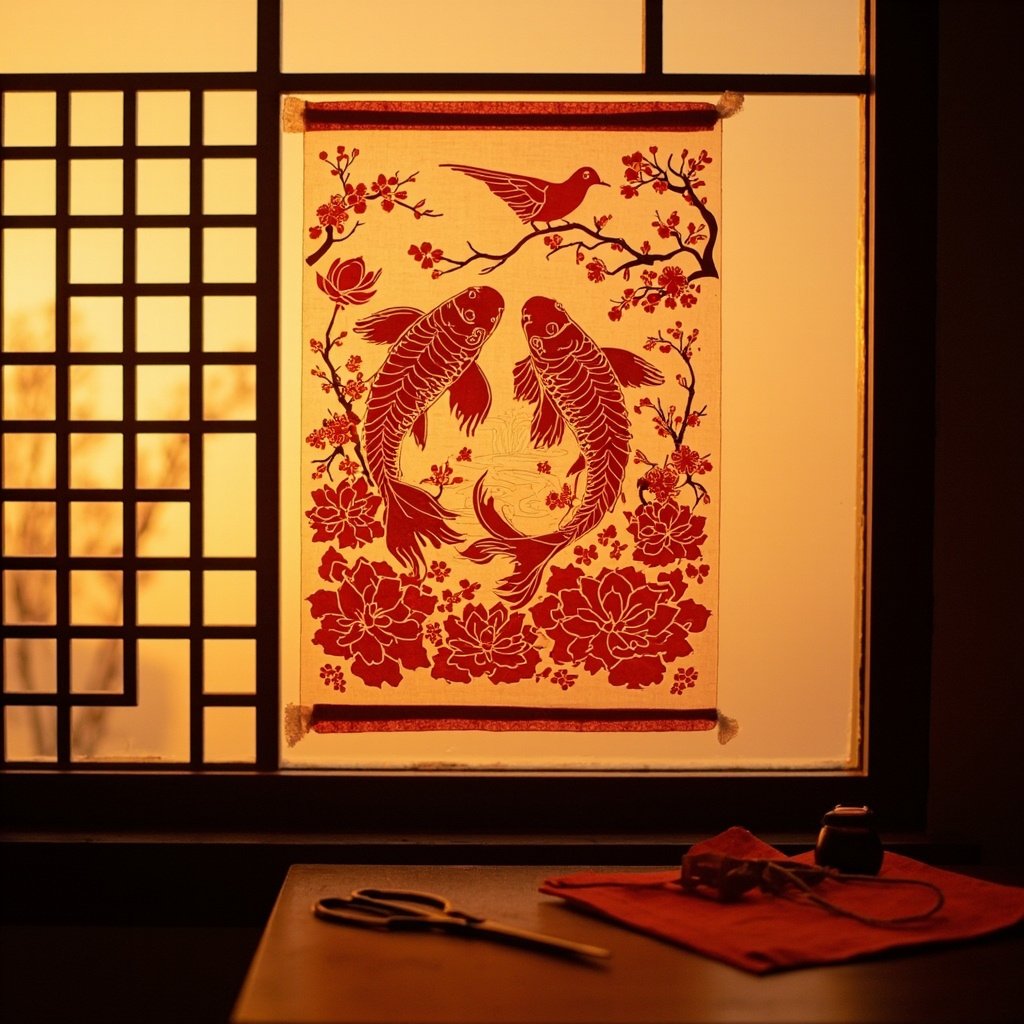
A paper cut is read against the light. Held flat on a table it looks like a red web; taped to a window it becomes a figure, a flower, a pair of fish, because the brightness behind it supplies the shape. Classical Chinese aesthetics treat emptiness this way in painting and architecture alike. A window is valuable because of the hole in the wall. The feng shui lesson is not decorative but structural: a home needs gaps, and a household that fills every surface has stopped letting anything circulate. Paper cutting makes that principle visible in a single sheet.
The Window as the Home’s Mouth
Windows are where exterior chi enters and stale air leaves, which is why traditional homes treated them as openings to be dressed rather than sealed. Window flowers were pasted on the paper lattice that covered the opening, so the design sat directly in the incoming light. The rule of orientation is simple. A cut placed on a window that faces the street greets what arrives. One on an inner or courtyard window softens light already inside. Never paste a paper cut on the window of a room you want to keep dim and still, such as a sickroom.
Reading the Pattern Language
Every motif in jianzhi is a rebus, a picture whose name sounds like a blessing. This is why the same dozen shapes recur across a thousand miles of countryside. Common readings include:
- Bat — the word for bat sounds like the word for fortune; five bats mean five blessings.
- Fish — sounds like surplus; a fish among lotus means abundance year after year.
- Peach — longevity, often paired with a pine branch for enduring health.
- Pomegranate — many seeds, many descendants, the blessing most valued on a farm.
- Magpie on plum branch — joy arriving with the first cold weather.
- Lotus and carp — purity combined with steady gain, a favourite for a home office.
Choosing a paper cut is therefore closer to choosing a sentence than a colour scheme. Decide what the household needs to repeat, then pick the motif that says it.
Symmetry, Pairs, and the Balanced Middle
The folding is not only a shortcut, it is a doctrine. A sheet folded down its centre produces an exactly mirrored design, the visual form of yin and yang in balance. Hang paper cuts in matching pairs on either side of a window, a door, or a bed frame, and align their centres on the same horizontal line. An asymmetric cut pushed to one side is a craft object, not a feng shui one. Pairs belong on the two sides of an opening; a single large round cut belongs centred above it.
Red Paper and the Question of Colour
Red is the default because it reads as yang, active, warm, waking. But jianzhi is not exclusively red, and the differences matter. Gold and yellow appear in wealth contexts. In a few northern regions, black cuts are used for mourning and never appear at a wedding. As a housewarming gift, stay with red or gold and keep the wrapping simple: the object is meant to be seen through.
Where Paper Cuts Do Not Belong
Two failure modes are common. The first is damp. Paper in a bathroom or above a stove curls, spots, and peels, and a sagging decoration reads as neglect rather than blessing. The second is damage. A torn, faded, or insect-nibbled cut is a small piece of sha chi, a visual irritation the eye keeps returning to. Do not tape over a tear or trim a frayed edge to make it fit. Take the piece down and replace it. Afternoon sun on a south window bleaches a cheap cut within a season; rotate it east or north if you want it to last.
When to Take It Down
Traditional households replace window flowers before the new year, and the reasoning holds even without the calendar. Paper carries the season it was hung in, so replacing it clears more than a pane. The sequence is short:
- Choose a dry, bright morning so the paper lifts cleanly.
- Peel the old cut slowly from one corner, working with the grain.
- Wipe the glass or lattice, then let it dry completely before anything new goes up.
- Retire the old piece respectfully. Wrapping it before discarding is enough; burning is reserved for offerings.
- Hang the replacement at the same height so the room does not shift.
Hanging a Paper Cut Today
In a modern flat, glass is everywhere and the old lattice is gone, so most people frame their cuts. Float-mount the paper against a plain off-white board so shadows show through the openings, and use acid-free mounting so it does not yellow. A cut hung inside a deep box frame loses the effect entirely, because the light can no longer pass through it. For renters who cannot touch the windows, a paper cut hung on an interior glass door or a light-coloured wall will still read, though the design will be flatter.
Final Thoughts
Chinese paper cutting asks for almost nothing: one sheet, one blade, one window. That economy explains its survival, and its fit with a tradition that has always preferred the empty part of the vessel. If you take one rule from jianzhi, let it be this one. Before adding another object to a room, ask what could be removed instead, and let the light in through the gap.