Blog

Chinese Snuff Bottle Feng Shui Meaning: The Vessel That Holds Qi
Most feng shui objects are placed once and then forgotten. A Chinese snuff bottle is different. It is small enough to sit in the palm, heavy enough to feel when you lift it, and shaped by three centuries of craftsmen who understood that a vessel is never just a container. In classical Chinese thinking, whatever holds something also governs it.
That idea gives the snuff bottle an unusually clear place in a feng shui interior. It is not a wealth charm like a money box or a protective tool like a bagua mirror, but an object about containment, personal energy, and the discipline of keeping something precious close.
What a Chinese Snuff Bottle Actually Is
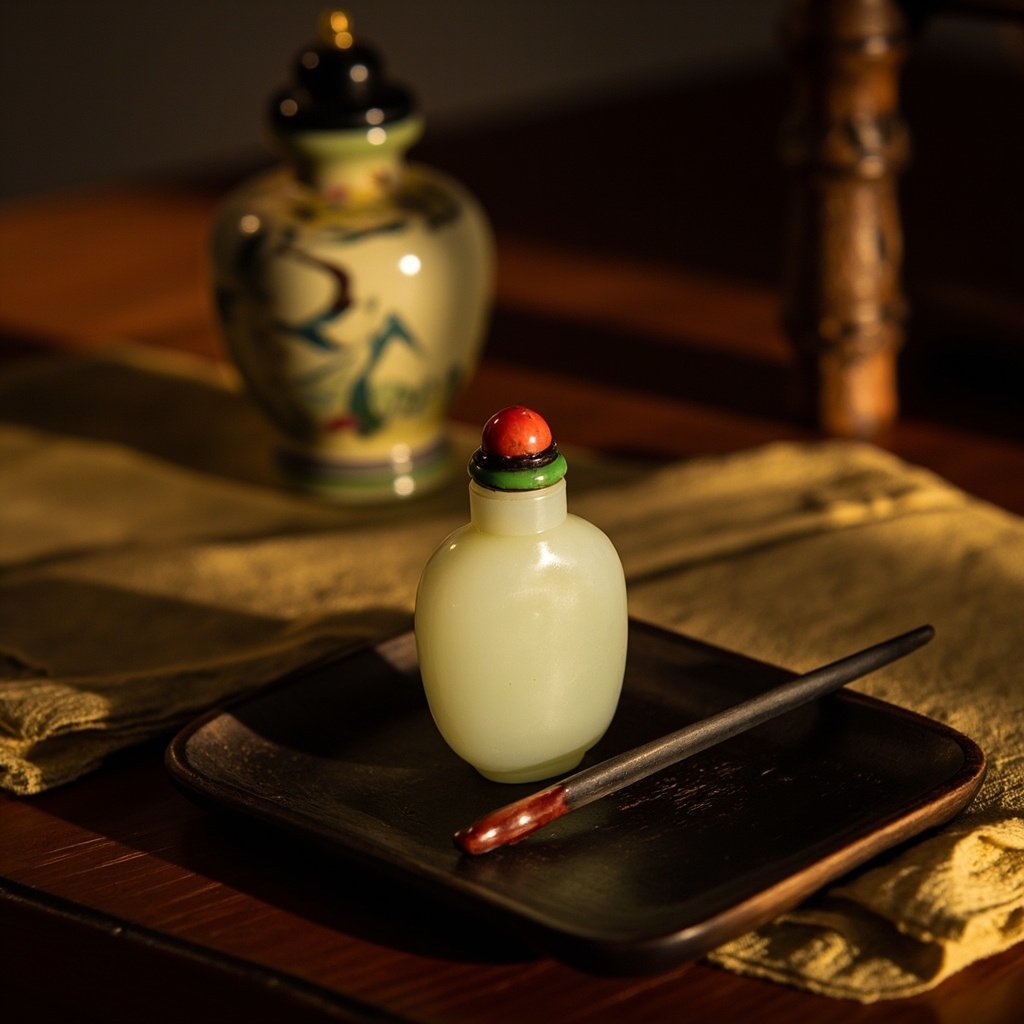
A snuff bottle is a miniature flask, usually between five and eight centimetres tall, made to hold powdered tobacco. It arrived in China during the late Ming period and became a Qing dynasty necessity. Instead of smoking, gentlemen and ladies inhaled a pinch of snuff, and the bottle that carried it became an accessory worn at the sash or carried in a sleeve.
Because the bottle was displayed in polite company, it quickly stopped being utilitarian. Craftsmen competed in porcelain, glass, jade, amber, lacquer, horn and metal. Inside-painted bottles, where an artist worked through a narrow neck with a bent brush, remain one of the most demanding miniature arts in the world. By the nineteenth century a good bottle marked a person of taste.
Why a Tiny Vessel Holds Real Feng Shui Meaning
Containment as a Form of Wealth
Feng shui treats storage vessels seriously. A jar or a box concentrates energy that would otherwise scatter, and a snuff bottle does this at the smallest possible scale. Value survives only when it is held: money that is never gathered disperses, and attention that is never focused leaks away.
Palm Contact and Personal Qi
A snuff bottle was handled constantly, warmed by the hand, passed between friends. In Chinese metaphysics, repeated contact transfers qi, so personal objects carry more weight than decorative ones. A bottle that has been carried for years is not a neutral ornament; it is a record of the person who held it.
Shape Language: Reading the Silhouette
Bottle shapes were never random. Each form carried a reading, and collectors still recognise them instantly:
- Gourd shape — the gourd sounds like the phrase for prosperity and rank, and its narrow waist is said to trap wandering energy. The strongest protective form.
- Round or spherical — associated with heaven and with smooth, unbroken fortune. Good for a central position.
- Flattened flask — the classic travelling form. It suggests mobility and safe passage, suitable near an entrance.
- Rectangular or square — an earth form. Stable, grounded, and best in a study or office where decisions are made.
- Figure-shaped — carved as a child, an animal or a deity. These carry the meaning of the figure rather than of the vessel, and should be read on their own terms.
Materials and Their Elemental Associations
Material matters more than most buyers expect. A bottle made of jade belongs to earth and carries a slow, consolidating quality. Porcelain is also earth, but fired and glazed, so it reads as earth with a metal finish: precise, clean, mentally clarifying. Glass admits light and behaves like water, which makes it suitable where a space feels stagnant. Amber and horn are organic and read as wood, supporting growth and health. Lacquer sits between wood and fire, warm and protective.
A practical rule follows from this. Choose the material for the quality you want in the room, not for the price tag. A modest porcelain bottle in a working study often does more than an expensive jade piece in a hallway nobody uses.
Snuff Bottles as Social Qi
There is a social dimension that collectors often miss. Bottles were given as gifts, compared among friends, and inherited within families. Exchanging one was an act of trust, and the object carried that history forward, which is the difference between an item bought for display and one that has moved through relationships.
If you inherit a bottle, treat it as a link rather than a decoration. Give it a proper place, keep it clean, and do not bury it in a drawer. Objects with a lineage stabilise a household because they anchor memory.
Where to Place a Collection at Home
Placement rules for a small vessel collection are stricter than for a single ornament, because numbers and grouping change the reading:
- Study or home office, north-west or north. These sectors support reflection and career movement, and a display of bottles reads as concentrated, disciplined attention.
- A lit cabinet, not a dark shelf. Glass and porcelain need light to release their quality. A closed, unlit cupboard turns a collection into stored clutter.
- Odd numbers, grouped. Three, five or seven bottles read as a composition. A single bottle standing alone looks abandoned rather than deliberate.
- Avoid the bedroom. Small dense objects with metal or glass elements disturb rest. Keep sleeping space calm and visually quiet.
- Never in a bathroom or above a toilet. Water and drainage sectors drain the meaning of any stored-qi object placed there.
- Keep the lid on and the stopper seated. An open vessel is read as a leak, and leaks in feng shui are always about loss.
Mistakes That Drain the Object
- Displaying a cracked or chipped bottle. Damage signals broken fortune. Repair it properly or store it out of sight.
- Crowding. Twenty bottles on one shelf cancel each other. A tight group of five communicates far more.
- Using it as a random container. Filling an antique bottle with modern pills or pins confuses its function and, in practice, damages it.
- Treating it as a talisman. A snuff bottle is a contemplative object. It rewards attention, not wishful thinking.
Caring for the Bottle and the Space Around It
Clean glass and porcelain with a soft dry cloth. Avoid water inside lacquer and horn, and never scrub an inside-painted bottle, since the pigment sits directly on the inner wall. Dust the shelf weekly. In feng shui, cleaning is not housekeeping but the maintenance of flow, and a dusty display undermines everything the object represents.
Conclusion
The Chinese snuff bottle is a small lesson in a large principle. Energy that is gathered can be used; energy that is scattered cannot. Whether you own one or a cabinet, the practice is the same: keep it clean, keep it lit, keep it closed, and give it a place that reflects why you keep it at all.