Blog

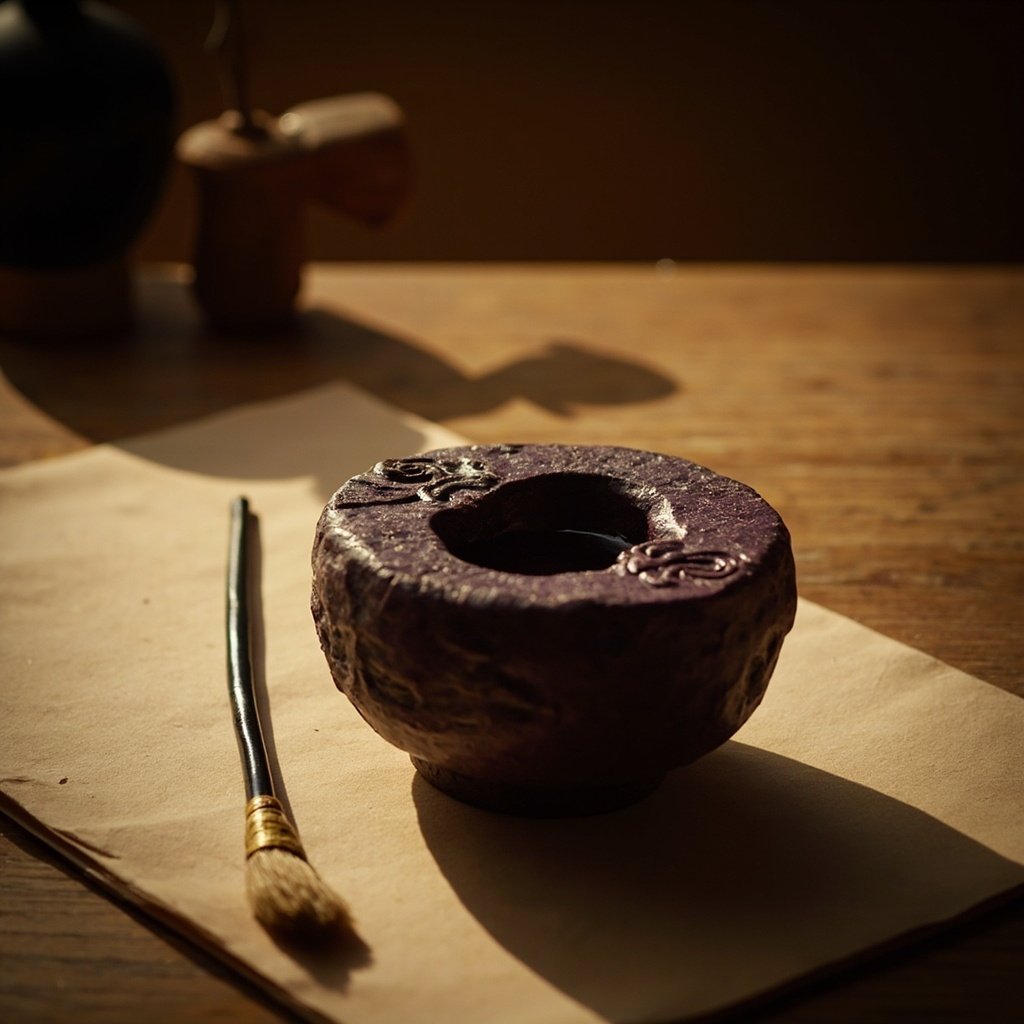
Chinese Inkstone Feng Shui Meaning: The Scholar’s Stone of Wisdom
Long before feng shui consultants spoke of study corners and desk orientation, Chinese scholars kept one object at the center of working life: the inkstone. A flat slab of fine stone with a shallow well, it held water and received the ink that carried every examination essay and every line of poetry that survived the centuries. In feng shui the inkstone is not merely an antique. It is a working tool of the water element, a compressed mountain in miniature, and one of the quietest ways to support study and career progress.
What an Inkstone Actually Is
The inkstone, known in Chinese as yantai, is the fourth of the Four Treasures of the Study: brush, ink stick, paper, and stone. Its task is grinding. A hard ink stick is pressed into a little water and worked slowly across the stone surface until the water becomes ink. A good stone grinds smoothly without grit, holds water in its well, and does not dry out too quickly between strokes. The whole apparatus is small, unglamorous, and designed to reward patience.
The finest stones are cut from specific beds: Duan stone from Guangdong, She stone from Anhui, Tao stone from Gansu. A stone used daily for decades develops a patina from ink, and collectors read that patina the way others read the wear on a jade pendant. In feng shui, provenance matters far less than condition and placement.
The Elemental Logic of Stone, Water, and Ink
Feng shui reads an object by what it is made of and what it does. An inkstone gathers three elements at once. Stone is earth, slow and compressed, the element of stability and patience. The water in its well is the element of thought, the ability to move around an obstacle instead of breaking against it. The ink is water made visible, the medium through which intention becomes record.
That combination is useful. Earth alone can be inert. Water alone can drift and scatter. An inkstone anchors water inside earth, which is exactly how good study energy should behave: fluid in thought, firm in decision. Because the object is small and dense, it accumulates rather than disperses, and it belongs in the quieter part of a room.
Why the Inkstone Matters for Literary and Career Fortune
In traditional practice, scholarship and examination luck belong to Wenchang, the literary star, and the study is read through the northeast sector. An inkstone is a natural yin object for that work: it is used in silence, it rewards repetition, and it produces a written record of effort. Households with children facing examinations kept one on the desk, not as a charm but as discipline made physical.
For adults the symbolism shifts slightly. The stone represents the ability to turn thought into something durable: a contract, a plan, a decision that survives the meeting in which it was made. Placed deliberately, it supports precision and the habit of finishing work rather than starting it. It does not manufacture luck, but it makes the conditions for careful work easier to hold.
Where to Place an Inkstone
- On the desk, toward the upper left of the working surface, where the hand naturally rests before writing. The left side is the dragon side, associated with active support.
- In the study or home office, preferably in the northeast or north sector, the conventional zones of scholarship and career.
- Away from the bedside and away from the main entrance. An inkstone is a tool of concentrated work, not of rest or of welcome.
- Never in the kitchen or the bathroom, where water already dominates and the stone becomes symbolic clutter.
One well placed stone does the job. A shelf of twenty inkstones is a collection, which belongs to the collector rather than to the practice.
Choosing a Stone That Suits You
- Condition first. A hairline crack across the grinding face ruins both stone and ink. Check the flat area under raking light.
- Weight and touch. A good stone feels cool and faintly oily, and it should be heavy for its size.
- Color with meaning. Dark purple and green stones read as water and wood. Pale grey reads as metal. Any of these work; choose the tone that matches the room.
- Scale to the desk. A block larger than the work surface reads as pressure rather than support.
- Provenance is optional. A new stone from a working workshop supports the same intention as a museum piece.
Common Misunderstandings
The most common error is treating the inkstone as decoration and buying a fragile replica that cannot hold water. A hollow ornament has no function and contributes little in a working space. The second error is a lighted display cabinet with no water at all: an inkstone without water is earth with no flow, stable but inert.
There is also a myth that an inherited stone carries the luck of the ancestor who used it. What it carries is the pattern of attention practiced on it, which is worth honoring but never a substitute for your own habits.
Caring for the Stone
Rinse the surface with clean water after use and let it dry face up, out of direct sun. Do not scrub with detergent, because the porous face absorbs it and keeps the smell of soap for years. Leave a little fresh water in the well before you leave the desk. That small habit is itself a form of practice, since the objects we keep alive are the ones that keep supporting us.
Bringing an Old Object into a Modern Practice
An inkstone is one of the few traditional feng shui objects that is still genuinely useful. You can grind ink in it, or keep it as a deliberate object: a stone that asks for silence and careful work in a room full of notifications. Used or unused, it earns its place by holding the discipline of one single task.
Frequently Asked Questions
Is an inkstone a cure for poor examination results?
No. It is a support object, not a cure. It helps a student hold a routine of study, and the routine is what changes results.
Does the inkstone have to be real stone?
Real stone is strongly preferred, because the object must be able to hold water and grind ink. A piece that cannot be used loses the functional symbolism that gives it weight.
Which direction suits an inkstone best?
Northeast is the conventional sector for scholarship, with north as a secondary choice for career. If neither exists in the room, the upper left corner of the desk is a reliable substitute.