Blog

Chinese Spear Feng Shui Meaning: The Ancestor of All Weapons
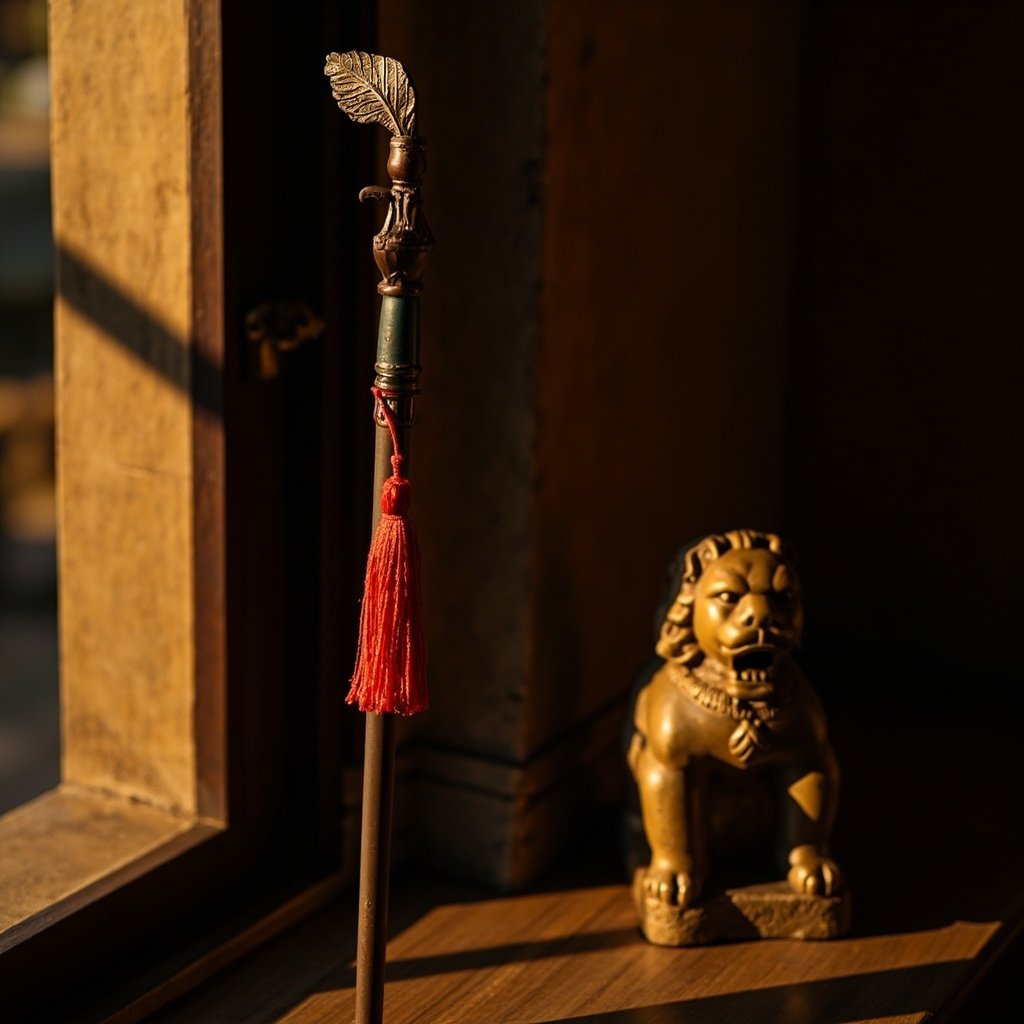
The spear occupies an unusual position in Chinese culture. It is the oldest and most fundamental of weapons, credited with a lineage running from the hunting spears of the Zhou court to the ceremonial halberds carried by imperial guards. At the same time it survives as a household object, a temple object, and a protective emblem in rural homes, where a spear on the wall was said to turn away misfortune. Understanding spear feng shui meaning requires holding both identities at once: a deadly instrument of war and a guardian of the household.
The Spear as the Ancestor of All Weapons
Classical texts describe the spear as the ancestor of the entire armory, and the principle given is mechanical: a weapon that extends the reach of the arm and concentrates force at a single point will defeat one that does neither. The spear does both. Every other weapon in the later tradition is described as a variation on what the spear had already achieved.
That is why the spear appears in the earliest records not as a soldier’s tool but as a ceremonial mark of rank. A noble holding a spear at court held a sign of authority, and the great strategists are described reading the spear as well as the sword.
The Spear and the Five Elements: A Weapon of Metal
In the five element correspondences, the spear is classified as metal, along with the sword, the axe, and the halberd. The head of the spear is the working element, and it is pure metal in the classical sense: sharp, decisive, and associated with autumn, with the west, and with the moment when things are cut away.
Metal also carries the quality of righteousness and correction. It is not a warm element. Its function in a feng shui reading is to remove what does not belong and to give an edge to what does. A metal weapon is therefore a corrective instrument rather than a nurturing one, which is why it is valued in periods of conflict and treated with more care in a household already in balance.
Jiang Taigong Here, No Taboo
One of the most widespread protective inscriptions in China is the phrase meaning “Jiang Taigong is here, nothing is taboo.” Jiang Taigong, the Jiang Ziya of history, was a strategist of the Zhou founding and became patron of fishermen, of travelers, and of people who arrive from outside. Writing the phrase on a surface, or posting it at a threshold, said that whatever crossed here would be met by a power with no restriction on it.
The custom is closely associated with weapons, and the spear appears alongside it in many regional traditions. A spear mounted behind such a sign was read as a guard posted at the gate. The two worked on different levels: the inscription named the authority, and the spear supplied the visible form of it.
The Spear in Rural Folk Warding and the Shadow Wall
In the architecture of older Chinese courtyards, there was a practical custom of placing spears, or spear-like poles fitted with iron heads, above the inner courtyard wall and on the outer gate. The purpose was largely practical, against intruders and animals. The symbolic reading grew directly out of it: a spear above a wall is a weapon pointed at everything outside, so it holds the boundary of the household and keeps the outside world from pressing in.
- Above the inner courtyard wall, where intruders and animals would climb.
- On the outer gate, at the height of a standing guard.
- Projecting from the screen wall behind the entrance, with the tips facing outward.
Placing a Spear in the Home: Orientation Rules
A weapon inside a home is a serious object, and the placement rules exist because a spear has a direction and a direction has consequences.
- The point faces inward, never outward. A spear whose head turns toward the door is read as sending the household’s own energy into the street, and as an invitation to confrontation at the threshold.
- It never points at a person. The head should face a wall, a corner, or the blank side of a cabinet. A spear aimed at a seat, a bed, or a doorway is a source of constant tension for whoever sits there.
- It never hangs over a bed. Metal suspended directly above a sleeping person is read as pressing down on health and rest. Mount it on a side wall, well above head level.
- It is never held at eye level. A weapon a person must look at daily becomes an irritation. Height and distance protect the atmosphere of the room.
Peach Wood Spears and the Dragon Subduing Rod
Not every spear in the tradition is metal. Peach wood has a special standing in Chinese protective practice, and a peach wood spear or rod is a distinct category from a metal weapon. The peach tree is associated with longevity and with warding off harmful influence, and the myth of the peach wood sword the divine healer carried to subdue the evil dragon is part of the record that gives the material its authority.
Peach wood is wood, so it carries the element of wood rather than metal: growth, expansion, and gentle upward movement rather than correction. A peach wood spear is therefore a softer instrument than a metal one. Many families kept the two separately, using metal for the sharp edge of a difficult period and peach wood for steady protection across the year.
The Spear as Guardianship and One Man at the Gate
Set against all of this, the spear has a deeply humane meaning. The expression of one man holding the pass describes exactly the posture of a spear planted in the ground by a doorway: a single point of resistance that says the way is watched and the line holds. That is the emotional core of spear feng shui meaning, more than the martial reputation.
A well-placed spear tells the household that it is defended, not by force but by the presence of something alert where the household meets the world. Placed well, it is a stabilizing presence. Placed carelessly, with the point turned toward the door or hovering above a bed, it becomes exactly what the old masters warned against: an instrument of conflict turned inward.