Blog

Fluorite Crystal Feng Shui Meaning: Purple Healing and Clear Focus
Fluorite is one of the most collected crystals in the feng shui world, partly because it is beautiful and partly because it does something unusual. It is a stone of focus. Most stones carry a single quality, but fluorite arrives in a range of colours that span the five element system, and it is valued for the clarity of mind it is said to sharpen. Its feng shui meaning also carries a caution that is rarely mentioned: this is a soft mineral, and the more it is handled, the more care it demands. This guide covers what fluorite is, how each colour reads in the element system, what the familiar cuts signify, where to place it, and how to keep it from being damaged.
Name, Chemistry and Origin
The name fluorite comes from the Latin fluor, meaning to flow, because it was one of the first minerals used in metallurgy to help ore separate in smelting. The mineral itself is calcium fluoride, written as CaF2, and it forms in hydrothermal veins, often alongside quartz, calcite, and galena. That chemistry explains both its appeal and its fragility. Fluorite has perfect octahedral cleavage, meaning it splits cleanly along planes and can be shaped with very little force, but it also fractures under impact. A specimen should never be dropped onto a hard floor.
Colour Families and Their Element Meanings
Fluorite is coloured by trace elements and by the conditions in which it forms, and each colour carries a different reading in the five element system.
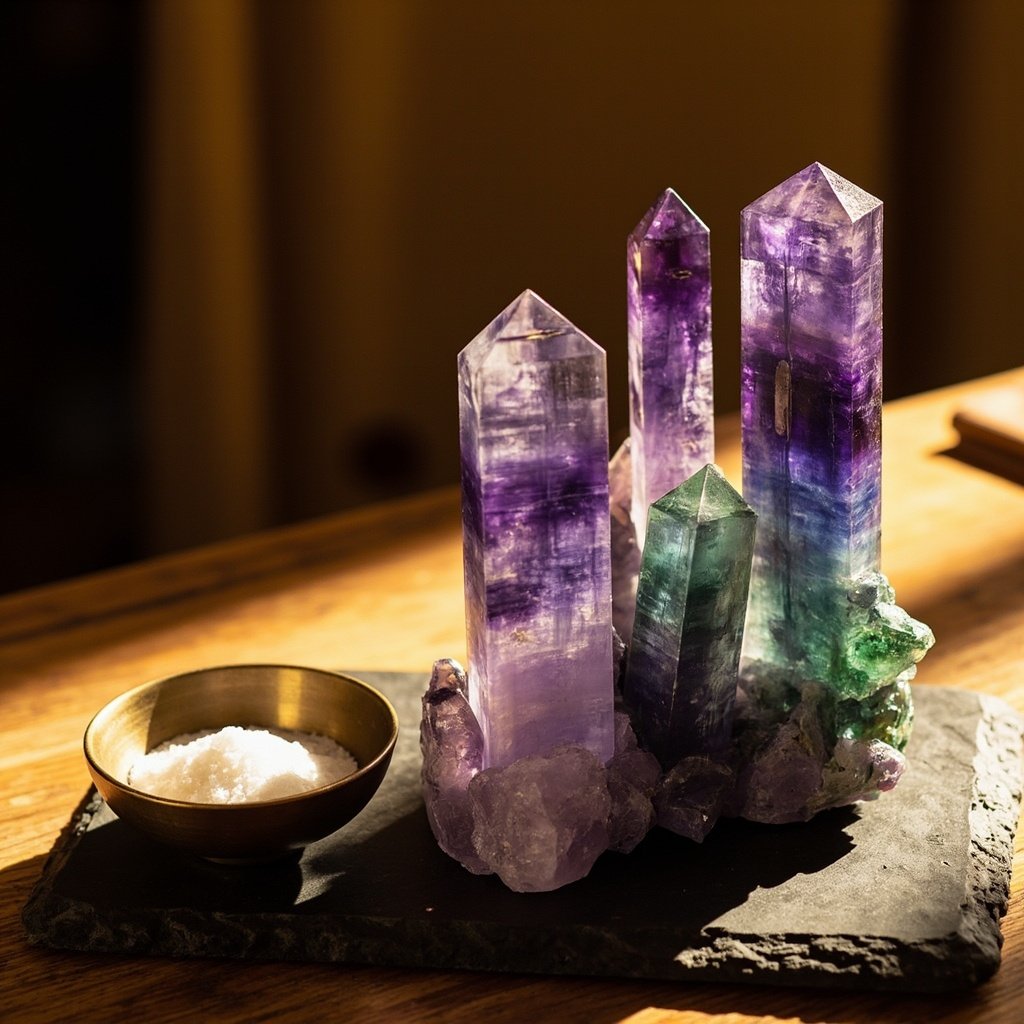
- Purple fluorite. Violet shades correspond to fire, the element of visibility, reputation, and the south. Purple was the colour of the sovereign in classical China, so this is the most authoritative of the fluorite colours.
- Green fluorite. Green belongs to wood, the element of growth, spring, and the east, and it is the colour most used to encourage development and new ventures.
- Blue fluorite. Blue corresponds to water, the element of flow, career, and the north, and is traditionally used for focus, communication, and mental clarity.
- Rainbow fluorite. Multi-coloured pieces carry bands of several colours at once and are read as a composite, placed in a centre or a transition area rather than a single sector.
Hardness: The Reason for Careful Handling
Fluorite sits at only 4 on the Mohs scale, the same rating as ordinary window glass, and it is scratched by a coin. This is the most important fact to understand before buying a piece, because it changes how the stone can be used. A chipped edge on a fluorite tower is not a damaged antique, it is a soft stone that met a hard surface. For that reason many practitioners keep fluorite in a display position rather than a carried position, and choose larger pieces with clean faces for the centre of a desk or shelf. Polishing compounds and metal tools are never used on it. Handle the base, keep it away from the edge of a desk, and store it where a sleeve cannot catch it.
Why Fluorite Is Called the Stone of Focus
The common attribution to fluorite is mental organisation. It is associated with the ability to sort, to prioritise, and to hold a single line of attention for a long stretch of work. In practical feng shui terms, it supports the kind of thinking that requires a clean desk, a clear plan, and the discipline to finish a task rather than start many. This is why blue and green fluorite are the two colours most often placed near a work area. It is also why fluorite is described as grounding rather than energising. A stone about clarity does not push a person outward the way a fire element stone does; it lets a person settle into one thing, which is exactly the quality a long piece of work asks for.
Cuts and Forms and What They Signal
Shape carries meaning in feng shui, and fluorite is commonly sold in two distinctive forms. The pyramid cut, with four triangular faces rising to a point, is directional. It focuses intention in a single direction and is traditionally placed facing a work desk, a window, or a door that leads to the part of the house you want to activate. A pyramid on a flat base gathers energy inward and upward. The cube, by contrast, is a stability form associated with grounding and holding a position, and it is placed where something should remain settled rather than move. Spheres and tumbled stones are also common: a sphere spreads energy gently in all directions, while a tumbled stone is the correct form for a pocket or a bag.
Where to Place Fluorite
Placement follows the colour and the purpose. A purple piece belongs in a south-facing sector or on a desk where your work needs to be noticed, since fire governs visibility and reputation. A green piece suits the east or southeast, the wood directions, and supports a new business, a study programme, or a project that is still growing. A blue piece fits the north or a personal work corner, where water governs career flow and clear communication. A rainbow piece works well as a centre piece in a living room or on a shelf where several people pass. Regardless of colour, keep fluorite out of prolonged direct sunlight, since heat can fade the colour and a sunlit sill is the fastest way to dull a purple piece.
Cleansing and Care Without Damage
Care for fluorite is a short list because the stone is fragile in two specific ways.
- Never use an ultrasonic cleaner. The vibration can fracture a specimen along its cleavage planes and separate a composite piece from its base.
- Never soak the stone in water. Fluorite can absorb moisture along those same planes, and a submerged piece may come out with a dull, patchy surface.
- Clean with a soft dry cloth. Use a barely damp cloth only if there is visible dust, and dry the piece immediately.
- Keep it away from perfumes, cleaners, and skin oils. These dull the polish over time.
Store a polished piece in a soft cloth pouch or a padded box. Placed where that quality is actually needed, fluorite is one of the most practical stones a serious practice can own. It takes a scattered mind and gives it a shape, and it earns its place in a working interior faster than any louder stone.