Blog

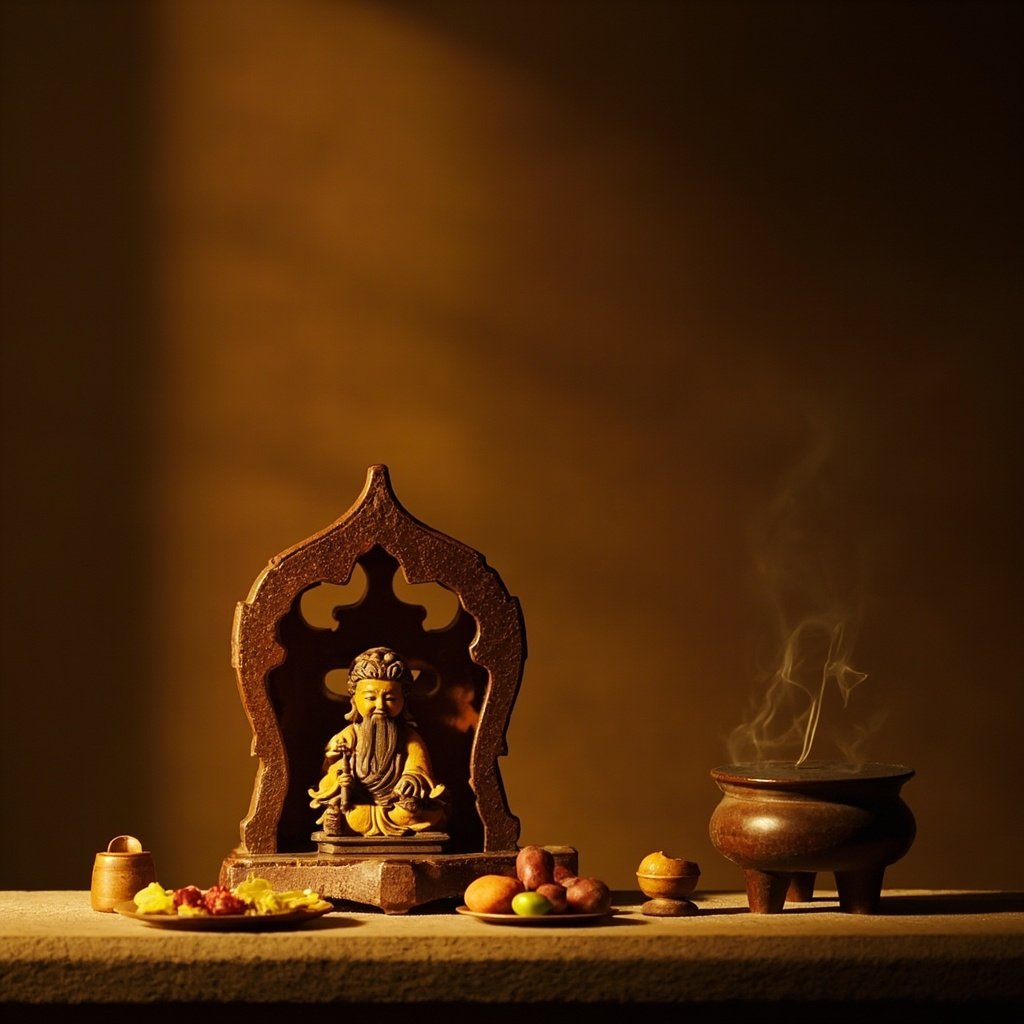
Earth God Feng Shui Meaning: The Tu Di Gong Guide
The Earth God is the least spectacular and possibly the most useful of the local deities, because he is never asked to do anything grand. He is installed at the edge of a settlement, a crossroads or a well, given a modest offering, and left to hold the ground while larger forces are asked for favours.
This guide covers who the Earth God is, where shrines were traditionally built, the offerings and rituals that were expected, the relationship between the deity and land, burial and construction, and how a modern household or shop can set up a place for him without copying the old customs badly.
Two Offices: the Local Guardian and the Great Earth
He appears in Chinese tradition under several names and in two related offices. As the local Earth God, usually titled Fude Zhengshen, he guards a specific patch of ground: a village, a street, a district, sometimes a single courtyard. He is the one asked about permissions, boundaries and the mood of a place.
As the great earth deity, Houtu, he is a cosmic figure associated with the element earth itself and with the principle of carrying and nourishing. That distinction matters: the local Earth God is a function within a community, while Houtu is one of the great powers of the five elements, standing at the centre with the other four.
Where Earth God Shrines Were Built
Shrines were placed where the ground changed status, which is why they are often found in places that look accidental today.
- At the village entrance, on the outgoing side, where cultivated land ends and the settlement begins.
- At a street corner or crossroads, where a route leaves the built area and enters open country.
- Under a large tree, which in many villages was the meeting point before it was ever the shrine.
- Beside a well, spring or culvert, because that is where the ground is believed to give its water.
- At the edge of a market or temple yard, in a niche that is present but set aside.
The common principle is threshold. The deity holds the seam between two kinds of ground, and a boundary can only be watched from the place where it changes.
Incense, Wine and the Offerings That Are Expected
The offerings are deliberately modest, because the request is small and the local god is close at hand.
- Five cups of wine, poured in a formal sequence, the traditional number matching a five element set of offerings.
- Tea, which in many districts replaced wine and served exactly the same function.
- Fruit and sweets, offered in odd numbers and removed before they spoil.
- Rice and a bowl of cooked rice for households asking for one specific favour.
- Incense, one or three sticks, lit and allowed to burn out rather than being stubbed out.
The bow is brief and the request is specific. Vague or repeated asking is considered poor manners, and the god of the ground does not like to be doubted, or doubted twice.
Land, Burial and the Ground That Is Asked First
The connection between the Earth God and the ground is literal. Before land was broken for building, for a grave or for a well, the ground was asked for. That is the origin of honouring the earth before work begins, and it is still visible in the ceremony at the start of a major construction project, where an offering is made before the first dig.
For burials, the same deity holds the boundary between the household of the living and the place where the dead are laid. A small offering at the grave is treated less as feeding the dead than as maintaining the relationship with the ground that now holds them. The logic is the same in both cases: the ground is a party to the agreement, not a surface.
Earth Element and the Stability of a House
In five element terms the Earth God is earth at its most settled: the element of the square, of the centre, of yellow and of the steady harvest. An earth deity in a home reinforces the ground itself, and with it the sense of permanence and of a foundation other things can be built on.
This is why the Earth God is rarely the deity of ambition. He is the deity of the arrangement that makes ambition possible: a house that is stable and a family that stays in one place long enough to accumulate anything. A home with a strong earth element can afford to be patient; one without it tends to move on and lose what it gathered.
Modern Home and Shop Placement
In a house, the traditional position for a household shrine is the southern wall, low and close to the ground, because the south is the direction of the earth element and because a low shrine does not compete with the living. It is placed where it can be seen on entering, never in the position of honour.
In a shop, the position is usually the financial position of the shop, with the offering table set low and to one side so that it does not block customer flow or face the door. Two rules are consistent in both cases: the shrine should not face a toilet, and it should not stand where the ground is a main passage.
How the Cult Changed in the City
The deity has changed form as the country has changed. The roadside shrine with its little stone shelter has given way to a tablet on a shelf, a small wooden cabinet, or a printed image in a frame. The offerings have shortened, and in many households one person tends the shrine on a fixed date rather than the family.
What has not changed is the logic of the request. The urban Earth God is asked for the same things the village Earth God was asked for: that the building be sound, that the neighbourhood be peaceful, that the business have fair custom, and that the family be left in peace to work.
Kept in this way, the Earth God is not superstition so much as an acknowledgement of what a piece of ground obliges you to. Setting aside a small place for the deity of the ground records that dependence, and asks for the one thing a well-run house can never manufacture for itself: a stable ground to stand on.