Blog

Umbrella Feng Shui: Rain Protection, Home Shielding and Symbol Guide
The umbrella occupies an unusual position among feng shui symbols. Most auspicious objects were chosen for what they resemble: the dragon for authority, the peony for wealth, the lotus for purity. An umbrella was chosen for what it does. It is a portable roof, a moving shelter, a tool that stands between a person and the harshness of the sky, and practitioners still work with it today.
The Character and the Form
The Chinese word for umbrella, san, is written with the character for number three on top and the character for plant or growth below. The upper component is an ancient pictogram of a small parasol or tent, and the lower component was added later for sound and sense. Read as a picture rather than a definition, the character shows a canopy sheltering something living underneath it: a roof over growth.
The physical form says the same thing. A traditional oiled-paper umbrella has a central shaft, radiating ribs, and a curved dome above. Seen in section it is a canopy, a mountain form, a roof. It is a miniature piece of architecture that anyone can carry, which is why the umbrella translates so directly into feng shui language: it is shelter made portable, and shelter is the most fundamental protective function of a home.
Shelter, Cover and the Idea of Protection
Form-based feng shui reads a curved overhead covering as a protective form. The symbolism is straightforward: what is under the canopy is protected, what is outside the canopy is exposed. This is why a dark umbrella carried during travel is treated as a counter to the open exposure of a road, a station, or a crowded threshold. It does not remove the journey, but it reframes the person as covered rather than exposed.
The Old Custom of Opening an Umbrella for Cleansing
There is a folk practice that appears in older texts and survives mainly in regional custom: opening an umbrella in a specific place and waving it, or holding it open while something is carried beneath it, to sweep away harmful influence. The umbrella is treated as a boundary that can be opened and closed deliberately. To open it is to draw a circle of shelter around what stands beneath it; to close it and shake it out is to disperse what was gathered.
Practitioners who still work this way describe it as a form of clearing rather than a charm. Other traditions use a long-handled umbrella to brush light over a person or a room in a single downward pass, much as a smoke brush would be used. It is worth separating the custom from the popular image of an umbrella held over a ghost to trap it: the working practice is drawing a boundary, gathering, and releasing.
Where an Umbrella May and May Not Be Placed
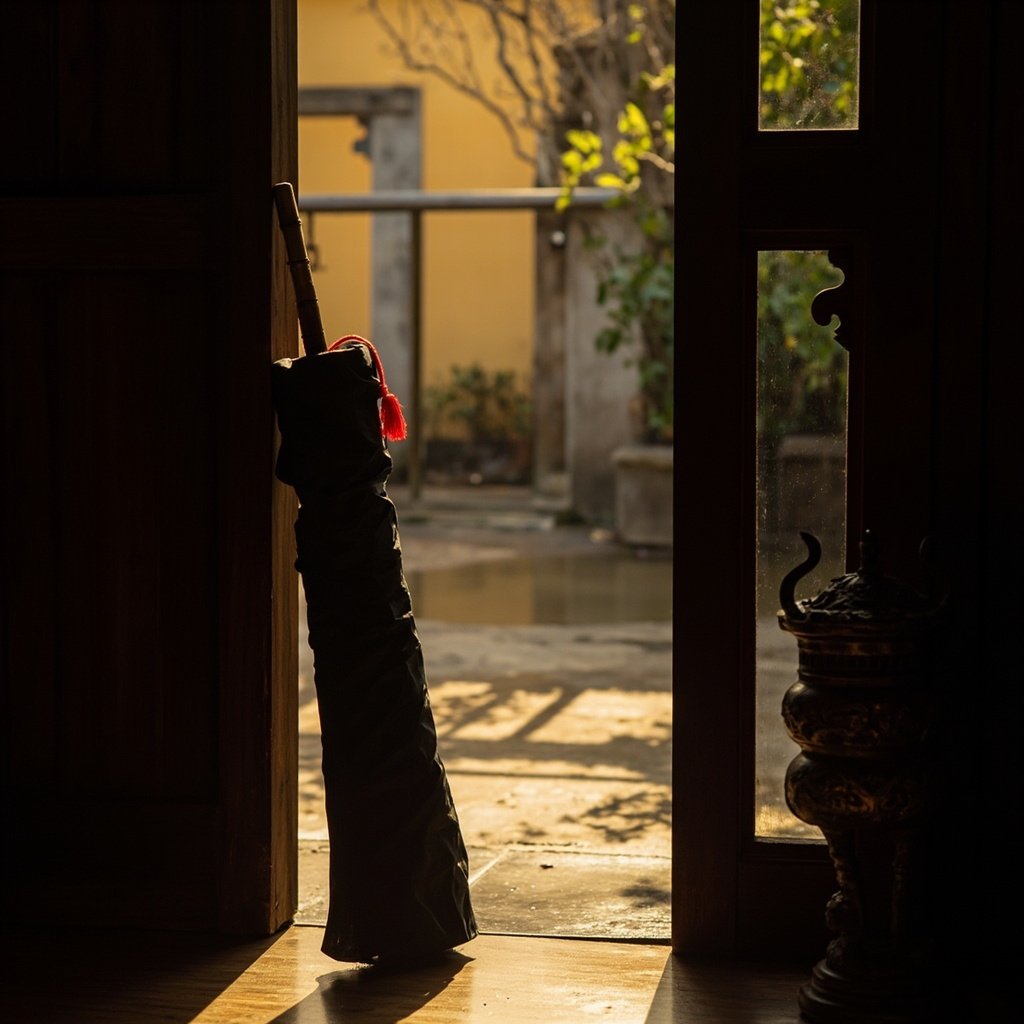
This part of the subject most often produces a wrong decision, so it is worth stating clearly. The classic prescription is that an umbrella should not be left standing open, or leaning so that it faces the front door permanently.
- Do keep a closed umbrella in a designated stand, ideally in an entrance cabinet, a side corner, or a basket against the wall away from the door swing.
- Do wipe the umbrella and dry it before storing it. A wet canopy left folded is a magnet for damp qi, the kind of slow stagnation the cleaning rules are meant to prevent.
The principle is simple. A protective object placed at the threshold becomes an obstruction. Protection works when it is held, worn, or set aside in a defined place, not when it is left standing in the mouth of the house.
Colour and the Five Elements
Because the umbrella is a large, highly visible, movable surface, colour is unusually effective with it.
- Black belongs to water. The classic choice for travel, for a north-facing journey, and for a household that runs hot, dry, or too fast.
- Red belongs to fire. It raises the energy and improves confidence, and suits an important meeting or a journey that needs warmth and visibility.
- Yellow and brown belong to earth. These are the colours for stability, for grounding a restless household or a scattered individual.
White aside, a coloured canopy has one more practical virtue: it is visible across a street, which is itself a form of protection. A person who can be seen is a person who is not approached from an angle of surprise.
Carrying an Umbrella as Everyday Practice
Most readers will use the umbrella the way most people use it, and that is already a feng shui action if it is done deliberately. Opening it at a threshold, walking under it, and closing it once you are inside is a small ritual of containment that can be repeated without thought. And dry the canopy before folding it, because wet fabric folded into a dark drawer is the classic example of a protective object turned stagnant by careless storage.
Umbrellas Inside the Home
Placed well, the umbrella is a good object to keep in an entrance area, because it records daily movement and therefore the flow of the household. It also has a practical advantage in humid climates, where a wet canopy brought indoors is a genuine risk to the rest of the home. A ventilated stand near the door, with a drip tray, aligns with the feng shui rule of not letting damp accumulate at the threshold.
For a residence, the general principle is that protection belongs in the hands of the people, not in the doorway. For a shop, a traditional alternative is to hang a broad, dark canopy over the entrance as an awning, where the shelter function is inverted: instead of blocking the door, the canopy extends the covered space of the shop outward and draws people in beneath it. That is the difference between an umbrella that obstructs and an umbrella that welcomes, and it is decided entirely by placement.
A Working Checklist
- Choose a canopy colour that matches the element you need: black for water, red for fire, green for wood, white or silver for metal, yellow and brown for earth.
- Keep every umbrella closed and stored in a fixed place away from the line of the main door.
- Never leave an open umbrella facing the entrance, and never let the handle point inward at the threshold.
- Dry the canopy fully before folding it, and clear it of debris rather than shaking it indoors.
- Open the umbrella only outside, and use it as a deliberate boundary when you need to feel contained.
- In a shop or covered courtyard, extend the canopy outward as a shelter that invites, rather than inward as a screen that blocks.
The umbrella is a modest symbol, and that is what makes it useful. It works through an accurate idea: that shelter is a form of protection, that a boundary can be drawn deliberately, and that the same shape which protects you can also obstruct you if it is put in the wrong place.