Blog

Fly Whisk Feng Shui Meaning: The Taoist Purification Tool
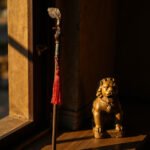
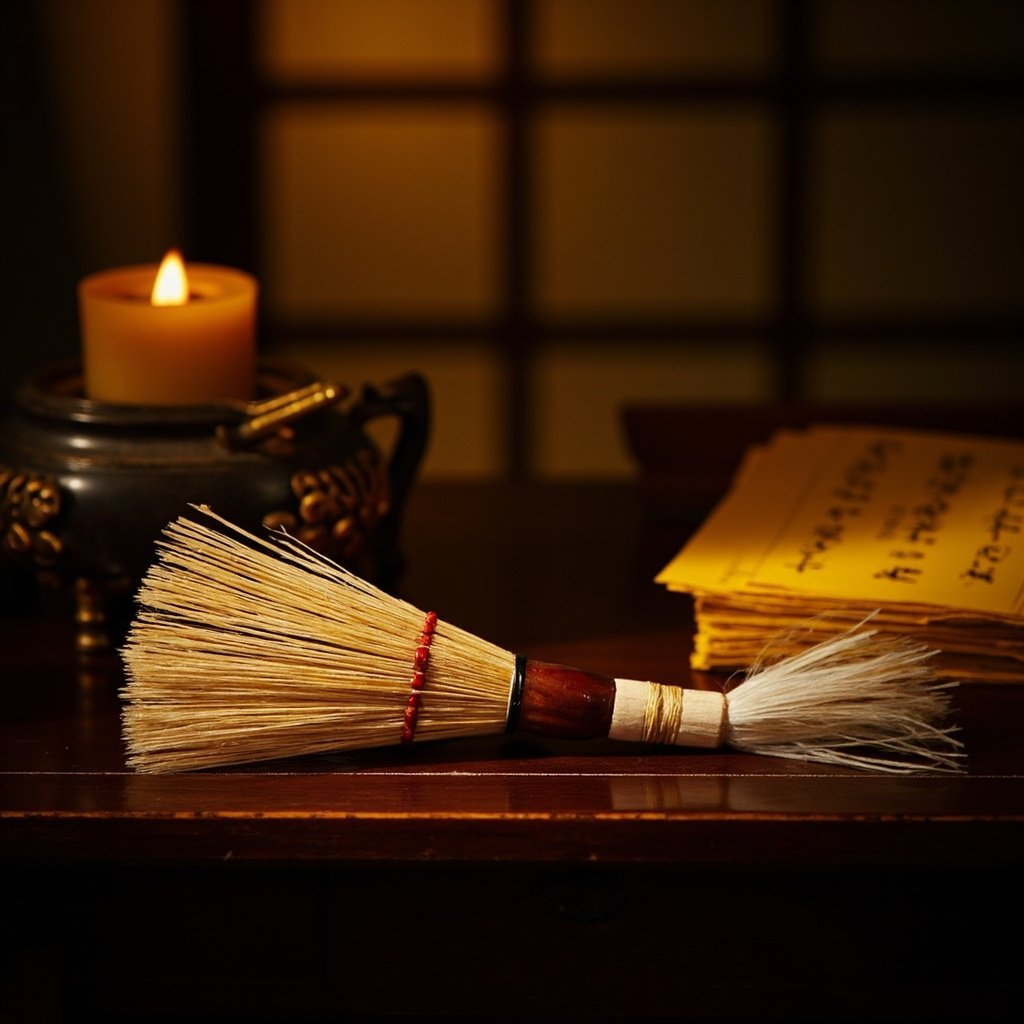
The fly whisk is one of the most visually distinctive objects in the Taoist tradition, and in a Western interior it is often mistaken for a decorative feather duster. It is not. A fly whisk, known in Chinese as a fu chen, is a ritual implement held by a priest during a ceremony, and its feng shui meaning is precise: it removes what should not remain, in a form that visibly sweeps.
Where the Fly Whisk Comes From
The character fu means to brush or to dust, and chen denotes a tuft of hair or the tail of an animal. A fu chen is, in plain terms, a duster, and the Taoist usage is an elevation of the ordinary rather than an invention from nothing.
In the classical worldview, dust is not only dirt. Settled dust is the visible sign of stale qi, of accumulated fatigue, of a place left alone too long. To brush the dust away is to brush away what has gathered without intention. The fly whisk takes that household gesture and makes it deliberate, performed with awareness over a person, a room, or a threshold rather than over a floor.
Taoist ritual manuals list the fly whisk among the standard implements of the priestly kit, alongside the sword, the seal, and the ritual tablet. In ceremony it is held in the left hand and used to draw boundaries in the air, to gesture a protective arc around a person or an object, and to signal the opening and closing of a rite.
The Horsehair and the Five Phase Elements
The traditional fly whisk has a handle of hardwood, bamboo, or bone, and the tuft is usually horsehair. The classic teaching of the five phases assigns the horse to fire, which is why horsehair suits the instrument: fire relates to light, visibility, and the south, and it burns away what is stale.
- White horsehair. The highest grade, associated with the white tiger of the west and with the clarity of metal.
- Black horsehair. The common choice, associated with the black tortoise of the north and with water, used when a rite calls for depth and containment.
- Rat-tail or squirrel tail. The most prized material in serious practice, dense, springy, and long lasting.
- Modern synthetic blends. Acceptable for daily home use. They shed less and clean more easily, and the symbolism rests on the gesture rather than on the fiber.
The handle also carries element weight. Sandalwood and rosewood are wood and therefore growth and warmth; a black handle suggests water and depth. If you are choosing a fly whisk for feng shui use rather than for collection, the tuft matters most.
Household Dusting as a Folk Practice
Long before Taoist formalization, Chinese households had their own cleansing customs. Before the lunar new year, the house was swept from the inside out, clearing away the accumulated bad luck of the departing year. Traditional cleaning also included beating dust out of quilts and mats on the threshold, and in many regions dust was swept toward the doorway rather than away from it, so that unwanted energy would leave with the sweep.
The fly whisk inherits this logic and makes it more precise. Where a broom moves floor dust, a fly whisk moves qi. Where a broom is a chore performed once a year, a fly whisk is a short, specific act of attention.
Using the Fly Whisk in a Home
A fly whisk is not a permanent arrangement in a residence. It is a tool, and the tool works by being used.
- Purification before a new beginning. Before a housewarming, the opening of a shop, or the first day in a new office, the space is swept with the fly whisk in the four cardinal directions and then toward the door, so that what is swept out leaves rather than circulates.
- Around the person. In a rite for an individual, the fly whisk is drawn over the shoulders and around the body from a respectful distance, never touching, clearing what has adhered to the aura.
- Above the main threshold. The entrance is the most active boundary in a building, and sweeping there has an outsized effect on how the space receives energy.
- Over an object of value. When a new talisman or inherited object is brought into a home, it is swept once before being placed, clearing the influence of the journey and of whoever handled it.
For a family that is not ceremonial, the same principle works in an ordinary way. Sweep the front door, the four corners of the main room, and the door of the family business on the first day of the lunar year, then put the whisk away. That small act replaces the heavier new year cleaning ritual with something more focused.
Placement Rules
If a fly whisk is displayed rather than used, it must be placed with care, because a ritual implement left carelessly can work in the opposite direction from what it is meant to do.
- Never hang it in a bedroom. It belongs to the temple or the hall, not the sleeping chamber, and it should not hang above a pillow.
- Do not suspend it with the tuft pointing at the front door, which reads as sweeping the good energy out of the house.
- Do not leave it lying on the floor or on a low table, where it can be stepped on.
- Keep it in a clean case or on a high shelf, away from damp, with the tuft pointing downward when not in use.
For a business, a well made fly whisk displayed in the reception area says that the people here care about the condition of things. Visitors read it as restraint and order rather than as superstition.
Symbolism of Avoiding Impurity and Welcoming Auspiciousness
At the level of meaning, the fly whisk stands for three ideas. The first is removal: every space accumulates things that need clearing, and clearing them is a normal, responsible act rather than a sign of bad luck. The second is discernment: to sweep is to know what does not belong, which is a form of honest assessment.
The third is welcome. Because the sweep at a doorway is performed so that auspicious qi may enter, the tool is not only a device for sending bad energy away. It is the instrument that opens a door in the right direction, and that is why it appears at the start of ceremonies rather than at the end.
Care and Handling
- Store the tuft in a breathable bag, never pressed flat, and keep it away from direct heat.
- Wash a natural hair tuft sparingly, with cool water and a little mild soap, and dry it in shade.
- Replace a tuft that has gone brittle and sparse, since a limp whisk performs no sweep at all.
- Keep the object off surfaces where food is prepared.
The fly whisk rewards a household that treats clearing as a discipline rather than a reaction. The tradition built a beautiful tool for the moment when a person decides to sweep out the stale and let something better come in.