Blog

Fish Tank Feng Shui Placement: How to Work With the Water Element in Your Home
An aquarium is one of the most popular objects in modern feng shui and one of the most frequently misplaced. People buy the tank for its looks, place it wherever the hose reaches, and expect the water to do work it was never positioned to do. A tank of water is a genuine feng shui instrument because it holds, circulates, and renews the water element in a space, but it works only where its position allows it. This guide sets out the placement rules, the counting and colour conventions, and adjustments for small flats.
Live Water and Its Comparison With a Fountain
In classical feng shui the water element is the element of flow, communication, wealth, and the movement of qi. Water that stands still is said to stagnate, and turbid water carries disorder. The fountain and the aquarium are not interchangeable.
A feng shui fountain is placed to spray upward and to make noise, because its function is to raise and disperse qi. An aquarium does something different. The water moves in a closed loop, the fish are alive within it, and the container is a defined field that gathers energy rather than dispersing it. The aquarium is the stronger instrument where a specific place must be strengthened, and the fountain the general one for keeping a room moving.
The Placement Rules That Matter Most
Position is decided by what the water is being asked to do. The restrictions below are traditional rather than decorative, and each has a reason.
- Do not place it in a southeast corner, traditionally the source of household quarrels.
- Do not place it in a bathroom, where water doubles an already excessive element.
- Do not place it opposite the foot of the bed, where circulating water disturbs sleep.
- Do not hang it above a wealth point, since falling water over stored value is read as a leak.
- Do not place it in line with the front door, so arriving energy rushes in and is carried out.
- Do not place it beneath a window seat, where the tank blocks light.
The principle behind most of these is that water should circulate inward through the room, gathering energy on its way, and never be placed where it drains away from the house. A tank in a corner, off to the side of a doorway, receives arriving qi and draws it into the room rather than sending it back out. A tank near the entrance circulates qi deeper into the space, a tank along an internal wall gathers qi that would otherwise drift, and a tank in the middle of a large room becomes a centre that stops the space feeling scattered. Height matters too: a low tank keeps the energy near the floor.
Round Tanks and Square Tanks
The shape of the container is read as part of the arrangement rather than as a matter of taste. A round tank is circular, and the circle is associated with the movement of qi and with completion, so a round vessel circulates energy evenly in every direction. It suits smoothing the flow of a room or softening a harsh corner.
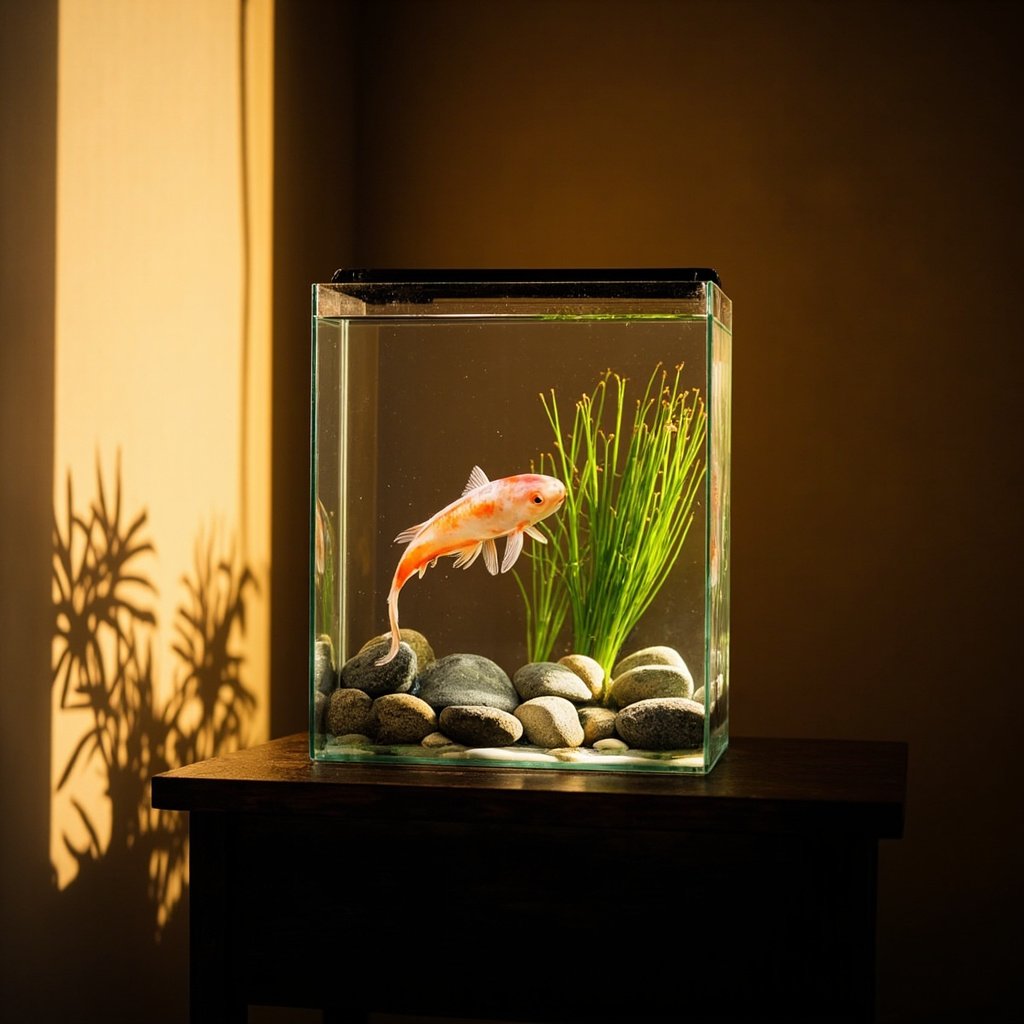
A square or rectangular tank has flat sides and clear corners, so it is read as containing energy in a defined area. It is the form preferred when the intention is to strengthen a specific point, and it fits the geometry of a wall and a corner far more naturally than a round one. Some classical texts also give the square tank a metal-like character, which links it to the metal phase and therefore to wealth. In practice, a square tank on a stable cabinet in a living room corner is the most defensible arrangement.
How Many Fish and Which Ones
The Number of Fish
Numbers carry meaning here because they carry meaning in Chinese culture generally. Nine is the highest single digit, it is associated with heaven in the classical cosmology, and it is the count most often recommended for an aquarium. Even numbers are avoided, because they read as pairs, and pairing is associated with division rather than completion. Eight is a special case, associated with prosperity and the endless cycle. For a beginner, nine fish is the safest choice.
- Nine fish in a single tank, the most common and most complete arrangement.
- Six fish, sometimes used in a small tank where space is genuinely limited.
- Three fish, acceptable for a small desktop tank though the least complete.
- Even counts are best avoided, and a mixed number like seven draws criticism.
Colour and Species
Species carry elemental colour rather than luck in themselves. Koi are the traditional choice for a wealth arrangement, valued for their endurance and their willingness to breed in a closed system, and they come in every colour of the five phases. A pale gold koi draws on earth, a white fish on metal, a black fish on water, a green or blue fish on wood, and a red fish on fire. A single-colour tank strengthens one element; a mixed tank serves general balance.
Small Tanks in Modern Apartments
Most people now live in flats where a large aquarium is impossible, and this is where the rules need interpretation rather than abandonment. A compact tank of twenty to forty litres placed correctly serves better than a large tank placed wrongly.
- Choose a rectangular tank, which fits a wall, a corner, and a cabinet better than a round bowl.
- Keep the tank off the floor and out of the line of the door, and away from direct screen glare.
- Use three fish for the smallest tanks, six for a medium, nine only where there is space.
- Turn the pump off at night if the filtration cycle allows, so the room is quiet.
- Place a dark backing behind the tank so the light does not flood the wall.
A bowl with a single goldfish on a windowsill, by contrast, sits close to three of the problems already described: it is in the line of the window, it is placed at a height rather than at a working level, and the fish are kept in numbers never chosen with intention. A small tank should still be placed like a deliberate arrangement.