Blog

Cicada Feng Shui Meaning: Rebirth, Transformation and Symbol Guide
Of all the insects in the Chinese symbolic vocabulary, the cicada occupies an unusual position. The reason is that the cicada does something very few creatures do visibly: it leaves its own body behind. The insect climbs a trunk, splits its shell, emerges pale, and leaves an empty husk attached to the bark. That image of a complete transformation, performed in full view, is why the cicada became a feng shui symbol.
The Empty Shell and the Idea of Transformation
The classical reading of the cicada shell is that it represents the body left behind by a being that has moved on to a higher state. In symbolic terms this is the picture of renewal: the old form is not destroyed, it is cast off and left where it can be seen. This is why a cicada shell is treated as a favourable object rather than a macabre one, and why folk practice often had the shell picked up, cleaned, and kept as proof that the transformation succeeded.
What the Phrase About Leaving the Shell Teaches in Business
The four character phrase in Chinese that refers to the cicada leaving its husk has become a well-known expression of strategic escape. Its literal sense is a cicada emerging from its shell; its practical sense is a person or a firm that extricates itself from a difficult situation with nothing lost and everything intact. In commercial feng shui writing this is treated as the cicada’s most valuable lesson for the world of work.
The teaching is about timing and form rather than about disappearance. The classical advice for a business or a career is to prepare the seam in advance, wait for the right condition, and leave without breaking anything that has to be left behind. A move, a change of direction, or the release of a long-standing burden is best undertaken when the conditions are prepared rather than when the pressure is at its peak.
Voice, Season and the Wood Element
Sound matters in feng shui, and the cicada is a sound before it is a shape. The cicada therefore belongs to the wood phase in the annual cycle: it is the sound of things reaching maturity, of the season that produces most of the growth of the year.
That seasonal association is the basis of the folk gift custom. Cicada-shaped objects were given to students in the early summer, around the time the real insects begin to sing, as a wish for success in the coming examinations. The gift does not work through the animal at all. It works through the season and through what that season is associated with: expansion, achievement, and the result of long preparation.
The Jade Cicada and the Tradition of Wearing the Symbol
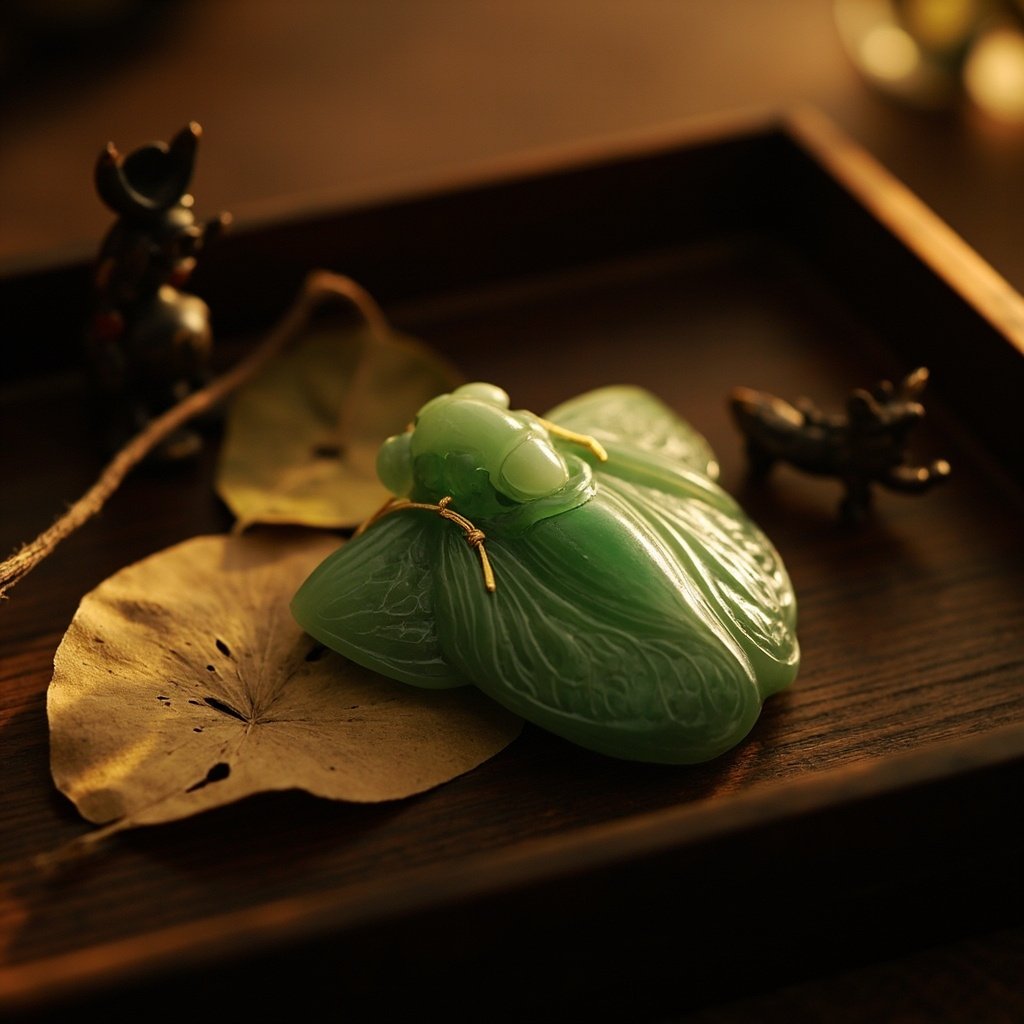
The most valued form of this symbol is the jade cicada, carried on a cord or set into a pendant, and sometimes crafted as a hollow locket that contains a small image inside the body. The carving follows the natural form closely: the ridged wings, the segmented body, the folded legs, and the two round eyes. What the craftsman reproduces is not decoration but a specific image: a thing that has completed a cycle and kept its own shape.
The material carries its own reading. A jade cicada given to a child is therefore a wish for healthy growth, and it is one of the traditional gifts given at a birth or at a first birthday. White or black jade is metal and water respectively, and reads more toward cultivation and refinement. The hollow cicada with an image inside carries a further layer of meaning: the outer body is the completed form and the shell, while what is held inside is the seed of the next stage.
Cicada, Official Rank and Academic Success
The cicada is strongly associated with official position and with examination success, and the reason is again the shell. On a study desk, a small bronze or jade cicada placed where the eye returns to it while working is a reminder that the visible result depends on a hidden period of preparation.
Placement Rules and Wearing Taboos
The cicada is a small, light, easily lost object, so most of the practical guidance is about keeping it in a position that sustains rather than scatters its meaning.
- Place a cicada ornament in the study or in the office rather than scattered across a living room. It is an achievement object, and it reads best where work happens.
- Keep it slightly behind and to the side of the working position, or on a shelf at eye level. A cicada that sits flat in the middle of a desk is pushed aside by daily clutter, and a discarded cicada loses its symbolism.
- Do not place a cicada ornament in a bathroom, a drain, or a rubbish area. A shell that has been thrown away reverses the meaning entirely, because the symbol is about successful emergence, not the discarded husk.
- Keep it away from direct bright sunlight if it is jade, so the stone does not dry out, and wipe a bronze piece with a dry cloth rather than water.
- A cicada pendant worn on the body is fine for students and for anyone in a period of career development. Traditional guidance advises against wearing it while bathing or sleeping, and against dropping it, since a damaged shell is no longer a successful emergence.
- A household should not display a cicada ornament directly opposite a main door, where the incoming qi strikes it and it appears to be pushed out of the room.
A Working Checklist
- Choose the material to match the element you need: green jade for growth and for a child, yellow jade for the centre, white jade for refinement, dark jade for water and depth, bronze for metal and structure.
- Place the ornament in the study, the office, or a home office shelf, not in a general display area where it collects dust.
- Give the cicada form as a gift to a student, a graduate, or a person at a career turning point, ideally in the early summer when the season turns.
- Use the transformation reading as a planning principle: prepare the exit carefully and leave without breaking what must be left behind.
- Never discard a cicada ornament into rubbish, and never place one near a drain or in a bathroom.
- Keep the jade conditioned and the bronze dry, and handle the piece as an object with a complete form rather than as a trinket.
The cicada earns its place in feng shui because it makes an abstract idea visible. Growth, examination, appointment, escape and change all look like the same picture: a creature that spent years in the dark, waited for the right moment, came out complete, and left the old form behind as evidence that the change had been real. A household that keeps such a symbol nearby is reminded, at the point of work, that the visible outcome is only the last stage of something much longer.