Blog

Tian Xing Feng Shui: The Wen Chang Star for Study Success
Years ago, a father brought his daughter to see me two weeks before her university entrance examination. She was diligent, disciplined, and clearly capable, yet her mock scores had stalled and her confidence was slipping. I asked where she studied each evening. Her desk, it turned out, stood against a wall in the darkest corner of the living room, facing a door that opened directly onto the kitchen. In the language of Tian Xing Feng Shui, the celestial branch of Chinese geomancy, she was sitting with her back to the Wen Chang Star — the heavenly office of learning and wisdom. We rearranged her study space within an hour. She passed with marks her teachers called unexpected. I have never considered that a coincidence.
This is the tradition I practice as a twenty-seventh-generation Tian Xing Feng Shui master, and it is the subject of this guide: the Wen Chang Star, how it works, and how you can welcome it into your home and your studies.
What Is the Wen Chang Star?
In Tian Xing Feng Shui, the sky is not decoration. Every star that rises over your home carries a quality, and the Wen Chang Star governs intellect, language, writing, and the calm focus that examinations demand. It is known by several names across the classical literature — Wen Qu in the flying star system, the fourth Green Star in the nine-star cycle — but its office never changes. Where the Wen Chang Star rests, learning flourishes; where it is neglected, effort quietly loses its return.
The star is personal as well as seasonal. Each person has a natal Wen Chang position, calculated from their birth year, while each year the star moves to a fresh direction within the home. A master reads both — the fixed seat of the chart and the moving seat of the year — so a study desk can sit in a place of genuine celestial support.
Wen Chang and the Chinese Classical Tradition
Chinese culture has honored this star for more than a thousand years. Under the imperial examination system, scholars who won the highest honors were said to be “blessed by Wen Chang” — touched by the same celestial office that the Tang dynasty honored in poetry and the Song dynasty enshrined in state ritual. Temples across China still stand in the name of the Wen Chang Emperor, the deified star spirit to whom students offered incense before every examination.
This is why the Wen Chang Star is not a modern invention dressed in old robes. It is one of the oldest continuous strands of Chinese educational culture, carried into the present by families who still mark a child’s desk with cinnabar and green silk before a major examination. When I work with overseas families today, I am connecting them to a practice their great-grandparents would recognize instantly.
Finding the Wen Chang Position in Your Home
You do not need a master’s calculation to make a first, meaningful improvement. Three practical rules will place most students in a stronger position than they occupy now.
- Face the door, never the wall. The ideal desk allows the student to see the entrance of the room without being directly in line with it. Sitting with a wall behind the back is preferred to sitting with a wall before the eyes, because an open view signals the mind to expand while a closed view signals it to contract.
- Keep the study quiet and lit. The Wen Chang Star responds to stillness. A desk placed beside a noisy hallway, a television, or a frequently used kitchen door scatters the very focus the star provides. Warm, even light — never a bare bulb overhead — keeps the energy gentle and steady.
- Honor the northeast. In the classical reading, the Wen Chang direction of the natal chart most often falls to the northeast of the home. If your study can be arranged in the northeast sector, or your desk can face northeast, you have already taken the single most reliable step.
Activating Wen Chang Energy with Objects
In the Taoist practice that surrounds Tian Xing Feng Shui, intention is anchored in objects. The classical activations for the Wen Chang Star are simple, meaningful, and easy to maintain.
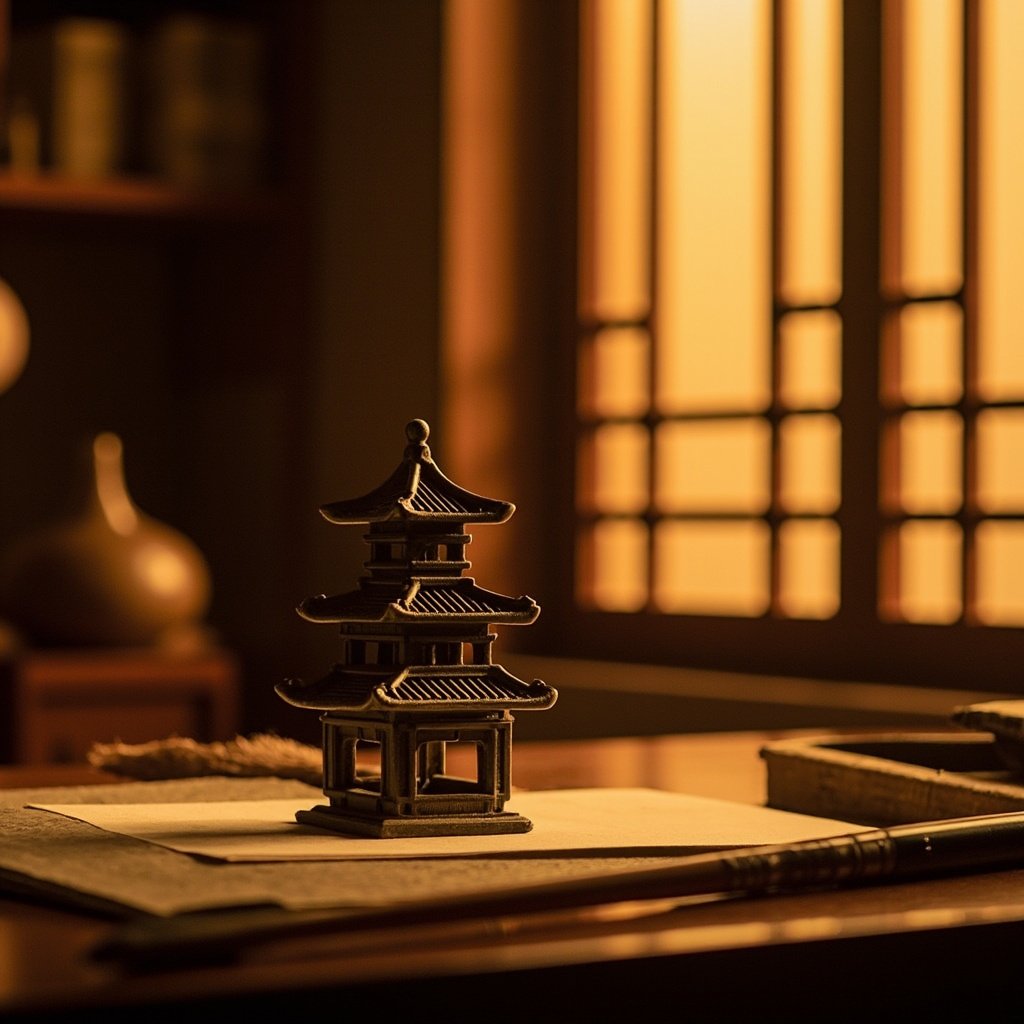
- The Wen Chang Tower. A small pagoda, traditionally of crystal, jade, or ceramic, placed on the study desk is the best-known activator. Its layered form is said to gather upward-rising energy, mirroring the ascent of a student’s understanding. Many families keep one on the desk through an entire examination season.
- The Wen Chang Brush. A calligraphy brush, or a pen kept only for study, carries the star’s association with writing and expression. It should be placed at the student’s writing hand, never stored away in a drawer.
- Green and black accents. The Wen Chang Star belongs to wood and water in the five-element cycle. A green desk mat, a small plant, a black stone, or even a green notebook on the desk quietly tunes the space to the star’s frequency.
- Wen Chang talismans. Taoist talismans inscribed with the star’s characters are traditionally placed at the northeast corner of the desk or pasted above the study door. At yihui.store, the talismans and cinnabar pendants offered are prepared according to classical ritual, each one consecrated before it leaves the workshop.
One caution, from years of practice: these objects work as anchors for intention, not as substitutes for effort. I have never seen a Wen Chang Tower earn a mark its owner did not study for. The star opens the road; the student still walks it.
Wen Chang for Adults and the Modern Home Office
The Wen Chang Star is not reserved for schoolchildren. Every profession that depends on writing, analysis, or clear speech — lawyers, researchers, writers, engineers, translators — draws on the same celestial office. If your work involves deep concentration, treat your desk as a study, not a workstation. Clear it of unrelated clutter, keep a single green object at the left of your keyboard, and choose a seat that faces the room rather than the wall. The principles of the imperial examination halls apply remarkably well to the quarterly report.
For families, keep the study door closed during study hours and treat it as a quiet boundary; in my experience, this single habit does more for concentration than any rearrangement of furniture.
Closing Thoughts
Every culture has asked the same question: why do equal efforts produce unequal results? Tian Xing Feng Shui answers that the environment has a vote in every outcome, and the Wen Chang Star is the environment’s way of voting for the mind. You do not need to believe in stars to sit facing the door with a green desk mat and a quiet room; you only need to try it for a season and observe the difference in your own focus.
If you wish to bring the tradition into your own home, the Wen Chang Tower, cinnabar talismans, and study-friendly pieces at yihui.store are prepared by a lineage workshop in the classical manner. May your studies be bright, and may the star rise over your desk.