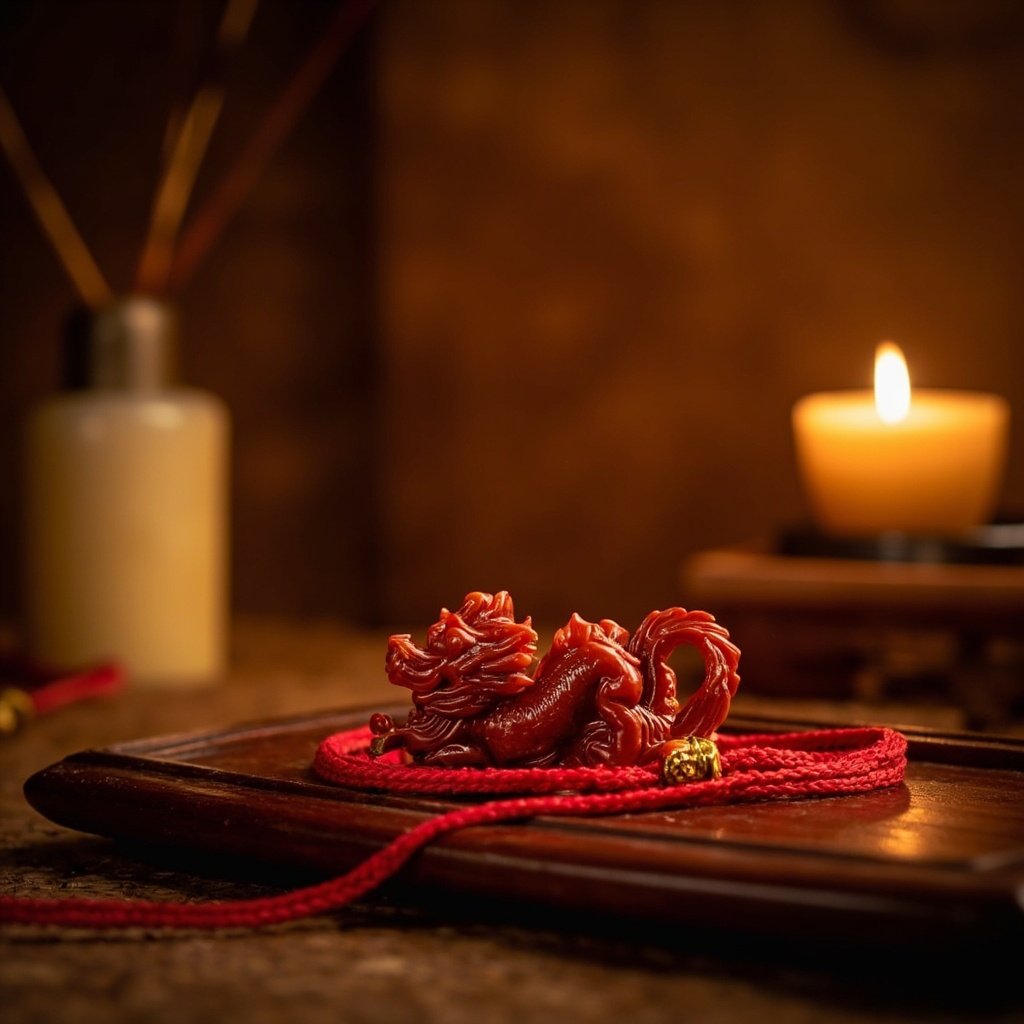
Cinnabar Dragon Pendant: Protection and Luck in Feng Shui
People ask me which protection object I would carry if I could keep only one. As a 27th-generation Tian Xing Feng Shui master, my answer surprises them: a dragon carved in cinnabar. Not because the dragon is the loudest symbol in Chinese culture, but because it is the most disciplined one. In my family’s lineage we were taught that the dragon guards by holding a line, not by roaring.
The Dragon in Taoist Culture: Guardian, Not Decoration
Western readers usually meet the dragon through fantasy, as a monster to be defeated. The Chinese dragon is nearly the opposite: a bringer of rain, a keeper of rivers, an emblem of legitimate authority. In Taoist cosmology it belongs to the eastern quadrant of the bagua, the direction of spring, growth, and benevolent power. Emperors wore it, but so did scholars and farmers, because the dragon was never only about rank. It was about the force that moves water and weather, the same force that moves a household’s luck.
When a dragon is carved into a protective object, it is asked to do one job: hold the boundary. My teacher described it as a sentinel that never sleeps. That is why the dragon appears on door knockers, on roof ridges, and above all on pendants worn close to the chest, where it watches the person rather than the house.
Why Cinnabar Has Warded Off Misfortune for Millennia
Cinnabar is a red mineral that appears in Chinese records more than three thousand years old. Taoist priests ground it into vermilion ink for talismans and seals. It appears in burials, in medicine chests, and in the bags of travellers crossing dangerous roads. The tradition places cinnabar in the Fire element, and Fire disperses whatever has stagnated. Where sha chi, heavy and exhausted energy, collects in a corner of a home or in a stretch of life that has gone quiet, Fire keeps it from settling.
Worn against the skin, cinnabar is treated as a small steady flame that follows you. I want to be careful here. This is cultural practice and personal discipline, not a medical claim. No stone repairs a broken situation by itself. What a stone can do is hold your attention on what you have decided to protect, and attention eventually changes behaviour. That is the honest version of the tradition, and it is the version worth keeping.
Zodiac, Dragon Years, and Who Wears the Dragon
The dragon is one of the twelve zodiac animals, and people born in dragon years often feel an obvious pull toward it. The pendant is not reserved for them. In traditional practice the dragon is paired with the rooster, and those born under the rooster are sometimes advised to wear the dragon as a balancing companion. Those born in years that clash with the dragon are usually counselled differently, not because the symbol is dangerous, but because the tradition prefers harmony over force.
Most people I meet are not deciding by chart at all. They come to the dragon for a reason they can already feel: a demanding job, a long illness in the family, a year of hard decisions. For them the rule is simple. If the dragon steadies you when you look at it, that is the sign you needed.
How to Wear and Place a Dragon Pendant
Tradition says the left side of the body receives and the right side releases. To draw in protection and opportunity, the pendant is worn on the left. To push back against pressure, a court case, a difficult negotiation, a heavy season, the right is often chosen. Both are accepted; the difference is emphasis, not correctness. Keep the pendant near the chest, where the heart and the breath are, rather than low against the stomach.
When you are not wearing it, give it a place rather than a drawer. A clean surface in the main room or a small tray in the bedroom works well, and where possible turn it to face the entrance. In feng shui an object facing the door is understood to be watching it. The Divine Dragon Protection Consecration • Luck Amplification pendant is finished for exactly this kind of daily use, heavy enough to feel deliberate and light enough to forget.
Cleansing and Care
Cinnabar is a soft mineral and it responds badly to heat, chemicals, and long direct sunlight. Nothing dramatic is required, but consistency matters more than intensity:
- Wipe the pendant with a dry soft cloth every week or so to lift skin oils.
- Take it off before bathing, swimming, or heavy cleaning.
- Keep it away from perfume, hairspray, and household solvents.
- Avoid storing it in direct sun; the red colour fades with prolonged exposure.
- Rest it in a cloth pouch or a small box so metal edges cannot chip the carving.
- If you keep a cleansing habit, moonlight or a wipe with a clean cloth is enough.
One more note on placement. Some clients set the pendant on a small dish beside a bowl of water overnight, then wear it again in the morning. Others keep one fixed spot and never move it. Choose one habit and repeat it. Consistency is what most people are actually missing.
Choosing a Protection Object You Will Keep On
The most common failure of any protective object is not impurity. It is absence. A pendant that stays in a box does nothing at all, culturally or personally. That is the whole test I apply before recommending anything: will this be worn on an ordinary Tuesday, or will it live in a drawer?
If this one feels like the right weight for the season you are in, the natural cinnabar dragon protection necklace pendant, consecrated for protection and luck is available at yihui.store for $102.89 USD.