Blog
Chinese Firecracker Feng Shui Meaning: Sound, Yang Energy and Clearing Stale Qi

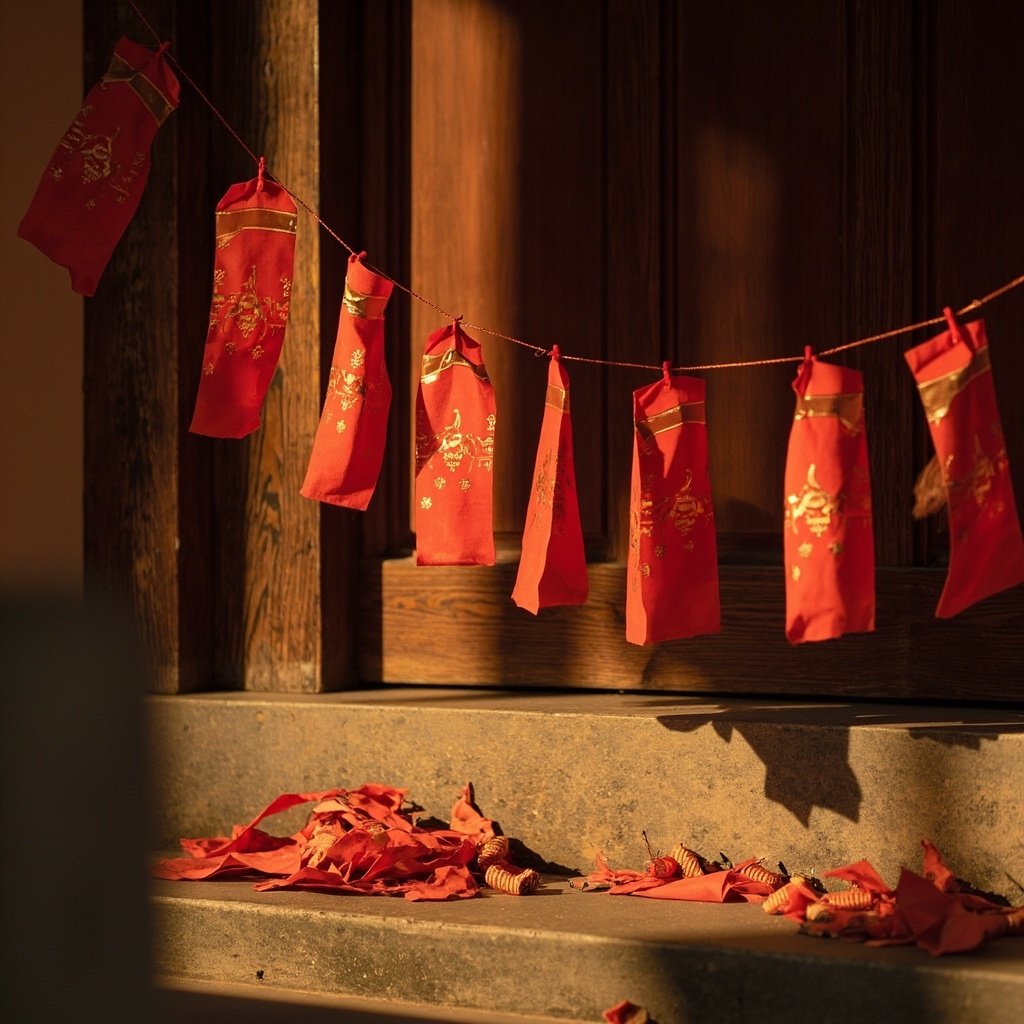
Chinese Firecracker Feng Shui Meaning: Sound, Yang Energy and the Clearing of Stale Qi
Every Lunar New Year, strings of red paper firecrackers are hung on doorframes across China, and the crack they make is not decoration. In Chinese metaphysics a firecracker is a compact instrument for changing the quality of a space: it manufactures yang energy, breaks stillness, and disperses what the tradition calls sha chi, or killing energy. Why the cracker works also explains how feng shui treats sound and smoke as working tools rather than ornament.
Why Sound Belongs to Feng Shui at All
Feng shui is usually taught as a study of placement, but the classical texts read a space as a field of moving influences. Stillness accumulates and movement disperses. Sound is the cheapest way to create movement in a room that has gone flat. A closed apartment, a corridor nobody walks, a corner behind a door: these collect a heavy, settled quality that residents feel before they can name it. One sharp, clean sound reorganises that field instantly, which is why bells, gongs and firecrackers appear in Chinese ritual life far more often than statues do.
The Legend of Nian and the First Firecracker
The origin story explains the design. Legend describes a beast called Nian that came down from the mountains at the turn of the year and raided villages. It feared three things: loud noise, the colour red, and firelight. Villagers found that green bamboo thrown onto a fire burst with a sharp crack, and the beast fled. Those burning bamboo joints, bian pao, are the ancestors of the modern firecracker, and the customs built around them keep the same logic: red paper, gunpowder, a flash, a bang, a cloud of smoke. Every element in the original recipe still carries meaning.
Firecrackers as Concentrated Yang Energy
A firecracker delivers five yang qualities at once. Fire is obvious. Red is the colour of protection. The report carries through walls and reaches every room. The smoke physically moves through the air. And the whole event is fast, abrupt and impossible to ignore. Most cures in home feng shui are passive, a crystal or a plant sitting quietly in a corner. A firecracker is active: it does not adjust a static arrangement, it interrupts a pattern, which is exactly what a stagnant area needs.
Reading the Cracker Through the Five Elements
The five element lens gives a more precise reading of the same object.
Fire and Wood
Bamboo is wood, and the crack converts it to fire. Wood feeds fire in the generating cycle, so the firecracker is a self-feeding yang object, which is why it belongs to New Year rather than to ordinary cleaning days.
Metal and Water
The metallic report is metal sound cutting through air, while the smoke behaves like water, drifting into gaps and corners a broom cannot reach. Households in southern China still walk through the house with a smoking bundle after a funeral or a long illness.
Earth
The paper and ash return to the ground, closing the cycle. Nothing is left to accumulate, which is the philosophical difference between a firecracker and a piece of clutter.
Practical Placement and Timing
Traditional usage is tightly tied to thresholds and moments of transition.
- The front door threshold. The sound is set off outside, facing outward, so the clearing happens at the boundary, not inside the home.
- New Year and the start of spring. The largest collective transition of the year, and the cracker marks it.
- After renovation or a long vacancy. Dust and unsettled air are residue that must be broken up before the household settles in.
- Moving into a new home. The first act at the door is often a loud one, so the space registers as occupied.
- Business openings. Shops hang red strings above the entrance to announce that the premises are active and trading.
Rules for Modern Homes and Small Apartments
In most cities real crackers are restricted, and the tradition adapts without losing its logic. A recording played from a phone carries almost none of the effect, because volume and physical vibration are the working parts. Better substitutes keep the yang qualities: open every window at the turn of the year, hang red paper at the door, ring a small brass bell through the rooms, and burn incense to move the air. Where fireworks are legal, set them off outdoors, never inside a building or on a balcony above neighbours.
- Read local law before buying anything.
- Never store crackers indoors near heat, and never let children handle them unsupervised.
- Light and retreat immediately. Do not stand over the string.
- Keep a bucket of water or sand within reach.
- Clear the debris the same day, so the ash does not linger at the door.
Common Misunderstandings
Three errors come up often. The first is volume inflation, the belief that louder is stronger. A single clean report does the work; a barrage creates chaos, and chaos is not movement. The second is treating the cracker as a substitute for layout. Sound clears a room, it does not fix a bed under a beam or a stove facing a sink. The third is assuming decorations must be activated to count. A red paper garland at the door is a statement of intent, and intent carried consistently by an object is a real influence, not a superstition.
Firecracker Charms as Decoration
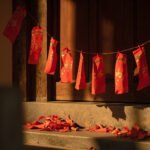
Printed cracker garlands, red paper couplets and tasselled ornaments are the practical version for households that cannot burn anything. They keep the visual code intact: red, gold, repetition, and the suggestion of a string about to go off. Hang them on the outside face of the door, above eye level, and replace them when the paper fades. A faded charm says the household stopped paying attention, the opposite of what the object is for.
Frequently Asked Questions
Can decorations replace real firecrackers?
For symbolism, yes. For the physical clearing of a stagnant room, no. Open the windows and use sound you can actually hear.
Which way should a red cracker string face?
Outward, away from the interior. The cleaning action is directed at the boundary, not into the living space.
Is firecracker imagery acceptable in a bedroom?
Generally not. Bedrooms are yin rooms and need quiet, soft materials. Loud, red, explosive imagery belongs at entrances and in active areas.
Bringing the Practice Home
The firecracker is a ritual tool for transitions: the turn of the year, a move, a reopening, the end of an illness. Its feng shui meaning is not mystical noise but a precise idea, that a space has a state and a sudden bright sound can change it. Used once, at the right threshold and moment, it does its job. Used constantly, it becomes exactly the clutter the tradition warns against.