Blog

Chinese Sundial Feng Shui Meaning: The Sun Clock That Reads Direction
Long before pendulum clocks and pocket watches, a flat stone with a raised pointer told people exactly where they stood in the day and in the world. The Chinese sundial, known as the ri gui, turned sunlight into a readable line. For feng shui practitioners, that same instrument carries a second layer of meaning, because it measures two of the most important quantities in the whole tradition at once: time and direction. A sundial does not merely report the hour. It records how yang energy arrives, how it moves across a space, and when it departs.
That double function is why sundials still appear in gardens, temple courtyards, and scholar studios: they teach a house to notice the sun.
What a Chinese Sundial Actually Is
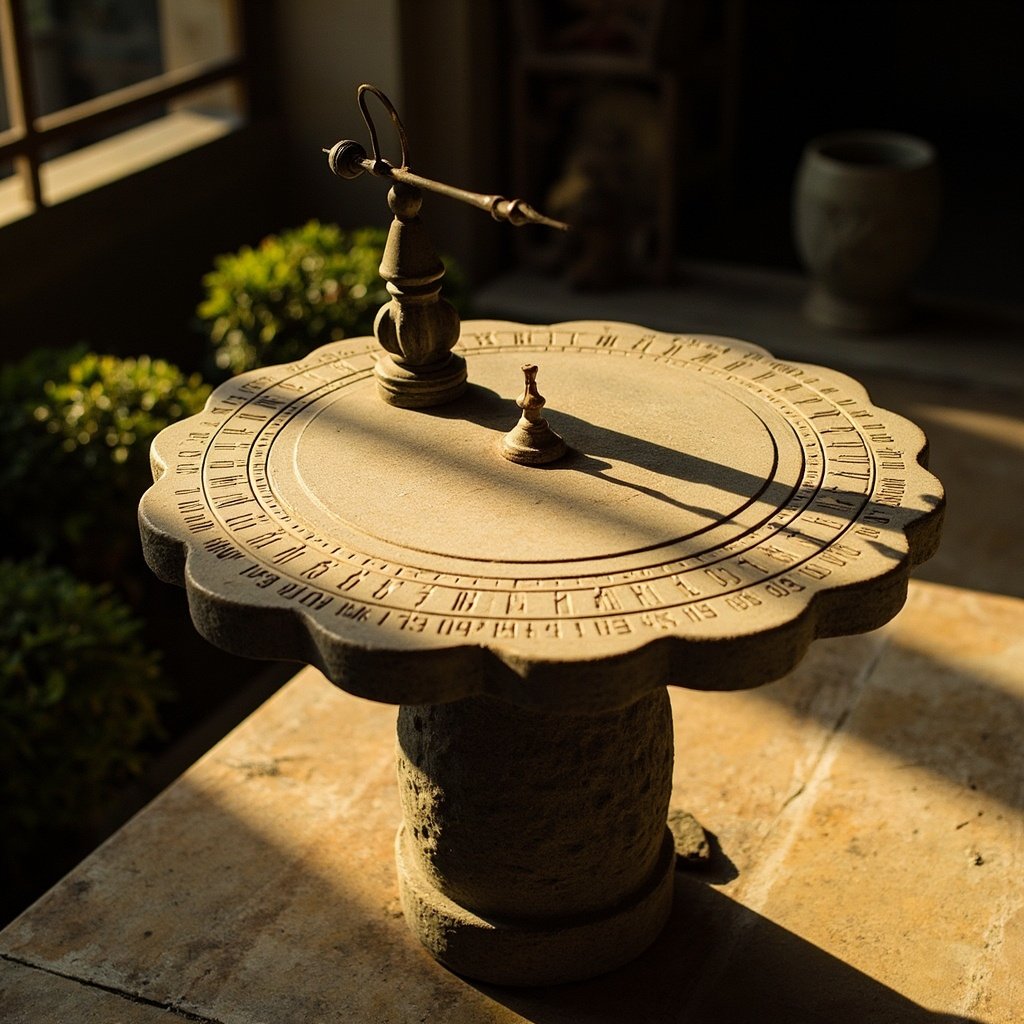
A traditional Chinese sundial is a calibrated dial face with a central upright rod called the gnomon; as the sun crosses the sky, the rod casts a shadow across engraved hour lines. On the equatorial type the face is tilted to align with the earth axis, so the shadow sweeps at a constant rate and the markings can be spaced evenly. On the horizontal type, common in courtyards, the face lies flat and the lines fan out unevenly.
Older examples were cut from dense grey or dark limestone, with the dial face and the twelve double-hours carved by hand; bronze and jade versions served imperial and scholarly use. The instrument was never a decorative novelty but a measuring tool, grouped with the calendar, the compass, and the water clock.
Why a Sun Clock Matters in Feng Shui
Feng shui reads a place through light. Every classical assessment begins with the same question: where does the sun enter, how long does it stay, and which rooms never receive it. A sundial answers that question physically instead of theoretically.
The shadow itself is the teaching. At sunrise it is long and points west; at noon it is short and dense; by late afternoon it stretches east again. A full day of shadow on one dial shows something a diagram cannot: yang energy is not a fixed substance but a rhythm that rises, peaks, and withdraws. Homes that ignore the rhythm end up with bright unused rooms and dim occupied ones.
Because the gnomon works only in direct sun, the instrument marks the boundary between the yang half and the yin half of a day. A dial legible from mid-morning to mid-afternoon sits in genuinely strong light; one readable for a single hour sits in a pocket of shade, which is useful information when deciding where to place a desk, a plant, or a bed.
The Three Parts and What Each One Means
Practitioners read a sundial as a small model of a site, with each component carrying its own symbolism.
- The gnomon. The upright rod is the single point of concentrated yang. It stands for the self, the fixed centre, and the will that does not drift with circumstance.
- The dial face. The flat plate is the receptive field, carved with ordered divisions. It represents the ground, the household, and the structure that receives whatever heaven sends.
- The shadow. The moving line is time made visible, the only part of the instrument that changes. It reminds a household that the fixed parts matter only because something moves across them.
Read together, they describe a working relationship: a steady centre, a well-ordered base, and an awareness of change.
Direction Before Clocks: The Sundial as a Compass
For centuries the noon shadow served as the practical reference for true south, the baseline of the whole feng shui system. Compasses drift with local iron, but the shortest shadow of the day always points to true north or true south. A correctly installed dial therefore doubles as a calibration tool.
This is why old garden sundials were positioned with such care. A dial rotated even a few degrees lies about the hour, and the same misalignment makes every later reading of the site slightly wrong. Placement was a survey, not a decoration decision.
Where a Sundial Belongs
The instrument belongs wherever light is honest and unobstructed. A few reliable positions:
- South-facing garden or courtyard. The classic position, with the dial receiving sun across most of the day and the gnomon standing clear of tree shadow.
- Entrance forecourt. Placed to one side rather than dead centre, a dial draws attention to the sunlit approach and gives the front of a home a measured, deliberate feel.
- Study or scholar desk corner. A small desktop dial next to a window keeps the working day tied to real daylight rather than to a screen.
- Meditation or reading terrace. A dial here turns a passive outdoor seat into a place where the passage of the day is visible.
Keep the dial out of dense shade, away from reflective walls that throw false light, and clear of roof overhangs that block the noon sun. A sundial that cannot cast a clean shadow is furniture, not an instrument.
Common Misunderstandings
- That a sundial is only a garden ornament. Its original job was measurement, and it still performs that job accurately when aligned.
- That any flat spot will do. Tilt and orientation decide whether the readings mean anything. An unaligned dial is decorative noise.
- That a sundial brings luck by itself. No classical text treats it as a wealth charm. Its contribution is clarity: it shows a household where the light actually falls.
- That it replaces a compass. It confirms direction, but it also depends on clear sky, so the two tools check each other rather than substitute for one another.
Choosing and Caring for One
Choose a dial whose markings are cut rather than painted, since painted lines fade within a few seasons outdoors. Stone suits gardens and entryways; bronze suits sheltered courtyards and desk use. Weight matters more than ornament: a light dial shifts in wind and soil movement and silently loses its alignment.
Clean the face with plain water and a soft brush, never acidic cleaners, which etch limestone and blur the hour lines. Once a season, check the alignment at local noon, when the shadow should fall exactly on the noon mark.
A Final Word
The Chinese sundial is a modest object with an unusually complete job: it measures the hour, confirms direction, and shows the daily rise and fall of yang energy in one sweep of shadow. Placed where the sun can reach it and aligned with care, it gives a home something most modern houses lack entirely, a visible relationship with the sky above it.