Blog

Mahjong and Feng Shui: The Hidden Meaning of the Chinese Tile Game
Mahjong is one of the most recognizable objects of Chinese daily life, played in teahouses from Chengdu to Taipei and in family kitchens from Vancouver to Melbourne. Most visitors assume it is simply a gambling pastime, a loud cousin of rummy and reflex. Look closer and the game turns out to be a compressed map of Chinese cosmology, carried in the hand. Its tiles name the four directions, the three powers of heaven, earth and humanity, and the cycle of the seasons that Taoist thought uses to describe all change. Once that map is visible, a box of tiles stops being a toy and becomes a household object with real symbolic weight.
What a Mahjong Set Actually Contains
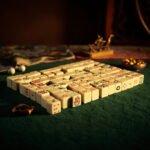
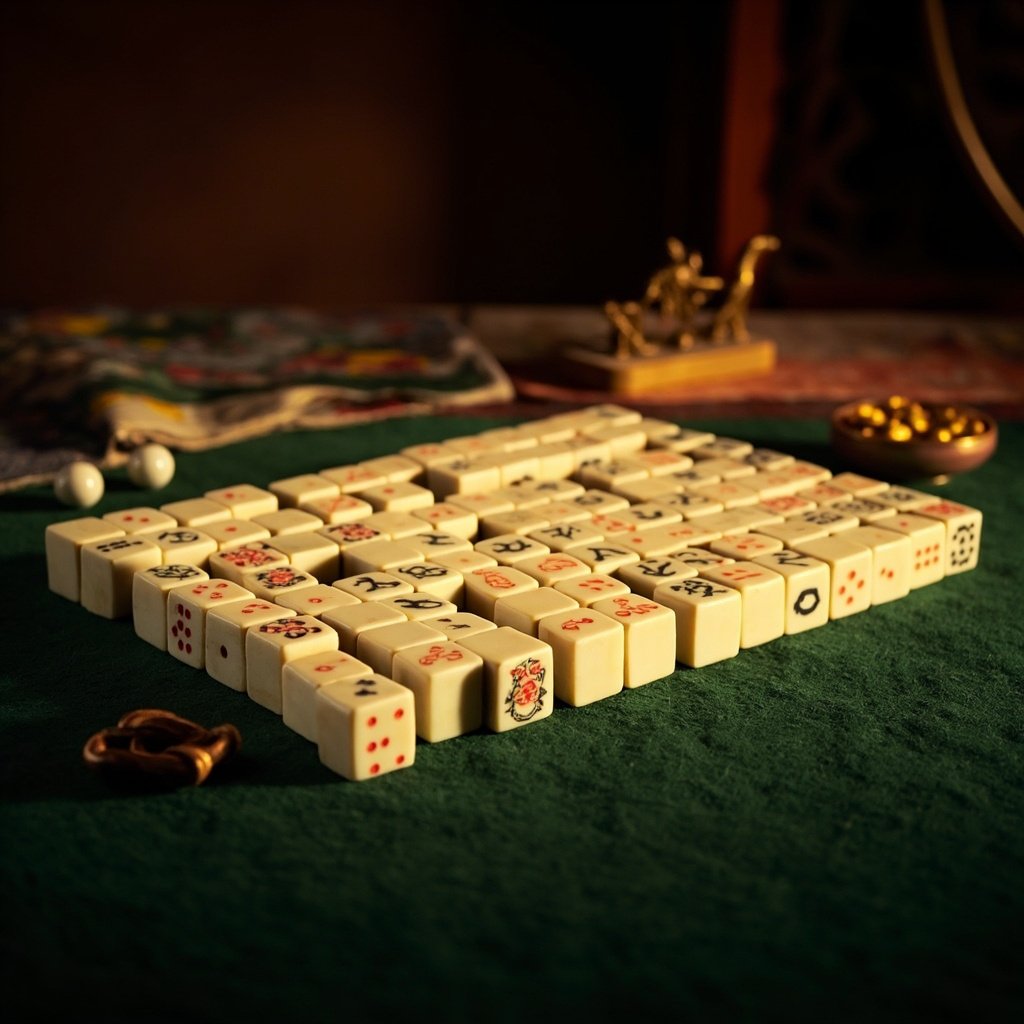
A standard set holds 144 tiles. Three suits run from one to nine: bamboo, characters and dots. Beyond them sit four wind tiles repeated four times, three dragon tiles repeated four times, and a small group of flower and season tiles that serve as bonus draws. The number of tiles and the exact scoring rules vary by region, with Cantonese, Taiwanese, Japanese and American schools each keeping their own customs.
The game is usually dated to the mid-nineteenth century and associated with the trading city of Ningbo, where earlier card games were adapted into carved pieces. Older legends credit Confucius or the court of an ancient dynasty, but no document supports those claims. What matters for our purpose is not the inventor but the design: whoever assembled these tiles built a small model of the Chinese universe into them.
The Tiles as a Cosmological Map
The four winds are the four cardinal directions, the same grid that organizes the bagua and the compass of classical feng shui. East, south, west and north are not decoration; they are positions on a board that a player physically occupies. Each round rotates through the winds, so the seat that was east becomes south, and the advantage moves around the table like a season.
The three dragons carry the three powers. The red dragon stands at the centre, the green dragon speaks of growth and prosperity, and the white dragon represents the unmarked board, the empty and receptive field from which form appears. Together they repeat the triad that runs through Chinese metaphysics: heaven above, earth below, and the human being who stands between them.
The three suits mirror that triad a second time and also echo older instruments of value. Dots resemble strings of copper coins. Bamboo evokes the plant that stands for resilience and steady increase. Characters carry the idea of ten thousand, an old formula for abundance. A single suit is a game mechanic; three suits together form a closed symbolic system.
Direction, Seating and the Flow of Qi
Traditional play is directional before it is numerical. The dealer is the east seat, and the deal moves counterclockwise, so every player eventually holds each wind. Serious players still observe seating preferences, and the habit survives because it feels right: a player who sits with a solid wall behind and a clear view of the room tends to settle faster and read the table better. That instinct is ordinary feng shui, applied to a chair.
Etiquette at the table is also a study in energy management. Players are expected to keep their tiles quiet, to avoid sighing over a bad hand, and not to reach across another person to draw. Lending money mid-game is discouraged, as is beginning a session with an incomplete set. These rules are usually explained as manners, but they share one logic: protect the composure of the group, and do not let one persons agitation scatter the attention of the other three.
Luck, Skill and the Idea of a Good Hand
Mahjong is often dismissed as chance. In practice a long session rewards memory, probability and reading of opponents far more than it rewards the draw, which is why experienced players speak of a hand that has qi and a hand that has gone cold. The phrase is not mysticism; it describes the felt difference between a position that keeps opening and one that keeps closing, and it is the same language practitioners use for a room that supports effort and a room that resists it.
Placing a Mahjong Set in the Home
A set that is used is furniture; a set that is stored is a symbol. Either way, a few ordinary rules serve it well.
- Keep it complete. A missing tile is traditionally read as an incomplete household, so replace lost pieces rather than playing around the gap.
- Store it dry and closed. Damp cupboards and bathroom shelves damage bone, bamboo and lacquer, and a mouldy set carries stagnant energy into the room it is opened in.
- Choose a gathering sector. The east and the southeast are the conventional sectors for family and for abundance, which makes them natural homes for a game built around company and gain.
- Display with restraint. A single framed tile, a carved case or a small stack on a study shelf reads as cultural reference rather than clutter.
- Avoid the bedroom and the floor. Sleeping rooms should stay quiet, and tiles stored on the ground collect dust and are treated carelessly.
Common Misunderstandings
Three assumptions are worth correcting. The first is that mahjong is mainly gambling. In most households it is a social ritual with small stakes or none, closer to a weekly dinner than to a casino. The second is that the tiles are arbitrary numbers. They are, but the numbers are chosen to describe cycles, not to fill a box. The third is that feng shui requires a compass reading before any object can be understood. Symbolic objects work on attention and association, and a mahjong set placed with care does its work without a single measurement.
Why the Game Still Matters
Mahjong survives because it does several things at once. It gathers four people around a square table, it gives them a shared language of winds and dragons, and it rehearses the Chinese conviction that fortune moves in cycles and that a person who reads the cycle can act well inside it. None of that requires belief. A family that plays on a Sunday is already practising the underlying idea: attention, patience, and the willingness to let the turn pass and come back. That is, in the end, a very old description of a good life.