Blog

Bronze Ding Feng Shui Meaning: The Three Legged Ritual Vessel
There is an object in Chinese culture that outranks almost every other symbol of stability, and it is not a dragon or a coin. It is a cauldron. The ding — a round bronze vessel resting on three legs, usually with two upright handles — appears in temple halls, museum vitrines and now in contemporary homes, and its feng shui meaning is unusually concrete: a vessel that stands on three points cannot rock, and a bowl that holds grain can feed a lineage. Understanding the bronze ding feng shui meaning means understanding why the Chinese built their idea of power around a cooking pot.
What a Ding Actually Is
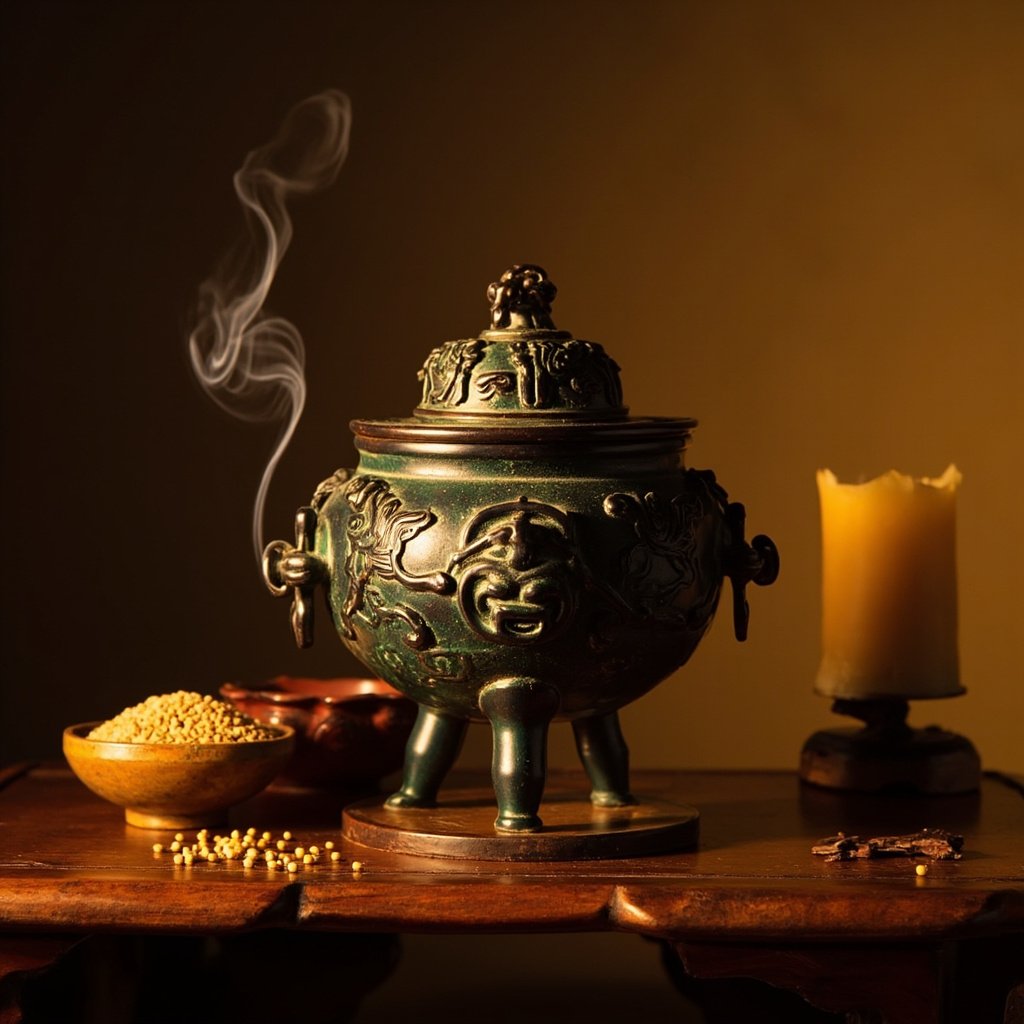
Early ding were practical: bronze or pottery cauldrons used for cooking and for holding offerings of grain, wine and meat in ancestral rites. Over centuries the form became ceremonial. By the Shang and Zhou dynasties, bronze ding were cast with deep relief patterns — most famously the taotie, a symmetrical animal mask with no lower jaw, read as a guardian face that consumes without speaking. The number of ding a family or a lord was permitted to own became a direct measure of rank, and the phrase “asking the weight of the ding” entered the language as a euphemism for coveting the throne.
So from the beginning the ding carried two ideas at once: nourishment and authority. It fed people, and it declared who had the right to feed them.
The Core Feng Shui Meaning of the Bronze Ding
Three Legs and the Logic of Stability
Three points define a plane. This is engineering, but Chinese metaphysics read it as a moral statement: a household that stands on three legs does not tip. In practice the three legs are interpreted as the three foundations of a settled life — the material, the relational and the spiritual. A ding in the home is a visual reminder that if any one of those is missing, the whole structure leans.
This is why the ding is rarely treated as a wealth symbol in the way citrine or a money toad is. Its promise is not abundance but continuity: that what has been built will remain standing.
Metal, Earth and the Cauldron Fire
In the wu xing, a bronze ding is a metal form that once held fire and still symbolises contained heat. The element signature is layered: metal for the body, fire for the function, earth for the grain it holds. Metal governs boundaries and refinement; fire governs visibility and transformation. Placed deliberately, the object brings a slow, defining quality to a room rather than an expansive one.
Feet, Belly, Handles
Traditional reading treats each part of the vessel as a statement:
- The three feet — grounding, and the support of a family line
- The round belly — capacity to receive, the receptive quality of a household
- The two handles — the ability to be lifted and shared, and the balance of two parties
- The lid knob — a sealed top, meaning what is stored stays stored
- The taotie mask — a guardian face that wards off what should not enter
Where to Place a Bronze Ding at Home
The Entrance or Reception Area
A ding near the front door is the most common placement, and the reasoning is straightforward: the vessel grips the qi as it arrives and prevents it from rushing straight through the house. Position it on a solid console rather than a thin shelf, and keep the interior clean. An empty ding at the threshold represents a household ready to receive.
The Family or Ancestral Sector
Because the ding began as an offering vessel, its strongest traditional setting is where a household honours its forebears. A small ding on a family altar, or on a shelf holding photographs of grandparents, reinforces the lineage reading of the symbol. Keep it dusted and never use it as a storage bowl for keys or receipts.
The Career and Authority Corner
In the north or northwest sector a bronze ding supports the authority reading of the object. This is the placement for a home office where decisions are made, and it pairs naturally with a stone or metal desk accessory. Avoid placing it directly behind your chair, where a heavy object at your back is read as pressure rather than support.
The Dining Room
The most grounded placement is also the most literal: a small ding as a centrepiece, holding fruit or grain. It aligns the vessel’s original function with the room’s, and it keeps the symbolism visible in daily life rather than locked in a cabinet.
Where to Avoid
Bathrooms and laundry rooms drain energy, and a ritual vessel there inverts its purpose. Bedrooms are also a poor fit: bronze is heavy and cold, and the fire association of the cauldron is activating rather than restful. Do not place a ding on the floor, and never at the foot of a bed.
Bronze Patina and What It Signals
Most decorative ding sold today are cast in bronze or a bronze-finished alloy, and the surface matters. A genuine patina is a slow green-brown oxidation that sits in the recesses of the carving and lightens on the high points where hands have touched. Uniform green paint, or a finish that feels chalky, indicates a cast resin replica.
- Weight — bronze is dense; a large ding that lifts easily is resin.
- Coldness — metal draws heat from the hand immediately on contact.
- Sound — tap the belly lightly; bronze rings, resin thuds.
- Recesses — real patina collects in the low relief, not on the raised edges.
- Seams — hand-finished pieces show faint tool marks along the casting line.
Care and Conduct
- Dust with a dry soft cloth. Water accelerates verdigris and can stain the wood beneath.
- Keep the vessel out of direct sunlight, which dries and can crack a thin cast wall.
- Lift by the body, not by a handle; handles on decorative pieces are often the weakest joint.
- If you use it to hold fruit or grain, empty and wipe it regularly — stale offerings defeat the point.
- Do not polish away the patina. In Chinese connoisseurship, the aged surface is part of the object’s value.
The Ding and the Habit of Keeping
What makes the bronze ding unusual among feng shui objects is that it does not promise anything new. It promises that what exists will hold. In a culture that has spent three thousand years casting the same three-legged form, that is not a small promise. A ding in a modern home is a quiet argument for continuity — for the idea that a household, like a good cauldron, is worth keeping steady rather than keeping full.