Blog

Cloisonne Feng Shui Meaning: The Enamel and Brass Art of Contained Luck
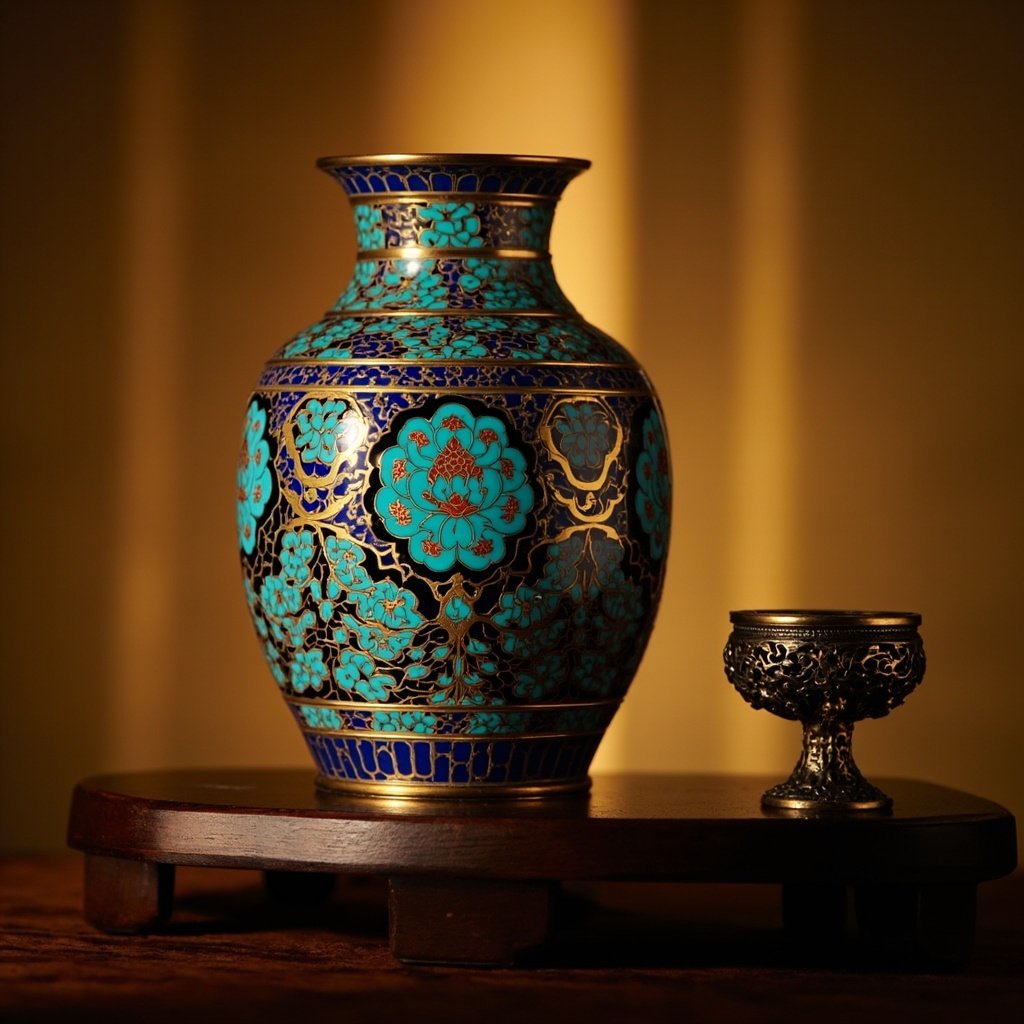
Walk into a traditional Chinese reception room and your eye will often find one object before anything else: a vessel of deep blue enamel, threaded with gilded wire, glowing as though lit from inside. This is cloisonne, known in Mandarin as jing tailan. For centuries it has sat on altars, scholars’ desks and ancestral tables not merely as decoration, but as a considered feng shui instrument. Understanding the cloisonne feng shui meaning begins with a simple premise from classical Chinese thought: a container is only as valuable as its ability to hold.
What Cloisonne Actually Is
Cloisonne is a metalwork technique. A craftsman forms a body from copper or brass, bends fine wire into outlines, and solders those wires to the surface to create thousands of tiny compartments — the cloisons from which the English name derives. Each cell is then filled with vitreous enamel paste, coloured with mineral oxides, and the whole piece is fired repeatedly. Finally it is ground flat, polished and often gilded, until the wires and enamel read as one continuous surface. The process is slow and unforgiving: a single firing can crack a piece that took weeks to prepare, which is why cloisonne historically belonged to imperial workshops rather than ordinary households.
The Core Feng Shui Meaning: Metal That Holds
In the wu xing, or Five Elements, cloisonne is unambiguously a metal object. Metal governs structure, clarity, boundaries, precision and the capacity to receive and refine. It is the element associated with the west and northwest, with autumn, and with the harvest instinct that gathers rather than scatters.
But cloisonne adds something that plain metal lacks. Because it is a hollow vessel, it also participates in the logic of emptiness found throughout Taoist thought: the usefulness of a bowl lies in what it does not contain. A metal form with an empty interior becomes, in feng shui terms, a chamber.
Why the Enamel Matters
The enamel layer is not incidental. Vitreous enamel is fired glass — a product of earth, transformed by fire, seated on metal. This gives cloisonne a rare three-element signature: metal as the body, earth as the enamel, fire as the kiln that fused them. Water and wood appear in the decorative motifs, where lotus, waves and peonies are rendered in coloured cells.
Colour as Directional Instruction
Traditional cloisonne is dominated by deep cobalt blue, historically derived from imported cobalt pigments. In feng shui colour theory, blue relates to water and to the north — the direction of career, flow and hidden depth. This is one reason a blue cloisonne vase works so naturally in a study or an entryway.
- Blue enamel — water element, north, career flow and quiet authority
- Turquoise and green — wood element, east and southeast, growth and family harmony
- Red and coral — fire element, south, recognition and reputation
- Gold gilding — metal element, west and northwest, clarity and completion
- White and cream cells — metal and purity, useful in bedrooms and meditation spaces
Where to Place Cloisonne in a Home
Cloisonne rewards deliberate placement. Because it is visually dense and highly coloured, it draws the eye and holds attention — which means it concentrates qi wherever it sits.
The Entrance
A cloisonne vase or bowl on a console near the front door acts as a gathering point for arriving energy before that energy disperses through the house. Keep it clean and empty, or fill it with fresh flowers or a bowl of water. In traditional practice, an empty vessel at the threshold is sometimes described as a treasure basin awaiting abundance rather than a receptacle for waste.
The Study and the Wealth Corner
In a home office, a small cloisonne incense burner on the desk brings the metal element into a space dominated by invisible work; the classical association is focus and the finishing of things. In the southeast wealth sector, a piece rendered with peonies reinforces accumulation.
The Living Room and Display Cabinet
Living rooms benefit from cloisonne because the material tolerates the energy of gathering. A single larger piece generally outperforms a cluster of small ones. If a cabinet holds several pieces, order them by size and keep the darkest or most intricate vessel at the visual centre.
Where to Avoid
Metal is a controlling element for wood, so a heavy cloisonne object beside living plants can suppress growth. Bathrooms and laundry rooms, which govern the draining of energy, are not the place for a prized vessel.
How to Judge a Genuine Piece
Cloisonne is widely imitated. Enamel applied by decal, painted resin, or cast polyester with wire-like ridges will be sold as cloisonne in many markets. A few physical checks are reliable.
- Look for a gilded rim and foot. Fine cloisonne is almost always gilded at the base and lip, and the gilding should look worn where a hand would touch.
- Run a fingernail across the surface. In genuine cloisonne the wires sit level with the enamel after grinding, so you feel a continuous plane with slight texture, not raised plastic ridges.
- Check the weight. Copper and brass bodies are dense; a large piece that feels light is cast resin.
- Examine the cells. Hand-wrought wire creates cells of irregular width, and enamel pools slightly where wire meets wire. Perfect symmetry points to a decal.
- Smell it. Fired vitreous enamel has no odour; solvent or plastic smell indicates a cold-cure imitation.
- Listen for resonance. Tap the rim lightly. Metal-bodied cloisonne rings; resin thuds.
Cloisonne and the Taoist Vessel Idea
There is a deeper layer to the cloisonne feng shui meaning that connects it to Taoist practice. In temples, cloisonne was used for censers, offering bowls and water vessels precisely because it did not corrode and did not absorb impurity. It was considered pure enough to face the altar.
That sense of containment carries into the home. A cloisonne vessel signals that this household sets aside a place for what it values. Whether it holds incense, flowers, coins or nothing at all, the object tells the room that something is being kept on purpose. A home that visibly keeps something meaningful tends to feel, and behave, differently.
Practical Care That Preserves the Energy
- Dust with a soft dry cloth; gilded wire is easily abraded by abrasive cleaners.
- Never soak cloisonne in water. The enamel is durable but the underlying metal and the seams between cells are not.
- Keep pieces away from direct, sustained sunlight, which can fade red and green enamels over years.
- Handle large vessels by the body, never by a rim or handle that may be soldered.
- Empty and clean a vessel used for water or flowers regularly — stagnant water inverts its purpose.
Bringing It Home
Cloisonne is a rare object in feng shui because it satisfies both the eye and the logic of the practice. It brings metal for structure, enamel for earth and fire, colour for direction, and the form of a vessel for containment. The cloisonne feng shui meaning is ultimately about intentional continuity: a material chosen centuries ago because it could hold what mattered without decay.